Sunday, 15 March 2015

King: Mandrake The Magician #1 - Dynamite Entertainment

KING: MANDRAKE THE MAGICIAN No. 1, February 2015
Despite heroically confronting gangsters, mad scientists and even extraterrestrials since he was first created by Lee Falk in 1934, the newspaper strip character of “Mandrake The Magician” has arguably struggled for any sort of comic book success since the Seventies and is probably best known since that time for his 1995 mini-series written by Mike Barr; albeit even then “Marvel Comics” only ever published two of the three planned issues of “Mandrake”. However following his significant role in the events of the 2013 “Kings Watch” five-issue story-arc by “Dynamite Entertainment” the popularity of the extraordinary hypnotist has enjoyed something of a revival.

Indeed the captivating conjurer’s contribution to Jeff Parker’s modern-day re-imagining of ‘Defenders Of The Earth’ proved such a success that the American publishing imprint of “Dynamic Forces” have now provided the mesmerizing magician with his own title under its “King” imprint; the first of four issues dedicated to portraying the illusionist as a solo adventurer.

Unsurprisingly Roger Langridge’s storyline for this mini-series picks up straight after Emperor Ming’s failed incursion of the planet, and finds Mandrake moodily remembering the fateful day his wife, Princess Narda of Cockaigne, betrayed his love and joined forces with his bitterest foe, the Cobra. What then follows is a basic straightforward yarn which sees the “false wizard” perform a charity gala in order to generate relief funds so as to help those “hit hardest by the recent invasion”. Naturally the aid event is a huge success but it also permits a female thief to break into Mandrake’s occult chamber in Xanadu and release the evil spirit Acheron. Bearing in mind that his long-time associate, Lothar, the World’s Strongest Man, has since become the latest incarnation of the Phantom, the emergency benefit also provides the conjurer with a replacement ‘sidekick’ in the guise of the African magic-user Karma.

What isn’t quite so simple to comprehend however is CEO Nick Barrucci’s choice of artist for this book being Jeremy Treece. The Detroit-based illustrator’s cartoony drawing style, whilst highly animated and furiously detailed, fails to provide any sense of mystic foreboding or sinister skullduggery as his pencils appear far too fun, jovial and light for such a story. Indeed there’s a splendid agelessness to the freelancer’s zanily bouncy characters which just jars with the serious undertones of the script, and genuinely seems better suited to the “Mandrake” cartoon strips of yesteryear than this comic book.
The variant cover art of "KING: MANDRAKE THE MAGICIAN" No. 1 by Ron Salas

Saturday, 14 March 2015

Dredd: Uprise #1 - Rebellion

DREDD: UPRISE No. 1, October 2014
When a motion picture only earns just over $41,000,000, a demoralizing four million dollars less than what it reportedly cost to actually make, and despite some generally positive reviews as to its visual effects and acting, overall receives little critical praise, then there is not much chance that a second feature film will occur. No matter how popular its home media sales are or that it is subsequently ‘awarded’ cult hit status. Unless… the 2012 science fiction movie in question is based upon the popular “2000 A.D.” comic strip “Judge Dredd”, and the ‘official’ sequel is actually a two-issue mini-series scripted by Arthur Wyatt and drawn by Paul Davidson.

Interestingly though, even this thirty-page publication by “Rebellion” steers away from the rather insular and claustrophobic narrative of the film and instead of just showing Joseph Dredd (and Cassandra Anderson) bottled-up battling local criminals, portrays the entire Justice Department combating what initially appears to be the machinations of a seriously organized crime syndicate known as Uprise.

Indeed the future lawman is far from being the central character for much of the story, and predominantly just appears to push the main plot along. It is only when the seasoned veteran takes disgraced rookie street Judge Conti under his wing in order to search the “old Richardson building” for a suspected sniper, that Dredd is shown at his no-nonsense and dry-humored best. Instead, the British writer drip feeds the reader with a succession of one or two page long scenes, which quite quickly introduce a potentially overwhelming array of different characters to the Mega-City One uninitiated.

Most noteworthy however has to be Judge Darryl, “some old judge, probably hanging on to the job past the point he should have retired.” This portly double-chinned lawman is as violent as he is vindictive, and it is somewhat predictable that he is revealed to be the corrupt link in the chain of events which concludes the first instalment of “Dredd: Uprise”.

Unsurprisingly for such an evidently well-made and gloss-finished magazine, the artwork of Davidson is rather nicely done. The freelance illustrator’s Judge uniforms are especially representative of their ‘big screen’ counterparts. Whilst his impressive cityscapes are wonderfully detailed and sweeping as well. The man definitely has a style reminiscent of the late “Rogue Trooper” legend Brett Ewins, especially in his design of Oemling’s robot auxiliaries. Chris Blythe on colours must also take some credit for the lavishly rich look to the book’s drawings though, providing the comic with a suitably squalid overall feel despite incorporating a hint of red or green whenever the opportunity arises.
The regular cover art of "DREDD: UPRISE" No. 1 by Ben Willsher

Friday, 13 March 2015

'68 Jungle Jim #1 - Image Comics

'68 JUNGLE JIM No. 1, April 2013
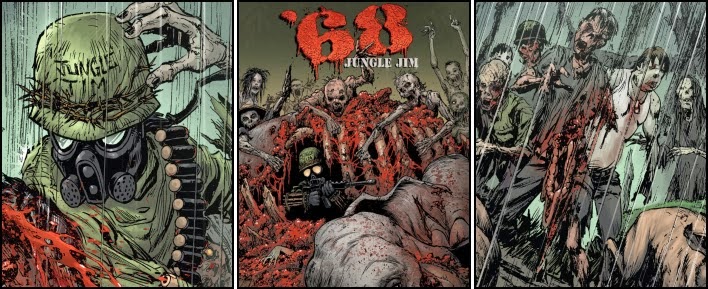
Combining the savage barbarity of the Vietnam War with the stark terror of a zombie outbreak of epidemic proportions, “‘68 Jungle Jim” has an awful lot of action and thrills to offer fans of either the horror or war comic book genre. But if the garishly grotesque variant cover art by Nat Jones and Jay Fotos does not make it clear enough, this magazine should also prove to be sugar sweet candy to any gore-fest devotees. For its twenty-two pages are absolutely crammed full of horrendously highly-detailed panels showing some seriously sickening human (and animal) mutilation.

Indeed the periodical actually starts with a wonderfully vivid double-splash depiction by Jeff Zornow, of an elephant not only having his head blown clean off by a bazooka warhead, but his entire belly cage spectacularly exploding outwards as well… and the gruesomely disembowelled Vietcong pachyderm rider, his legs disintegrating as a result of the blast, hasn’t even been mentioned yet; “Sorry Dumbo…” indeed.

Any bookworm managing to stomach such a violent extreme should be able to ‘soldier on’ but this comic genuinely does not get any less sickening as the so-called ‘hero of the hour’ Private Brian Curliss, merrily despatches his foes, both living and undead, by murderously chopping heads, eyes and noses off with a huge serrated blade or filling the panels with splattered brains, teeth and intestines as he guns them down with his semi-automatic pistol. 

Struggling to survive amidst this unrelenting and exorbitant bloodbath is Mark Kidwell’s story, a simple tale which is actually quite well told should a reader not be so squeamish as to already have both their eyes tightly shut. It is quite clear that the United States marine is mentally damaged, as he constantly talks to a non-existent Sergeant. But Curliss is also a good guy, first rescuing a group of prisoners of war and then leading them in a firefight against their former captors. In addition the man is not simply nor lazily depicted as some sort of ‘killing machine’, though at times he does a good impersonation, but is actually shown clearly struggling to cope with the horrors of the Vietnam War by “pukin’ [his] guts out after a firefight.”

However “Hellhole: Meet The New Boss…” is not just about the Private’s fight with the Northern Vietnamese. It is also about mankind’s struggle with the Asian zombie infestation and as a result the title’s creator additionally has the gas-masked combatant up to his literal neck in clawing, gnawing and biting undead; affording artist Zornow yet another opportunity to produce a stomach-churning double-page splash of brain matter, flying eyeballs, severed limbs and dismembered corpses.
The regular cover art of "'68 JUNGLE JIM" No. 1 by Jeff Zornow

Thursday, 12 March 2015

Arkham Manor #4 [The New 52] - DC Comics

ARKHAM MANOR No. 4, March 2015
There are times when the Dark Knight must remove his signature cape and cowl, and adopt the guise of the World’s Greatest Detective, using all of his vast analytical skills in order to discover, determine and decipher clues. Gerry Duggan’s storyline for the previous issues in this series have shown just such a need as a heavily disguised Batman, arguably at his methodical best, has stealthily secreted himself away within the shadows of Wayne Manor in order to identify a murderous serial killer.

“Out Of The Cold” however clearly portrays a time for the clandestine Caped Crusader to forgo any semblance of furtiveness as he must openly combat the threat of Clownface before the malleable menace murders both the staff and its fellow “Arkham Manor” inmates. Fortunately ‘Jack Straw’ is not alone in recognizing the “Clayface fragment” as a terrifying threat, and is joined in his endeavors to incarcerate the monster by the frosty internee Doctor Victor Fries. What follows is a reasonably straightforward team-up between the billionaire’s undercover alter-ego and Mister Freeze, but one in which for a change, the American author has the Bat playing the role of a lure and the molecular biologist as ‘the brains’.

Interestingly, this semi-mad dash through his ancestral home, also see the Dark Knight permitting some of the less dangerous Arkham inmates, such as Sybil Silverlock, to escape the prison rather than distract him from his more immediate task of stopping the potentially ‘Jokerized’ shape-shifter. This logical rationalisation and rather cold calculatingly prioritisation of threats even extends later to Fries himself, as rather than ‘burn’ “the Jack Shaw mask” Bruce allows the supervillain to depart Arkham with a ‘friendly’ “Nice working with you." This “lesser of two evils” also allows Bob Kane and Bill Fingers’ co-creation to return to the Batcave and once again don the ‘Mantle of the Bat’ just in time for one final confrontation with the homicidal “spider inside the Manor.”

The majority of this fast-paced action-orientated issue is drawn by Shawn Crystal with his usual competent, though kookily awkward-looking pencils. In fact the Atlanta artist’s odd and angular illustrations really convey a sense of the dramatic to the proceedings, especially when depicting Jack Straw racing through the corridors and rooms of the reformatory. Only occasionally does his work appear misshapen enough to jar with the sensibilities, such as when a female prisoner is being squashed to death by Clownface at the book’s beginning or Freeze’s robot is wantonly destroyed.
Writers: Gerry Duggan, Artist: Shawn Crystal, and Colors: Dave McCaig

Wednesday, 11 March 2015

Gotham Central #1 - DC Comics

GOTHAM CENTRAL No. 1, February 2003
First identified in Issue Four of “Batman” way back in the winter of 1940, the metropolitan area known as Gotham has always been undeniably and intrinsically linked to the Caped Crusader. The fictional American city is his home and anyone picturing its statuesque Art Deco rooftops will predominantly also envisage its night-time skyline being lit up by the glare from the famous Bat Signal. The Dark Knight’s Rogue Gallery is also legendary, featuring some of the most popular villains in the history of “DC Comics” if not comic book fandom per se. So why would the publisher ever want to produce an ongoing title which involves all of the above except for one thing… the costumed crime-fighter himself?

“In The Line Of Duty” answers that question exceptionally well, as Ed Brubaker and Greg Rucka follow the exploits of a handful of officers from the Gotham City Police Department as they go about their daily duty to ‘Protect and Serve’. Pitched as a “police procedural comic-book” the series gets off to a frantic start as two hard-working detectives follow up an apparently hopeless tip as to the whereabouts of some kidnappers, and end up confronting IGN’s 67th ‘Comic Book Villain of All Time’, Mister Freeze. Needless to say events do not go in the investigators’ favour. But it is genuinely fascinating to see just how powerful and terrifying one of Batman’s greatest enemies is in the eyes of a normal cop. As the wounded detective shivers “Think we’d walk into a room with… y-you in it… with no b-backup?”

What follows is a detailed look by collaborators Brubaker and Rucka at just how the everyday police force of Gotham City deals with such a uniquely powerful criminal, starting from the insensitive removal of the corpse belonging to ‘one of their own’, through some ‘backroom bitching’ over promotion, and ending with an alarmed street flatfoot discovering another potential victim of Doctor Victor Fries.

Perhaps more enthralling however is how the writers depict the hostility and resentment some of the officers have for Batman, including a somewhat impotent Police Commissioner. Detective Driver’s venomous rant as to how ineffective the Bat Signal actually makes them all feel is wonderfully power stuff; as is his viewpoint that the G.C.P.D. know they must arrest the insane cryogenically-suited scientist before dark… otherwise they’ll lose the ‘collar’ to the Caped Crusader and “it’s just not fair…” Such a viewpoint, one where Bruce Wayne’s alter ego is actually reviled and disliked for his ‘perpetual interference’ in police work, is refreshingly unique and thought-provoking.

Slightly disappointingly Michael Lark’s pencils are not quite as good as the pleasingly real dialogue and drama which this book contains. However the American artist still produces some competent compelling illustrations, most notably that of Mister Freeze himself; who despite his somewhat cumbersome and clunky outlandish attire, still exudes the sinister threat of a cold painful death.
Writers: Ed Brubaker and Greg Rucka, and Artist: Michael Lark

Tuesday, 10 March 2015

Uber #1 - Avatar Press

UBER No. 1, April 2013
Despite portraying of beginnings of a wholly inaccurate alternative Second World War, where German super-soldiers have somehow managed to defend a dilapidated Berlin from the Red Army during 1945. It is hard to agree with the publisher’s disclaimer that “the stories, characters and institutions mentioned in this magazine are entirely fictional.” For not only does Issue One of “Uber” start with a full-blown illustration of a heavily perspiring Adolf Hitler putting a pistol in his mouth. But just a couple of pages later, having shown the Fuhrer changing his suicidal mind, this “Avatar Press” periodical heavily involves some of the real War’s most pivotal players such as General Heinz Guderian, Albert Speer and the British Prime Minister Winston Churchill.

Indeed whilst the majority of the comic book admittedly concentrates on the exploits of Doctor Bergen, ‘Katyusha’ Maria, General Sankt and Lupin Schultz, the Fuhrer’s insane ‘motivational’ presence is felt throughout the entire book’s proceedings, and culminates in the man himself ordering the mass murder of a million Soviet prisoners of war with the words “Give me opera.” So whilst such a deed is clearly historically fictitious the character ordering it is most definitely not.

This edition is also surprising for its lack of action, especially when one considers its storyline is immersed within the final bloody days of the Soviet Union’s Berlin strategic offensive operation; a time of when soldiers from both armies fought one another in savage hand-to-hand combat, face-to-face, with little quarter being given or asked. True, Schultz, the first Panzermensch killed in action, dies an impressively gory death thanks to Doctor Bergen and an anti-tank round and the Projekt U facility is fire-bombed. But until ‘Battleship’ Siegfried's double-page mass extermination of Russian prisoners at the book’s end, most of writer Kieron Gillen’s scenes are either profanity-laden arguments between bickering German generals, or concern Bergen’s flight from the Swiss/Austrian border and subsequent murder of her bodyguard.

Disappointingly the artwork by Caanan White simply does not live up to the promise shown by his powerfully dynamic cover illustration. The penciller has gone on record to explain that as the Nazi regime was cruel and sadistic he wanted to portray them physically as smug, arrogant and remorseless. But by exaggerating such facial features with sneers and scowls he has also slightly disfigured them. Such an erratic ‘emotional’ style also slightly grates when White depicts the more historically well-known characters of Hitler and Churchill. Both of whom are immediately recognisable from decades of published caricatures. But neither of which prosper from the artist’s attempts to dramatically emphasize their feelings upon their faces.
The variant cover art of "UBER" No. 1 by Caanan White

Monday, 9 March 2015

The Walking Dead #119 - Image Comics

THE WALKING DEAD No. 119, December 2013
A moment of recuperation and solemn reflection in the aftermath of some desperate fighting or simply the quiet before the storm. Both are suitably valid reasons as to why the tempo of Robert Kirkman’s writing for Chapter Five of “All Out War” is so painstakingly slow and thoughtful. But such an understated and dialogue-heavy interlude should surely not last the entire length of a comic book? Any latecomers to this series would certainly struggle to acquire any sense of excitement from such a twenty-two page marathon of introspection and character development. Indeed this issue clearly demonstrates why at the time of publication, there was a growing unhappiness amongst some of the title’s longer-term readers; a palpable concern as to what was happening to “The Walking Dead” as a result of its unremitting bi-weekly publishing schedule. A belief that the lamentable slow-pacing was possibly due to “Image Comics” concentrating more on “trade-paperback-time” than offering ‘value for money’ to its fortnightly followers.

Whatever the explanation there really is little in the way of storyline progression within this book until a grenade suddenly explodes within the walls of the Alexandria Safe Zone. An event which heralds the much-anticipated yet unwelcome arrival of Negan and a large group of Saviours. Only then, some two thirds of the way through the issue, does the action and suspense finally start to mount and this is hardly created expeditiously as a result of some unashamedly large panelled drawings by Charlie Adlard.

Admittedly the comic’s closing scene of Holly being abruptly revealed as a zombie is as shocking a conclusion as a comic can probably get. But it still takes three whole pages to depict the hooded infected survivor stumbling towards the embrace of an unsuspecting Denise, and once freed biting her would-be rescuer on the arm.

Disappointingly, though hardly unsurprisingly, the dramatic appearance of Rick Grimes’ main adversary also leads to a hefty number of profanities colouring the subsequent dialogue. Though considering some of the supposedly appropriate expletives used by the creative team whilst answering some of their correspondence within their letters page, it may be those readers who simply just stuck to the wording contained within the comic strip got off lightly.

Unlike similarly slow issues, this edition can’t even rely upon a couple of impressive zombie-filled ‘double-splashes’ by its British artist to salvage any degree of satisfaction from its predominantly ‘lifeless’ content. Adlard has plenty of opportunities to depict fan favourites Ezekiel, Michonne, and Rick looking suitably pensive and perturbed. But aside from the main protagonist throwing his arms up in defence as he’s momentarily showered in glass fragments, there is little for the artist to draw but characters gloomily sat or stoically stood conversing with one another.
Writer: Robert Kirkman, Penciller: Charlie Adlard, and Inker: Stefano Gaudiano