Tuesday, 7 February 2017

Star Wars: The Force Awakens #3 - Marvel Comics

STAR WARS: THE FORCE AWAKENS No. 3, October 2016
Continuing “the search for Luke Skywalker”, Issue Three of “Star Wars: The Force Awakens” certainly starts off well enough with a sense-shattering chase through the maze-like corridors of The Eravana that sees Rey and Finn matching wits with a fearsome Rathtar, and Chewbacca exchanging laser bolts with the Guavian Death Gang. But whilst this scintillating set-piece soon leads to the Millennium Falcon going into light speed whilst still “inside the hangar”, and the First Order being informed “that Han Solo has the droid”, what then follows must surely have disappointed this comic book adaption’s 41,575 readers.

Admittedly, Chuck Wendig's script diligently conveys the exploits as seen in J.J. Abrams’ motion picture, yet rather than simply pad out proceedings with splash pages featuring Maz Kanata welcoming the heroes to her castle, it might have been more interesting for the Pennsylvania-born writer to pen some of the cinematic release's ‘deleted scenes’, such as Unkar Plutt having his arm ripped off by an angry wookie for threatening Rey, or simply better flesh out the action aboard the Corellian’s Baleen-class heavy freighter by giving Tasu Leech and the “notorious criminal organization” Kanjiklub a bit more ‘screen time’. 

Instead, all the American blogger delivers is a lack-lustre, and arguably choppy, narrative which leaps from Supreme Leader Snoke, to the Millennium Falcon, to Takodana, to The Finalizer, and then back to Kanata’s castle for a two-page treatment of Rey walking down some dimly-lit stairs and finding Luke’s long-lost lightsaber in a chest… A terrifically tense scene in the movie when supported by atmospheric sound effects, clanks and noises, but hardly the sort of minimalist action one can similarly enjoy when purely printed on paper.

Somewhat more successful than Wendig’s inauspiciously faithful summary of the film’s events, are Marc Laming’s breakdowns. Decidedly more detailed than this mini-series’ regular illustrator, the British designer’s drawings of Chewbacca and a silver-haired Han Solo are wonderfully realised, with the elderly smuggler’s craggy facial expressions proving to be a particularly well-rendered representation of actor Harrison Ford’s features. In fact, apart from the stand-in artist’s ‘amateurish’ panels involving Snoke and Hux within Starkiller Base, it genuinely seems a pity that the former “Fleetway Publications” penciller isn’t a permanent replacement for Luke Ross.
Writer: Chuck Wendig, Artist: Marc Laming, and Colorist: Frank Martin

Monday, 6 February 2017

The Amazing Spider-Man [2015] #16 - Marvel Comics

THE AMAZING SPIDER-MAN No. 16, October 2016
Despite this twenty-page periodical heavily featuring the machinations of Electro, the Lizard and the Jackal as it helped an astonishing 185,342 readers take their “first steps on the road to our big Spider-Event of 2016”, Dan Slott’s script for “Whatever The Cost” interestingly focuses far more upon the consequences of emotional decision-making involving extreme medical procedures than it does having Spidey battling any particular super-villain. Certainly Peter Parker’s involvement with the dubious Doctor Clarkson’s work at New U Technologies doesn’t even hit the radar of his alter-ego’s arch-enemies until Jerry Salteres’ “lungs are fired” in a chemical accident and the technology corporation employee needs “a miracle”; “This wasn’t part of the plan. Do it. Let’s give Mister Parker a taste of how the magic works.”

Fortunately that doesn’t mean that Issue Sixteen of “The Amazing Spider-Man” is simply filled with an endless parade of dialogue-heavy scenes, as the Berkeley-born writer’s narrative interjects his tantalisingly tense moral debates with as much action as an explosion at the Parker Industries plant in Edmond, Oklahoma can muster. Light-hearted and simultaneously nail-biting, these dynamically-charged rescue sequences really put plenty of the Spider-Cycle on show whilst Web-Head desperately tries to alleviate the mood with his usual wisecracks and copious amounts of web-foam.

Just as entertaining is the Eisner Award-winner's nod to Steve Ditko’s famous ‘heavy-lifting’ panel from this title’s February 1966 edition, as circumstances force the super-hero to shift a large metal pylon off of one of his employees. This demonstration of strength, as Peter wills his muscles to work beyond their normal limits, is fuelled by the C.E.O.’s heartfelt belief that the man is “my responsibility!” An incredibly emotional response which only then later fuels the lead protagonist’s rash decision to fly Doctor Clarkson’s “whole team whatever the cost” and pay for his worker’s experimental care.

Penciller Giuseppe Camuncoli also appears to be in great form drawing this comic book, with his renderings of Spidey’s “highly modified high-tech motorcycle” proving an absolute delight to the eyes. Indeed, despite this publication’s rather word-laden needs, the Italian illustrator’s artwork manages to still contain plenty of movement and life in its figures, and does a particularly good job of augmenting its characters’ sentiments on their faces.
The variant cover art of "THE AMAZING SPIDER-MAN" No. 16 by Chris Samnee & Matt Wilson

Sunday, 5 February 2017

The Punisher #8 - Marvel Comics

THE PUNISHER No. 8, March 2017
Worryingly devoid of any real “Parental Advisory” action until a good two-thirds of the way through, Issue Eight of “The Punisher” must have come of something of a disconcertingly sedentary reading experience for many of its fans when compared to the gruesome body-count depicted within some of its preceding editions. Indeed, it’s hard to think of another instalment of writer Becky Cloonan’s run on this title where every single murderous death has deplorably taken place ‘off-screen’ as opposed to being graphically illustrated within the confines of a splash page or two; “The bartender talked pretty easy. He won’t tell anyone anything ever again.” 

Arguably some of this change in the direction “Over The River And Through The Woods” takes is due to the Pisa-born American author’s exploration of “a gun-toting old crone” whom Frank Castle encounters having “barely escaped” an explosion at Exeter Asylum. Battered and bruised, yet ever the gentlemen, the titular character happily chops wood for the elderly widower in return for some kindness, hot soup, lots of stitches and a bed for the night.

True, this caringly human side to the “decorated Marine” makes a nice change from the one-time family man’s usual grim-faced blood-letting killing spree, and it’s not as if Ethel isn’t herself averse to gorily stabbing a Condor operative’s throat out with her knitting needles. But such moments of social interaction between the unlikely couple, such as when Bradford is reminded of her late husband and the Punisher fixes her Harley motorcycle, doesn’t understandably lend itself to causing too much bodily mutilation.

Disappointingly however, it isn’t just Cloonan’s desire to make Castle’s incongruous companion memorable which alters this twenty-page periodical’s tone. It is the competent, yet distinctly different, drawing styles of Laura Braga and Iolanda Zanfardino; one of whom pencils all the panels focusing upon Frank and his subsequent confrontation with Olaf, whilst the other sketches Face’s abduction of Ortiz in a rather disconcertingly cartoon-like manner which imbues the Drugs Enforcement Agent with a totally inappropriate comical gait. Neither style, perhaps intentionally, attempts to imitate the late Steve Dillon’s “unique ink line” and as a result appear genuinely inferior to the no-nonsense breakdowns the “definitive” Punisher artist would use for his storytelling.
Writer: Becky Cloonan, and Artist: Laura Braga with Iolanda Zanfardino

Saturday, 4 February 2017

Kong Of Skull Island #4 - BOOM! Studios

KONG OF SKULL ISLAND No. 4, October 2016
There’s an awful lot to like about James Asmus’ narrative for Issue Four of “Kong Of Skull Island”. For whilst the pulse-pounding pace of the twenty-two page periodical’s script does regrettably peter out midway through the publication and degenerate into a tediously tiring series of dialogue-heavy scenes, it’s opening, absolutely crammed full of giant apes, man-eating dinosaurs, native warriors and great sea beasts must have thrilled its 5,191-strong audience.

Indeed, for the first half of the Stan Lee Excelsior Award-winner’s story, it genuinely seems hard to believe any of the lead protagonists will survive for long on the “isle of demons” as the reader encounters “creatures of pure violence [which] burst from every brush -- and descend from every cloud.” It certainly appears clear that without the likes of Tuno, an enormous primitive who literally flattens a grounded pterodactyl with a well-placed foot, Ewata and her “brothers and sisters” would soon have fallen to the “deathrunners and dinosaurs” picking off her people; even if the determined warriors do manage to take down the occasional carnivore with their flame-arrows.   

Perhaps this book’s most notable passage however, is not one based solely amidst the mire of artist Carlos Magno’s well-pencilled mutilation, but rather a heart-wrenching look deep inside the souls of two Atu Kongs, as one sacrifices herself “to save all of us” by bodily grabbing two mighty lizards threatening her beloved, and running off the top of a cliff with them into the razor-toothed maw of a gargantuan fish. This noble loss of B’Lan is incredibly well-penned by the New Orleans-educated author, and the pain in her mate’s eyes as he initially tears into more of the bipedal “sentient dinosaurs”, then later sinks to the ground in utter grief, is visible for all to see…

Disconcertingly though Asmus’ sensibilities do arguably seem to leave him at this comic’s end, as the elderly Vdrell appears before his astonished people claiming he has simply walked along the bottom of the sea from the tribe’s razed homeland, in order to reach “our people… and guidance of Usana… as she leads us to our new destiny.” Admittedly the Tagu and Atu are a highly superstitious race, yet surely even they, despite just hearing the tragic news of former prince K’reti’s cold-blooded murder, wouldn’t trust such an utterly unbelievable falsehood as the Shaman somehow managing to breathe underwater for an entire day and then conveniently finding his way to his daughter’s side on Skull Island?
Writer: James Asmus, Illustrator: Carlos Magno, and Colors: Brad Simpson

Friday, 3 February 2017

Rough Riders #1 - AfterShock Comics

ROUGH RIDERS No. 1, April 2016
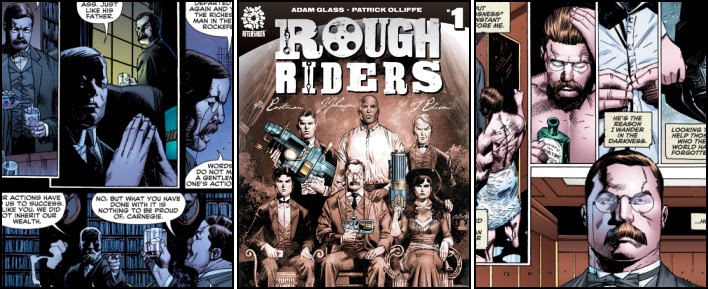
“One of the most exciting debuts” from “Aftershock Comics” during their “explosive first year of publications”, Issue One of “Rough Riders” must surely have captivated its 8,711 readers straight from the spinner rack, with its historically-based Nineteenth century roots, intriguing steer “into fictional territory, and wonderfully authentic-looking, Patrick Olliffe-illustrated cover featuring half a dozen straight-backed, bygone characters and some anachronistic steampunk firearms.

Indeed, the publication’s entire premise smacks of the series being alluringly akin to an “American League of Extraordinary Gentleman”, and just like Alan Moore’s Eisner Award-winning mini-series, author Adam Glass doesn’t linger long before hurling his leading protagonist into the fray by pitting Theodore Roosevelt up against a blazing inferno in order to save some seamstresses who, having “traded one tyranny for another”, were “working outrageous hours for pennies on the dollar in unsafe conditions that put their lives in constant danger.” This sense-shattering introduction to the future President, his space-age high-tech weaponry and admirable zest for danger, is incredibly well-penned, and stirringly ends on a poignant, heart-breaking moment as the hero helplessly watches a young girl fall through the unsafe factory roof to her death; “Today, nine women were saved. But for the rest of my life I’ll only remember the one I failed to rescue.”      

Just as engagingly written is the television producer’s piece introducing the eventual first African American world heavyweight boxing champion, Jack Johnson. Initially serious, as Teddy teaches the Hudson River-based pugilist a lesson in fist-fighting and prejudice, this punch-up becomes charmingly reminiscent of Robin Hood’s first encounter with Little John, especially when the fighter pulls his bespectacled antagonizer into the water with him just as soon as the older man grabs his hand in order to pull him ashore.

Described by Glass as having “an old school style” which is “perfect for this kind of book”, Olliffe’s artwork for “The Big Stick” is excellent, and, alongside Gabe Eltaeb’s colours, easily manages to convey both the dramatically dynamic, such as Roosevelt dropping through the skylight of a fiery factory, as well as the more sedentary stretches of this publication. In fact, it’s arguably hard not to disagree with this collaboration’s writer that the penciller is “a great partner for this” comic, and easy to see why Adam has “always been a big fan of Pat’s work.”
Creator & Writer: Adam Glass, Artist: Patrick Olliffe, and Colorist: Gabe Eltaeb

Thursday, 2 February 2017

Conan The Slayer #6 - Dark Horse Comics

CONAN THE SLAYER No. 6, January 2017
Enjoyably ‘down to earth’ and non-fantastical, at least until the comic’s rather grandiose finale as a fiery Taraslan returns from beyond the grave to burn alive the leader of a Ninja clan who has set his assassins upon the dead hetman’s tribe, Cullen Bunn’s script for Issue Six of “Conan The Slayer” brings the titular character’s journey to become head of the Kozaks to a somewhat satisfactory conclusion. Indeed, the American author’s script is arguably packed full of the seemingly endless blood-letting and savage swordplay one has come to expect from a publication featuring the barbaric creation of Robert E. Howard; especially an officially licenced one.

Fortunately, such a torrent of ‘thrills and spills’ is tremendously well-paced, and instead of simply being an unendingly empty gratuitous depiction of campsite carnage, the GLAAD Media Award-nominee manages to imbue the numerous combatants with a genuine sense of malice, panic, terror and determination, courtesy of a thoughtfully emotional beginning which sees a frustrated Jehungir Agha angrily give orders to have the horsemen dispatched, and a lamenting Conan honouring his fallen friend. Such character defining scenes are admittedly somewhat dialogue-heavy, but the barbarian’s anguish, in particular, is so well delivered that at one point it appears that the Cimmerian’s belief he is “haunted by the spectre of death itself” will lead him to just impotently walk away from the sorrowful broken wastrels and into the surrounding melancholic wilderness.

Rather enjoyably however, the “sword and sorcery hero” is never given the opportunity to make such a depressing exit, as an assassin’s arrow suddenly fizzes past his head and pierces the chest of a nearby Kozak. This bloody death, one which comes at the simple turning of a page, immediately alters the entire dynamic of Bunn’s narrative, and swiftly sees artist Sergio Davila not only pencilling black-clad ninjas, “their armour… padded and oiled so as to be silent”, mercilessly murdering any of the tribesmen who haplessly stand within reach of their dead throat-slitting knives. But Conan and Iksana gustily ridding the silent intruders of their innards, arms, throats and brains in all manner of macabre mutilations; “Take up arms, Kozaks! This is your Hetman’s funeral! Teach the dogs to respect the dead!”
Script: Cullen Bunn, Artist: Sergio Davila, and Colors: Michael Atiyeh

Wednesday, 1 February 2017

All-Star Batman #2 - DC Comics

ALL-STAR BATMAN No. 2, November 2016
The second best-selling title of September 2016, at least according to “Diamond Comic Distributors”, Issue Two of “All-Star Batman” must have driven its 137,748 readers into a frothing frenzy with its over-the-top thrill-a-minute narrative that essentially takes “a wrecking ball to Batman’s world”. True, the titular character’s “train ride from hell” alongside Harvey Dent has the Caped Crusader matching muscles with Killer Croc, King Shark and Amygdala all within the space of just a couple of pages. But Scott Snyder doesn’t seem even remotely interested in explaining just how the three seemingly unstoppable heavily-muscled monstrosities, at least one of which has a “devolved human brain”, came to catch the Dark Knight by surprise on top of a freight train… 

Indeed, the New York-born writer, and indisputably in-form John Romita Junior, don’t even appear overly-eager to justify just why Bruce Wayne’s alter-ego is riding aboard the timber-laden locomotive in the first place. They certainly don’t bother clarifying where within their “assassin-infested landscape” poison experts Cheshire and Copperhead, or Anatoli Knyazev a.k.a. the Beast, miraculously appear from, nor how the already groggy super-hero seemingly just shrugs off a toxic crossbow bolt perforating his guts; “I’ll admit, Bats, you made it farther than I expected. But now you got what? Maybe one minute before you go belly up? I warned you about betting against me.”

By far the most disconcerting plot development however, is Jim Gordon and Harvey Bullock’s storming of Wayne Manor alongside a horde of Gotham City’s finest, and their subsequent determined demolition of “the clock in study” in order to breach the entrance to the Batcave. This genuinely troubling sequence, which depicts Alfred Pennyworth being casually cast aside by the police as “Batman’s closest ally… until tonight” supposedly “break[s] under [the] pressure of Two-Face’s blackmail” and attempts to arrest Bruce for being the Dark Knight, is undeniably dramatic. Yet additionally seems to completely rewrite the Commissioner’s long-standing relationship with his jurisdiction’s foremost masked vigilante and unwavering sense of honesty. 

Equally as perplexing is Snyder’s script for this publication’s secondary story “The Cursed Wheel”. Rather disappointingly pencilled (and inked) by Declan Shalvey, who somehow manages to make even the Caped Crusader’s silhouette appear unconvincingly wooden, this seven-page tale depicts a rather incautious cowled crime-fighter leaving his latest protégé, Duke, to the tender mercies of Victor Zsasz in the basement of the serial killer’s latest victim.
The regular cover art of "ALL-STAR BATMAN" No. 2 by John Romita Junior