Monday, 31 December 2018

Planet Of The Apes: Ursus #4 - BOOM! Studios

PLANET OF THE APES: URSUS No. 4, April 2018
The three hundred and third best-selling title in April 2019, at least according to “Diamond Comic Distributors”, David F. Walker’s narrative for Issue Four of “Planet Of The Apes: Ursus” must surely have disenchanted many of its 3,774 fans with his peculiar plot involving the psychically powered human mutants living beneath the remains of New York City seemingly permitting a petrified Sergeant Moench to escape his captivity having first been driven half-insane with mental pain. Indeed, the “brave gorillas” exploration of the utterly destitute Big Apple appears to have been manufactured by this book’s writer solely to provide East Coast Ape City’s general with irrefutable proof that the destroyed metropolis is inhabited by ‘telepathic beasts’, who can simply immobilise a unit of Ursus’ finest soldiers from a distance just by thinking about it.

This bizarre narrative, which runs alongside a somewhat bloody flashback sequence depicting how truly powerful a fighter Kananaios’ son was in his youth following the town of Terminus falling “into the hands of the Humans”, arguably makes absolutely no sense whatsoever, especially when it’s clear from the dwellers living within St. Patrick's Cathedral, that they believe Moench will probably both inform his fellow apes about their ‘civilisation’ and resultantly return “with more of its kind.” Just why the mutants therefore permit their prisoner to flee from their control is utterly nonsensical and genuinely would appear to simply have been lazily engineered in order to provide Ursus with some semblance of rationale so as to “destroy the enemy with or without the approval of the Simian High Council.” 

Disappointingly, the military commander’s behaviour towards his fellow primates would also suggest that something is badly amiss with Walker’s penmanship of the titular character. There is undoubtedly an increasing darkness found within the young, yet-to-be General’s demeanour towards humans during his disconcerting discovery that “the unsimian evil of these beasts” has caused the destruction of several ape settlements. But such hostility towards mankind later suddenly sees Ursus angrily slap Zaius before their city’s Chancellor in a disrespectful move which many upon the High Council will see as a treasonous attack upon the good doctor, rather than a loyal soldier’s earnest determination to desperately do what he thinks best for his settlement; “Stop wasting time and endangering ape lives! Give the order. Let me do what must be done to protect Ape City.”
The regular cover art of "PLANET OF THE APES: URSUS" No. 4 by Paolo Rivera & Joe Rivera

Sunday, 30 December 2018

Micronauts [2016] #8 - IDW Publishing

MICRONAUTS No. 8, December 2016
There’s a palpable sense of fun to Cullen Bunn’s narrative for Issue Eight of “Micronauts” which clearly shows just how much of “a dream come true” this book must have been for the three-time Bram Stoker Award-nominee to pen. Indeed, this twenty-page periodical’s storyline, packed full of headlong car chases and bullet-laden helicopter assaults, validates just how sincere the American author was in his desire “to do everything in my power to make sure readers have the time of their lives reading this series!”

For starters, having previously “been rendered unconscious” and “sent off to be subjected to some ghastly experimentation”, this comic’s opening ably demonstrates just how difficult it is going to be for Oziron Rael’s team to escape their captors, even with the help of a sympathetic laboratory scientist. This sense-shattering sequence, which depicts the Heliopolis’ crew being literally thrown around a speeding vehicle whilst Acroyear and Space Glider attack their military pursuers, is tremendously well-paced and genuinely provides a few ‘laugh out loud’ moments as the pair of rebels ‘banter’ as to how many of “those giant vehicles” each took out.

Bullen’s aforementioned “love” for the Micronauts is equally as plain to see in the next stage of the heroes’ frantically-paced pursuit, with Microtron and his “ungrateful captain” taking to the skies in their toy-sized spaceship in order to take down two rotarcraft which in their astonished eyes are “larger than the Avon Federation Space Port.” Oz’s sarcastic first mate proves particularly amusing during these panels, criticising his team-mate’s lack of gratitude for all the robot's speedy, last-minute repairs despite the imminent danger they’re all in; “Biotron and I did a wonderful job of repairing her. Seems like the kind of thing one should be thanked for. Right, Captain?”

Of course, none of this enthusiasm would be quite so infectious for this publication’s 5,590 readers if it wasn’t for Max Dunbar’s dynamic artwork. In fact, a lot of this comic’s exhilarating entertainment is due to the Canadian’s ability to imbue his well-pencilled figures with a humorous look here or a straight faced rebuke there, such as when Orbital Defender slyly points out to Phenolo-Phi that the Pharoid is still vainly speaking to their would-be rescuer despite having just said that “the giants lacked intelligence because they kept talking even though we couldn’t understand”.
Written by: Cullen Bunn, Art by: Max Dunbar, and Colors by: Ander Zarate

Saturday, 29 December 2018

The Batman Who Laughs #1 - DC Comics

THE BATMAN WHO LAUGHS #1, February 2019
Announced at the San Diego Comic Convention in July 2018, this opening instalment to Scott Snyder’s six-issue mini-series undoubtedly captures the attention straight from the ‘get-go’ with its thrill-a-second opening featuring the seldom seen Bat-Raptor racing against a convoy of rowhouse-carrying flatbed trucks along one of Gotham City’s arterial freeways. In fact, this action sequence’s frantically-sketched panels, tightly packed full of heavy moving freight and the squeal of burning tyres, is arguably demonstrative of the Caped Crusader at his very best, hurling a lethal barrage of batarangs one moment, and cushioning a well-timed leap onto a fast-moving vehicle with the body of a hapless felon in the next.

Unfortunately for this comic’s readers however, this sense-shattering flurry of activity is disappointingly as good as the New York author’s narrative gets once Batman discovers the corpse of a Bruce Wayne duplicate which was secretly being smuggled out of the metropolis “to be hacked up” and Arkham Asylum is invaded by this book’s terrifying titular character. True, Jock’s marvellously pencilled massacre of numerous outmatched guards within the corridors of the criminally insane by the Grim Knight, as well as the Joker’s subsequent cold-blooded brutal murder at the hands of the Dark Multiverse’s most “insatiable villain”, undeniably provides this slightly 'over-sized' publication with a second injection of pulse-pounding positivity. Yet sadly, the “DC Comics writer extraordinaire” soon snatches away any shock caused by so traumatising a scene by quickly revealing that it was actually one of the Clown Prince of Crime’s Slapstick Men who received the deadly pick-axe to the head and not the chemically-bleached criminal himself.

Similarly as dissatisfying is this twenty-six page periodical’s conclusion, which almost seems to have been crowbarred in to its already near bursting covers simply to provide Snyder’s story with a suitably thrilling cliff-hanger. For despite only recently being confined to an Arkham cell, the Eagle Award-winner would have his audience believe that somehow the Joker “knew what was coming for him”, so not only managed to conveniently escape his captivity by having a duped decoy replace him, but also arrange for his patsy to undergo enough name changes so as to lead Batman to both an old Gotham Comedy Club and then eventually back to the Bat Cave where his greatest nemesis was waiting for him on the other side of its underground waterway security systems; “Now, now, Jeeves… I’m supposed to say Knock Knock first.”
Writer: Scott Snyder, Artist: Jock, and Colors: David Baron

Friday, 28 December 2018

Micronauts [2016] #7 - IDW Publishing

MICRONAUTS No. 7, November 2016
Disconcertingly set “in the aftermath of Revolution”, “one of the biggest events in IDW’s history”, Cullen Bunn’s opening three-page summary as to just how this comic’s titular characters have somehow become “trapped in a world inhabited by giants” following their recent flight from Karza’s forces in Microspace, must have proved a bewilderingly essential read for any non “IDW Faithful” who happened to ‘have been living under a rock’ in November 2016. In fact, even then, the rationale behind the GLAAD Media Award-nominee’s narrative for Issue Seven of “Micronauts” probably didn’t make a great deal of sense to some of its 5,918 bibliophiles until they perused Editor-in-Chief David Hedgecock’s “Welcome To The Hasbro Universe” exposition at the back of the book, within which he explains that “thanks to the storylines created in Revolution, some of Hasbro’s most popular franchises are now tied into one universe of epic proportions.”

Luckily however, understanding just how the tiny team have come to be trapped within a reinforced glass tank awaiting lethal experimentation at the hands of Mankind’s modern-day scientists isn’t essential to enjoying a thoroughly entertaining re-imagining of “Land Of The Giants”, as Acroyear lays down a seriously impressive smackdown upon a group of armed guards which results in at least one of the armour-clad goons losing a few teeth. This action-packed scene is tremendously well-paced, packed full of sense-shattering gun-play, and helps define just how formidably powerful the genetically engineered super-warrior still is despite his sudden diminutive size.

Indeed, the entire sequence imbues the American novelist’s storyline with some arguably much-needed energy, which then adds extra urgency to the subsequent exploits of Biotron and Microtron as they unsuccessfully attempt to outrun a pair of slavering sentry-dogs who seem intent on chomping up Acroyear as a tasty snack; “I really do wish everyone was conscious to witness this… Back! Back, you slobbering beast!” Such well-handled interplay between this comic’s non-human cast provides all three individuals with an opportunity to demonstrate their unique personality traits, with the “self-deprecating wit and biting sarcasm” of Oz’s first mate proving particularly humorous.

Max Dunbar’s beautiful illustrations also help to endow this twenty-page periodical with a palpable positive vibe, courtesy of some pulse-pounding storyboarding. The frantic nature of the heroes’ headlong flight to freedom is easily-captured by the Canadian’s pencilling throughout, and even gives the group’s meeting with a well-meaning, sympathetic biologist some noteworthy punch when Acroyear wrongly decides that “the giant who sent us to our condemnation! Now… stands in our way” and roughly brings her tumbling to the ground with a whack’ to the ankle.
Written by: Cullen Bunn, Art by: Max Dunbar, and Colors by: Ander Zarate

Thursday, 27 December 2018

Planet Of The Apes: Ursus #3 - BOOM! Studios

PLANET OF THE APES: URSUS No. 3, March 2018
Supposedly featuring a gorilla general who is “feeling betrayed by Zaius [for] taking control over the investigation” into a suspected tribe of talking humans, at least according to the pre-publication publicity of publisher “Boom! Studios”, David F. Walker’s storyline for Issue Three of “Planet Of The Apes: Ursus” arguably promised its audience a great deal upon its release with both the comic’s exciting inclusion of actor Charlton Heston’s 1968 motion picture character, Taylor, as well as its enthralling depiction of Sergeant Moench’s exploration of the Forbidden Zone. But despite the agitated apes’ discovery of New York City’s shattered remains, and nervous passage to the entrance of its Queensboro Plaza subway station, the vast majority of this twenty two page periodical’s plot instead disappointingly focuses upon Ursus desperately trying to drink away his problems with “too much berry wine” and some incredibly long-winded, flashback scenes…

Indeed, it’s hard to imagine many of this book’s dwindling 3,987 readers were impressed with its American author staggeringly squandering a quarter of this magazine’s length depicting Ape City’s befuddled military commander drunkenly getting out of bed and the resentful cell guard Julius simply making his way to Doctor Zaius’ office, rather than further fleshing out Moench’s impressive ability to overcome his fear of the strange phenomenon he witnesses whilst traversing humanity’s radiation-disfigured land. Certainly, it is arguably difficult to understand just why this comic’s creative team wastes three pages portraying a decidedly grim Ursus sat talking to a vacant-eyed, lobotomised Landon only to straight afterwards cram into a single splash panel Kananaios’ son savagely defeating a party of mean-spirited men; “In his youth, Ursus secretly wished humans could talk because if they could talk, they would tremble in fear whenever they spoke his name.”

Mercifully, Chris Mooneyham’s dynamic drawings of Moench leading his “group of frightened female orangutans” through the fiery illusions of the Forbidden Zone does at least imbue this poorly paced comic with a modicum of entertainment. Yet as much as it is enjoyable watching the artist’s well-pencilled gorilla soldiers carefully pick their way through the Big Apple’s deserted streets, especially when it’s clear their progress is being monitored by the destroyed city’s mutated inhabitants, it is difficult not to wish that Ursus was “ten years younger” and leading the expedition himself.
Written by: David F. Walker, Illustrated by: Chris Mooneyham, and Colored by: Jason Wordie

Wednesday, 26 December 2018

Doctor Strange #385 - Marvel Comics

DOCTOR STRANGE No. 385, April 2018
Considering that Donny Cates’ “Loki: Sorcerer Supreme” storyline significantly relies upon the presence of the Sentry in order for Stephen Strange to be able to match mystic arts with the God of Mischief, it probably came as little surprise to some of this comic’s 26,774 readers that the all-powerful evil imprisoned within the Sanctum Sanctorum is actually Robert Reynolds’ “dark opposite”, the Void. But whilst the presence of “the black and destructive counterforce” undeniably makes for a somewhat sense-shattering conclusion to the American author’s long-winded narrative, the simplistic ease with which Loki, the former “preeminent surgeon” and “arguably the most powerful of all heroes” defeats it smacks of this title’s writer mismanaging the plot’s pacing quite significantly.

For starters, having unleased a force supposedly “capable of destroying the Earth, if not the entire universe”, it disconcertingly takes this publication’s three heroes less time to batter the Void back inside its sealed room than it does Thor’s step-brother to later explain to Strange just why he duped the magic user into believing that the Vishanti had robbed him of his title. Indeed, the titular character appears to be in far more danger of being killed by a murderously enraged “Golden Guardian of the Good” than he does from the evil psyche of the Sentry, and probably would have been if not for Loki’s protective spells sparing the man from the bone-breaking fury of the angry New Avenger; “You told me we had to protect the world! I didn’t know we’d have to protect it from you. I trusted you, Stephen.”

Of course, all this pulse-pounding pugilism and carousel of theatrical spell-casting is soon disconcertingly diminished by Laufeyson’s revelation that “there… never was a tournament” for Doctor Strange to lose, and that he had apparently simply weaved the illusion so as to make the Master of the Mystic Arts better prepared for the War of the Realms, “Hell on Earth”, the gathering of the Infinity Stones and the Final Host.” This grand-sounding motivation momentarily appears disconcertingly credible, considering the Agent of Asgard has just “used the Exile of Singhsoon to consolidate Midgard’s magic into myself so I could jump-start the Dragon Lines." Yet such an explanation is soon disappointingly dispelled and clouded in doubt by a dubious Sorcerer Supreme and Loki’s abrupt departure...
Writer: Donny Cates, Artist: Gabriel Hernandez Walta, and Color Artist: Jordie Bellaire

Tuesday, 25 December 2018

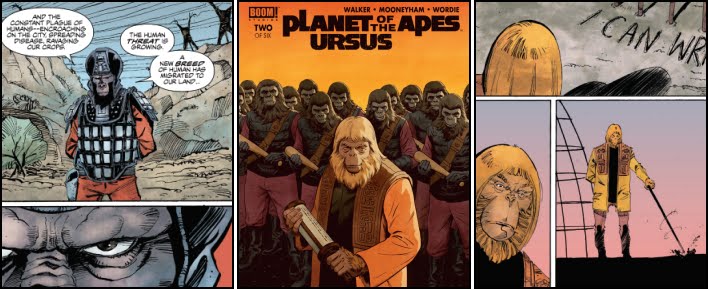
Planet Of The Apes: Ursus #2 - BOOM! Studios

PLANET OF THE APES: URSUS No. 2, February 2018
Considering that this limited series so closely courts the events of Franklin J. Schaffner’s 1968 American science fiction film, David F. Walker’s narrative for Issue Two of “Planet Of The Apes: Ursus” must surely have made its 4,453 readers in February 2018 feel that he had missed a major opportunity with which to significantly expand upon Robert Gunner’s ‘Silver Screen’ alter-ego John Landon. For whilst this twenty-two page periodical based upon “the franchise’s most notorious villain” undoubtedly provides a savagely brutal explanation as to why the troubled astronaut’s frontal lobes were removed from his brain by the chimpanzee Doctor Galen, it disappointingly does so within mere moments of the terrified talking human being discovered by Zaius and the orangutan’s former friend; “You call this an interrogation? You’ve fractured its skull.”

Admittedly, the timing to this publication’s plot is somewhat tight, as “the most powerful gorilla in Ape City” has to arrange for Sergeant Moench to assemble and deploy a loyal hunting party to the Forbidden Zone before the Chief Defender of the Faith rather cynically covers up Taylor’s writing in the dirt just outside the voiceless captive’s external exercise pen. Yet even so, it seems a shame that the six-foot-four, 200-pound ‘Liberty 1’ explorer wasn’t given something more ‘meaty’ to do than simply whimper in his cage that “the oxygen levels in my hypersleep chamber are off balance” and plead to “see my wife -- my family” before being beaten half to death by an enraged Ursus.

Mercifully however, the “award-winning journalist” does seem to find the time to depict the titular character’s first meeting with his beloved wife, Qama, when she was a servant of Zaius’ mentor, Doctor Cephina. This tender flashback scene, set against the backdrop of a violent human attack upon an easily overrun Ape City, not only provides the military commander with an opportunity to demonstrate his courageous bravery when he was a young primate, but also continues to reveal just why he “has always hated and feared mankind.”

Easily this comic’s greatest asset though, are Chris Mooneyham’s excellent illustrations. The Joe Kubert School of Cartooning and Graphic Art graduate really does imbue “the primary antagonist of Beneath the Planet of the Apes” with a formidable presence and it is genuinely a major anti-climax when a disillusioned Ursus is pencilled riding away from his hand-picked “most trusted gorillas” rather than sketched leading them into the Forbidden Zone in search of “a new breed of human [who] has migrated to our land…”
The regular cover art of "PLANET OF THE APES: URSUS" No. 2 by Paolo Rivera & Joe Rivera