Thursday, 28 March 2019

Conan The Barbarian #4 - Marvel Comics

CONAN THE BARBARIAN No. 4, May 2019
Set “mere months after claiming the throne” of Aquilonia by strangling Namedides and “placing the bloody crown upon his own barbarian head”, long-time fans of Robert E. Howard’s black-haired Hyborian Age hero probably felt Jason Aaron’s incarnation of the Cimmerian in Issue Four of “Conan The Barbarian” was disconcertingly different to the one created by “the father of the sword and sorcery subgenre.” For whilst the powerful monarch undoubtedly demonstrates all of his usual formidable ferocity with a bladed hand-weapon during this twenty-page periodical’s plot, the fact that the Alabama-born author’s entire narrative rests upon the perturbing premise that the mighty warrior is stricken throughout his story with some sort of sickeningly vile allergy to peace seems disconcertingly incongruous to the well-travelled adventurer’s character.

Indeed, the American writer pens Conan being so “sick as a Stygian dog” as a result of his sovereignty, that the poorly warrior actually starts being sick mid-way through an alleyway assault, and would have been beheaded if not for the all-too conveniently contrived arrival of the beleaguered man’s pet wild lion; “I owe you for that one, boy. It’s a good thing you’re as stubborn as me when it comes to staying put in cages.” Admittedly, the Cimmerian’s apparent need for swordplay in order to restore his usual vigour undoubtedly provides this publication’s audience with plenty of opportunities to witness the barbarian cleaving many a limb and head from the bodies of his opponents. But just how “the King’s maladies”, which unsurprisingly suddenly begin to manifest themselves as physical wounds, are bested by weeks and weeks’ worth of strength-sapping night-time skirmishes is never satisfactorily explained, nor why the heavily bearded monarch ever seems to suffer from such ignoble ill-humours again during the entirety of his reign?

Equally as troubling as this comic’s perplexing ‘team-up’ with “a gift from the King of Kush, caught in the great jungles of the south”, is Gerardo Zaffino’s unbearably busy pencilling, which seemingly fills each and every panel with all manner of overly-complicated tonal hatchings. This artistic technique isn’t arguably too intrusive for the sequences set within the better lit halls of Conan’s castle, yet debatably become somewhat indecipherable as soon as the Argentine freelancer applies them to the partially-masked ruler’s night-time bloody escapades, such as when the vomiting vigilante first fights alongside his unbelievably ‘tame’ feline friend.
The regular cover art of "CONAN THE BARBARIAN" No. 4 by Esad Ribic

Wednesday, 27 March 2019

Self/Made #4 - Image Comics

SELF/MADE #4, March 2019
Partially playing out like a disconcerting rehash of the street-level foot chase sequence from Paul Verhoeven’s 1990 American science fiction action movie “Total Recall”, Mathew Groom’s narrative for Issue Four of “Self/Made” regrettably rips the comic’s lead protagonist straight out from Amala Citali’s intriguing computer game based universe and rather brutally instead plonks the conscious artificial intelligence smack bang in the middle of her creator’s ‘real world’ buried deep inside the electronic workings of “a top-of-the-line personal assistant bot.” This wrenching from the beautifully rich and well-thought out fantasy land of Arcadia to something more akin to the “Back To The Future” film franchise is so savage that it really must have disgruntled those readers who were previously enjoying this title’s prodigiously penned “Dungeons & Dragons” subplot, especially when the “superstar talent writer” merely replaces all the Gary Gygax-influenced gaming with so questionably tired and overly-used a trope as a cognitive robot woodenly exploring “George Street down in the Rocks” for the first time in their existence.

Admittedly, Amala’s subsequent impressively dynamic fisticuffs with a squad of heavily-armed law enforcement officers, spectacularly sketched by artist Eduardo Ferigato, undeniably provides this twenty-two page periodical with plenty of pulse-pounding pizazz. Yet such a scintillating scene, packed full of bone-crunching punches, kicks and shattered helmet visors, still debatably doesn’t dispel the feeling that what was once a fairly innovative storyline has suddenly degenerated into a bog standard run-of-the-mill Isaac Asimov adventure complete with flying cars, “roasted slum rats” and a mysteriously cloaked android interloper who is clearly not “with the game company!”

Quite possibly this publication’s biggest problem however, is just how utterly unlikeable the Australian author makes Rebecca in his comic. The socially awkward inventor clearly has a history of struggling to meaningfully interact with her fellow workers, and the general population at large. But in “The Ta-Da Moment” this absolute disregard for the feelings of her creation turns the lonely woman into a truly brusque, unpleasant character, who seems hell bent on blaming Citali for all her own woes when it is clearly the technician’s selfish determination to succeed with her “unprecedented and historic procedure” which is the cause; “I’m not going to bail you out any more. Do you understand? I can’t give any more up for you, I won’t! If you walk away now, that’s it. I’m cutting my losses. We’re done.”
Writer: Mathew Groom, Artist: Eduardo Ferigato, and Colors: Marcelo Costa

Tuesday, 26 March 2019

Boy Zero: Volume Two [Part One] - Caliber Comics

BOY ZERO: VOLUME TWO, May 2016
There’s a genuine palpable sense of fear running through Charles Chester’s narrative for “The Maw” as “two young boys, 11 and 12 in age, were about to succeed” where “an entire Police Force was failing” and unmask the identity of the serial killer stalking the outskirts of Glass City. In fact, the adolescents’ utter naivety that a single battery-powered torch will suffice in protecting them from a creature that has already butchered so many of their hapless friends arguably must have made many of this graphic novel’s readers hold their breath in abject terror alongside Edmund as the petrified lad unnervingly waits for the homicidal murderer under his friend’s bed; “i’M. Going tO. lUre yOur fRieNd. EdMUnd oUt. oF His beD. and gUt hiM. in HiS liViNg rOOm. TTHEn I’M. going to. BASH. his SiSterS heAd. in.”

Of course, after all the grisly casualties and Detective Drekker’s laboriously incompetent enquiries, the “award-winning filmmaker” doesn’t simply pen a straightforward revelation as to just who so recently strangled “little Durga” to “death and buried [her] in less than half an hour’s time… [in] broad day light.” Instead he rather cleverly tries to reassure the more gullible within this publication’s audience that the overconfident Nigel has actually already got his man in custody, and that Christian is as wrong about knowing what is really going on as he debatably is about believing that “Superman would not have any powers” if “the sky was completely blocked out because of a nuclear winter”.

The police investigator’s utter assuredness that because Mister Adams’ cigarette lighter “was found next to the body of Dill” he is clearly guilty of the young bespectacled lad’s brutal slaying is arguably understandable enough, even if “a child was killed while you have me locked up.” However, the prisoner’s extreme reaction to seeing the portable igniter, as well as his realisation as to who he lent it too, must have taken many a bibliophile by surprise, as the moustached inmate literally sees red in his efforts to escape his shackles and tear to pieces the person he believes brutally disembowelled his own kids.

Equally as well delivered is Shiloh Penfield’s story-boards, which not only add an extra emotional element to Mister Adams’ torment, but undoubtedly ramp up the terror in the panels depicting the boys’ battle against the true evil stalking their neighbourhood. Dekker’s all-too brief attempt to thwart the murderer by gunning him down in the bedroom is especially well-pencilled, to the point where the agony on the officer’s face as he’s stabbed in the belly is involuntarily etched upon the memory well after this chapter in the story has been read.
Written by: Charles Chester, and Artwork by: Shiloh Penfield

Monday, 25 March 2019

Hey Kids! Comics! #2 - Image Comics

HEY KIDS! COMICS! No. 2, September 2018
Shifting 5,481 copies in September 2018, and resultantly becoming the two hundred and fifty-fourth best-selling book of the month according to “Diamond Comics Distributors”, Howard Chaykin’s narrative for Issue Two of “Hey Kids! Comics!” must have thoroughly entertained any bibliophiles with either a long memory or deep interest in the early years of the super-hero led story-telling medium. In fact, considering that the twenty-four page periodical’s New Jersey born writer openly admitted at the time of its publication that "much of it really happened” and “the names have [simply] been changed to protect the innocent and guilty alike”, this "behind-the-scenes” account of Silver Age shenanigans arguably reads more like a historical adaption of true events rather than a piece of imagined fan fiction for a creative era long gone.  

For starters, the American author’s marvellous sequence depicting Senator Eustis Cleghorne and the “renowned cartoonist” Pete Sawyer haranguing horror comics in Washington DC during the mid-fifties is clearly little more than a repackaged recapping of the 1954 Senate Subcommittee on Juvenile Delinquency hearings. “Foisted on innocent American boys and girls by publishers making illicit fortunes off this filth” and crammed full of “graphic depictions of unspeakable acts”, readers familiar with the formation of the Comics Magazine Association of America will instantly recognise the self-same prevalent public concern regarding the grisly contents of comics actually leading to the creation of the Comics Code Authority in the real world, and clearly a similar stringent set of self-regulations is imposed upon the artists of Chaykin’s narrative.

Likewise, this book contains a rather disconcerting scene at the Big Apple Gotham Con during the start of the twenty first century, where an aged Ray Clarke venomously attacks the work of upcoming popular penciller Tom Hollenbeck for “swiping my stuff since he got into the business” and demands “half your royalties.” The utter frustration in the elderly artist’s face as he publically speaks about spending “fifty years bouncing between hiding what we did and desperation for the world to know” only to see the younger generation carving a successful career out of ‘copying’ his work is genuinely heart-wrenching, and it is all-too easy to then see the late legend Stan Lee in the shape of Verve Comics editor-in-chief Bob Rose acting as peacemaker by stepping in between the two irate men and asking them to “bury the hatchet and keep smilin’ for the folks?”
The regular cover art of "HEY KIDS! COMICS!" No. 2 by Don Cameron

Sunday, 24 March 2019

Battlestar Galactica (Classic) #1 - Dynamite Entertainment

BATTLESTAR GALACTICA (CLASSIC) No. 1, November 2018
Undeniably packed full of outer space dog-fights and the utterly harsh brutality of the pitiless Cylons, this comic’s 7,238 strong audience probably still didn’t feel John Jackson Miller’s script for Issue One of “Battlestar Galactica (Classic)” quite resonated with them as well as Glen A. Larson’s science fiction television series from the Seventies did. Indeed, despite containing plenty of Adama’s brooding negativity regarding his “ragtag fugitive" fleet's headlong flight through the Empyrean Expanse, as well as Starbuck's endearing wit, such as when the Lieutenant grumpily acknowledges the return of Sheba and Silver Spa Squadron just in the ‘nick of time’, the inclusion of the lion-headed Okaati debatably seems to consistently dispel any illusion that this story is a genuine extension of the well-loved “American Broadcasting Company” programme.

Of course, that isn’t to say that the original network’s twenty-four episode long franchise was entirely devoid of aliens, as the likes of the wonderfully insect-like Ovions and their richly-varied casino customers showed in the three-part pilot “Saga Of A Star World”. But to seemingly crowbar in such an over-used sci-fi soap trope as a feline race for a fortieth anniversary celebratory mini-series like “Counterstrike” may well have struck some fans as a clichéd discourtesy, especially when instead the Memphis-born writer could have perhaps explored the fate of Carillon’s multi-limbed inhabitants following its tylium-fuelled destruction, or even offered an insight into another member of the seldom seen Cylon Alliance?

Resultantly, this twenty-page periodical only seemingly provides plenty of nostalgic joy when its narrative focuses upon the likes of Lucifer’s utterly merciless decimation of the “people of Kiernu” for allowing “the Galactica and the human fleet to cross your territory”, and Baltar’s impressive appearance at the very end of this comic when he smugly familiarises the Comitat with the concept of “the enemy of my enemy…” Sadly, the rest of this story-line smacks of its American author rather indolently penning some pretty unimaginative plot-threads, particularly as the book’s entire premise is ludicrously based upon Captain Apollo escorting a massive fleet of unknown extra-terrestrial ships straight to the highly-vulnerable location of his own people, simply because the Okaati “were being followed by [three] Cylons.”
Written by: John Jackson Miller, Art by: Daniel HDR, and Letters by: Taylor Esposito

Saturday, 23 March 2019

X-Force #2 - Marvel Comics

X-FORCE No. 2, March 2019
It is very clear from the frantic nature of this twenty page periodical’s plot, that Ed Brisson’s plan to “drop the reader right in the middle of it” with his “Sins Of The Past” storyline was certainly delivering the goods to this comic’s 32,420 strong audience in January 2019, courtesy of a screenplay which is simply packed full of pulse-pounding pugilism and gun-play as the “more militaristic force to assist mutants” bravely battle “to stop a mutant genocide” in East Transia. In fact, this title’s opening quarter is so ferociously action-packed that it is arguably easy to see just why Warpath’s savage bloodlust disconcertingly carries James Proudstar to the point where Cannonball has to intervene before the Apache cold-bloodedly guts a hapless member of the Transian Armed Forces with his large hunting knife; “X-Force doesn’t do this. We can’t kill when there are other options. There, I knocked him out for ya.”

However, that doesn’t mean for a moment that the “Marvel exclusive writer” simply relies upon endless sense-shattering shenanigans with which to draw in any perusing bibliophile who just happens to have picked up this particular publication off of the spinner rack. Far from it, as Issue Two of “X-Force” additionally provides plenty of intrigue in the form of President Constantin’s secret working relationship with the heavily augmented Ahab, and the senior soldier’s misplaced belief that his son Gheorghe’s grotesque mutation was as a result of direct contact with other contagiously infected Homo Sapiens Superiors, rather than “something in our DNA [which] could have allowed for such an abomination…” This enthrallingly dangerous, yet seemingly mutually-beneficial association provides plenty of character to the facially-disfigured former commandant and provides the grim-faced pair’s rather prickly exchange with lots of enjoyable menace, especially when Roderick Campbell is angrily accused of spouting dangerous Pro-Mutant propaganda when he explains that the military man’s offspring “was always a mutant.”

Just as intriguingly penned is Shatterstar’s marvellously taut relationship with Kid Cable, which at one point actually results in the two ‘heroes’ exchanging blows with one another at a temporary mutant refugee outpost on the Romanian/Transian border. It’s abundantly clear from Ben Gaveedra’s hateful distrust of the adolescent Nathan Summers that as far as Dazzler’s son is concerned everything the young time-traveller does or says will only infuriate the Prince of Blades further and cement the Mojoworld warrior’s belief that he “will never accept” this version of Ol’ Blue Eye. Such dissent within the already hot-tempered team genuinely looks set to erupt at any moment throughout this comic’s narrative and provides the Canadian author’s story-line with a palpable edginess that is debatably hard to stop reading.

First published on the "Dawn of Comics" website.'
Writer: Ed Brisson, Artist: Dylan Burnett, and Colorist: Jesus Aburtov

Thursday, 21 March 2019

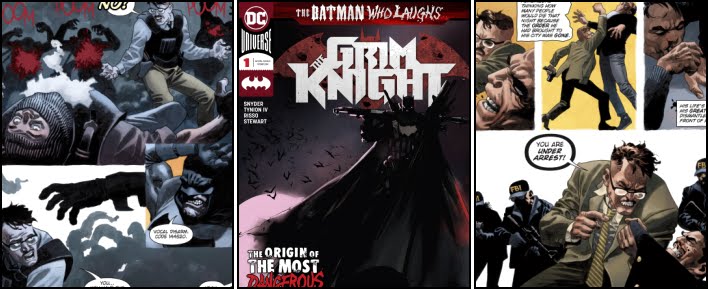
The Batman Who Laughs: The Grim Knight #1 - DC Comics

THE BATMAN WHO LAUGHS: THE GRIM KNIGHT #1, April 2019
Crowbarred into the middle of the publication schedule for “DC Comics” six-issue miniseries “The Batman Who Laughs”, and reading like one of the Burbank-based publisher’s “Elseworlds” imprint stories, James Tynion IV and Scott Snyder’s “origin of the most dangerous Dark Knight of them all” is a terrific tale of a well-meaning person’s best intentions going horribly wrong once a distraught young boy crosses a deadly line and cold-bloodedly guns down Joe Chill immediately after the incompetent robber has murdered the lad’s parents right in front of his tear-stained eyes; “Shut up! Shut up and die.”

Of course, to begin with a Gotham City containing a billionaire like Bruce Wayne who is willing to shoot all of the metropolis’ most vilest villains dead, sounds like a recipe for its citizens to enjoy long, peaceful, prosperous and happy lives, especially when the “Angel of Death” dispatches all of the crime bosses like Falcone and Zucco, so subsequently “never faced the kind of colourful enemies the Batman of other worlds did.” But things swiftly deteriorate as the morose Caped Crusader simply decides “to start using lethal force indiscriminately to win” even against the metropolis’ Police Department, and in doing so additionally wipes out every inhabitant of both Blackgate and Arkham Asylum using “the finest arsenal Wayne money can buy”.

Faced with a Jim Gordon who is unwilling to stand by and watch his beloved municipal fall under the sway of a “globe-trotting… chief executive officer of a tech and weapons company”, Snyder’s “second-deadliest Batman” degenerates even further, to the point where he forcibly controls his own butler, Alfred Pennyworth, courtesy of an explosive device implanted in the old man’s neck, and seemingly executes any citizen spotted misbehaving via a death-dealing Wayne Enterprises satellite. Such a formidably determined dictator truly is the stuff of nightmares, and is so prodigiously penned, that it is easy to see just why the Eagle Award-winner was apprehensive about bringing this one-shot’s titular character in for “Dark Nights Metal” due to his worry that “the other evil Batman would pale in comparison to him.”

Interestingly, Eduardo Risso’s artwork also adds an extra element to the unsettling nature of this comic’s atmosphere by providing a mixture of pencilled and contrastingly painted panels throughout its twenty-eight pages. This decision to differentiate between the cold, calculating abduction of the police commissioner in the ‘real world’, with that of the Grim Knight’s much more colourful journey towards becoming a blood-drenched despot in his own reality, really does help emphasise the deeply-troubled anti-hero’s emotional state, especially towards the book’s conclusion when it seems clear Snyder’s creation has decided to kill Gordon having just relived his own defeat at the hands of an alternative version of the morally-strong moustached lawman.
The regular cover art of "THE BATMAN WHO LAUGHS: THE GRIM KNIGHT" No. 1 by Jock