Showing posts with label Black Terror. Show all posts

Tuesday, 10 March 2020

Black Terror #5 - Dynamite Entertainment

BLACK TERROR No. 5, February 2020
There can surely be little doubt that Max Bemis’ penmanship for Issue Five of “Black Terror” will unquestionably catch a few fans of Richard E. Hughes’ co-creation completely off-guard, whether they were anticipating a somewhat hostile reaction to the pharmicist's long-overdue visit to his beloved “slip up”, Myrna, or Robby’s evident anger at a seventy-four year-old Bob Benton finally coming to see him having ignored his ‘cloned’ son for most of the heavily bearded, drug-taking deadbeat’s life; “When you despise everything around you, near-invulnerability ain’t no blessing. Thanks, Pops.” In addition, this twenty-two page periodical packs a conclusion which is not only shockingly sad in the extreme, but will irrefutably cause those who witness it to yearn for the far less emotionally complicated days of the Golden Age of Comics…

To begin with however, the New Yorker’s narrative commences with a fairly bog-standard scene depicting “the cosmonaut unaged” returning “to find the love of his life withering away” as a white-haired spinster living in a somewhat unremarkable abode. Romantically stage-managed, with artist Ruairi Coleman imbuing the titular character with all the innocent-faced, sweet-smiling charm of a bespectacled Clark Kent, this tenderly-pencilled introduction provides the tale with so totally disarming an opening, that it isn’t until the female science fiction novelist suddenly offloads upon her former lover with decades of pent-up angst that it becomes clear the American author is actually going to take his audience on quite the poignant passage.

Benton’s interaction with his petulant offspring is similarly infused with impassioned speeches concerning the unfairness of life and a modicum of physical conflict. Yet whereas Bob’s poor relationship with Myrna is clearly based upon the sense of betrayal the woman feels at being abandoned by the Black Terror’s alter-ego upon giving birth, the costumed vigilante’s connection to his son is swiftly revealed to be one of almost equals, where both men are constantly struggling with anxiety and depression on account of the losses they have suffered. This bond eventually leads to this comic’s fateful finale, as a world-weary war-veteran implores his super-powered spawn to take over his infamous crime-fighting mantle.

Such word-heavy, dialogue driven sequences doesn’t mean that this publication is entirely devoid of pulse-pounding pace though, as Bemis still somehow manages to crowbar in a fantastically ultra-violent flashback sequence into the mix. In fact, Doctor Disgusting’s bizarre experimentation upon his nemesis’ reproductive system, and the Nazi scientist’s subsequent horribly drawn-out demise in a laboratory fire, would undeniably have been the highlight of this tale if not for this book’s final page…
The regular cover art of "BLACK TERROR" No. 5 by Rahzzah

Wednesday, 5 February 2020

Black Terror #4 - Dynamite Entertainment

BLACK TERROR No. 4, January 2020
Firmly fixated upon the horrors of the Second Indochina War and the savage barbarity of American Sergeant Gary Greeley, Max Bemis’ script for Issue Four of “Black Terror” arguably provided something of a unique take on the conflict’s brutal repercussions for any surviving Vietnam era veteran. Indeed, the twenty-three page periodical’s plot arguably even manages to generate some considerable sympathy for the villainous Bad Groove, by gratuitously depicting just what wartime experiences made the star-shaped glasses-wearing druggie into the one-handed, sabre-carrying hoodlum Bob Benton dramatically beats up; “I won’t be attending prison again, sir.”

For starters, it’s clear that the Armed Forces never gave “Dumps” much of a fighting chance whilst he was in training, thanks solely to the prejudices of Greeley, and his insane delight in repeatedly abusing the soldier verbally. Thick-jawed and heavily-boned, the Sergeant is portrayed as a stereotypical bully in every respect, yet it isn’t until after Groove has been badly maimed in a frightening Viet Cong ambush that a chortling Gary sinks to his darkest depths by simply leaving the badly maimed “outcast” to the enemy so they can “make him hurt” all the more.

This tortuous affair clearly sets up the heavily-moustached Groove upon his life as a highly colourful criminal, and resultantly it is with genuine compassion that, having experienced his foe’s past courtesy of a drug-fuelled flashback, Black Terror tenderly touches the back of the man’s head after the crook has slit his own throat in a last, desperate attempt to evade incarceration. Delightfully, “Dumps” demise doesn’t however bring this publication to so demoralising an end, but instead leads Benton on a quest to confront a now wheelchair-bound Greely in the non-commissioned ranked soldier’s Tampa-based retirement bungalow.

The unexpected consequences of this meeting, especially following Bob’s green-coloured vomit somehow ‘infecting’ the slovenly oldster with Groove’s traumatising memories, provides artist Ruairi Coleman with an opportunity to pencil easily one of the most gruesomely shocking demises this book’s bibliophiles could probably imagine. The Northern Irishman's sketch of a quietly whistling invalid calmly 'wheeling' himself up to the swamp’s edge so as to await the ghastly fate he has apparently decided upon to “make it up to you, Dumps…” is packed full of pathos, and splendidly contrasts with the Florida alligator viciously disembowelling Gary in a disconcerting display of intestines soon afterwards.
The regular cover art of "BLACK TERROR" No. 4 by Rahzzah

Monday, 3 February 2020

Black Terror #3 - Dynamite Entertainment

BLACK TERROR No. 3, December 2019
Readers expecting Max Bemis to continue adding to the mythology of this series' “semi-tortured brutal vigilante” were probably a bit surprised with his narrative for Issue Three of “Black Terror”, considering it almost exclusively focuses upon the titular character’s “trusted sidekick Tim” rather than Bob Benton's alter-ego. But having gotten over that initial surprise, and the somewhat ludicrous premise that owing to a magical urn, the boy was “born with the memories of a life” he hadn’t actually lived yet, many bibliophiles probably gleaned a fair amount of enjoyment from the gratuitous violence on show within its twenty-one pages.

Indeed, it’s hard to imagine a more grisly-looking series of set-pieces than those pencilled by Ruairi Coleman in this book, thanks to the Northern Irishman’s ability to depict a group of non-powered kids being horribly mutilated by the Young Deadlies, and a pride of flesh-hungry lions later being let loose upon the villain’s secret hideout in an “exotic, creepy locale!” Such scenes really do ‘spell out’ the sheer sadism of the “original” sidekick’s ultra-violent surroundings, where the former “Nazi scum” basher now seemingly spends his time betting on illegal dice games in dingy alleyways or supplying informants with a “big bag of marijuana” in exchange for them “supplying us with information.”

Sadly however, what the “primary lyricist of the band Say Anything” also depicts with his writing is how unlikeable Tim Roland can be, especially once he lives beyond the point where “Pandora’s Urn should have shown up… and rebooted everything.” Now aged thirty-five, “but still looks like a Nineties-era Culkin”, the younger half of the “Terror Twins” genuinely seems to enjoy the decadent savagery of the world around him, and could arguably even be held indirectly responsible for Moonboy having his throat slit and Ms. Mystery being disembowelled by the likes of Princess Murder, Hollow Tip, Spell Slinger, Sapling and the weird-smelling Kid Tricklin’.

Mercifully, Bemis has been “blessed” to have the aforementioned Coleman illustrate this periodical, and as a result the vast majority of its macabre contents are a treat for the eyes of the non-squeamish. In fact, in many ways it is a pity that the comic’s narrative doesn’t feature more flashbacks to Tim’s origin and subsequent battles with the Third Reich, as its clear the artist has a real penchant for panels populated with jaw-breaking punches; “I love it! Powers! Again! Finally!”
The regular cover art of "BLACK TERROR" No. 3 by Rahzzah

Thursday, 30 January 2020

Black Terror #2 - Dynamite Entertainment

BLACK TERROR No. 2, November 2019
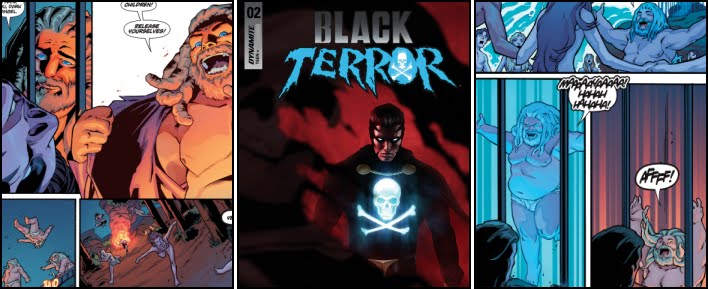
It’s a real shame that Issue Two of “Black Terror” was only the three hundred and twenty-seventh best-selling comic of November 2019, for as an examination into just “how Golden Age ideals came up against such a morally ambiguous, crazy time” such as the Seventies goes, Max Bemis’ narrative involving “a young woman… in the midst of a cult” proves a rather surprisingly compelling read. In fact, considering the blockbuster ending to this series’ previous instalment, which saw the titular character busting out of a diner so as to face a squad of heavily-armed goons, a somewhat sedentary story set in the wilderness and crammed full of super-powered “Hippies” was probably the last thing many of this book’s 3,329 bibliophiles thought they’d be perusing.

Happily though, this seemingly ‘standalone’ script soon scoops up any doubts with the intriguing premise that the rather portly Father Kind can somehow harness Bob Benton’s tremendous abilities and project them upon his long-haired companions. In addition, this magical feat, which at times seems a little similar to the final harrowing scene of Robin Hardy’s 1973 British horror film “The Wicker Man”, is witnessed through the eyes of non-believer Christina, whose douche of a (new) boyfriend only manages to convince her of their newly-acquired traits by punching the woman into a nearby solid-looking tree; “Now, are you gonna just lie there like a lump, or sweat out those emotional toxins with me?”

The “primary lyricist of the band Say Anything” also does a splendid job of making this tale’s lead antagonist quite believable, courtesy of the self-confessed crook providing his ‘family’ with a little background during his opening eulogy, and then later revealing his significantly darker side when he threatens Christina for going near the Black Terror’s cell. These scenes really imbue the rotund, white-bearded Santa Claus-like figure with plenty of hidden menace, and as a result it comes as no great shock when the true, despicable source of his siphoning power is unveiled in a side tent.

Ruairi Coleman’s visually impressive contribution to this twenty-two page periodical cannot debatably be understated either, with the Northern Irish artist’s wonderfully clean-lined storyboards giving the action a rather jolly, bouncy feel which is both energetic and attractive to the eye. This pencilling style works especially well for Father Kind’s scenes, as well as those of the numerous hippies taking full advantage of the superhuman powers with which they have been temporarily blessed, and it’s a pity the book ends before we get to see what revenge Benton is going to bestow upon his former captor…
The regular cover art of "BLACK TERROR" No. 2 by Rahzzah

Friday, 4 October 2019

Black Terror #1 - Dynamite Entertainment

BLACK TERROR No. 1, October 2019
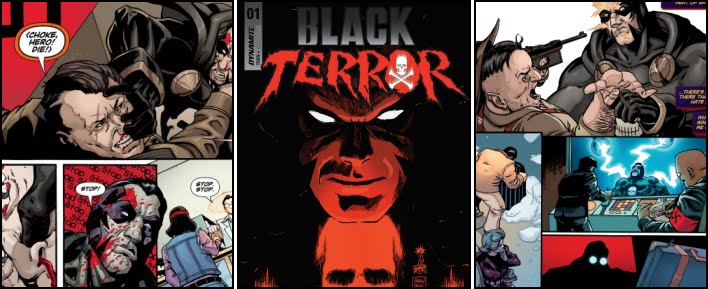
Described by “Dynamite Entertainment” in its August 2019 comic book solicitations as “a ride through the life of a superhero and all the weirdness along the way”, Max Bemis’ plot for Issue One of “Black Terror” definitely takes its readers on a disconcertingly downward journey into the nightmarish world of a costumed vigilante suffering the severe effects of post-traumatic stress disorder. Indeed, for the vast majority of this publication it seems likely that at any moment the “all sweaty” Bob Benton is going to cast aside “his boring life of being a pharmacist” and suddenly re-enact one of the grisly World War Two horrors he faced upon some hapless customer innocently attending his Chicago chemist store; “Uh, Bob? Bob. It’s okay, Sir. He’s had a long shift.”

Fortunately however, the New Yorker’s narrative isn’t simply limited to a carousel of uncontrollable thoughts concerning the Golden Age protagonist’s past battles against goose-stepping goons, swashbuckling femme fatales and swastika-wearing megalomaniacs, courtesy of the titular character’s chance encounter with a seemingly innocuous shoplifter. Benton’s gruesome discovery as to the softly-spoken man’s true criminal calling genuinely provides this twenty-page periodical with a drop-dropping moment, and imbues the rest of the comic with some much-needed pizzazz.

In fact, no sooner has Bob once again donned the skull and crossbones costume of his super-powered alter-ego, than the entire book’s somewhat pedestrian premise is turned upon its head, following the revelation that the anxious apothecary has actually been busy all this time being babysat by the grand-daughter of his arch-nemesis Black Satan. This shocking revelation hardly transforms Bemis’ script into the “Alan Moore take on the Project Superpowers universe” which the American author rather conceitedly suggested it does to the “Bleeding Cool” website, but it should definitely reignite the interest of any within the comic’s audience who were finding themselves wilting under his penmanship’s depressive, dialogue-driven storytelling.

By far the more consistent contributor to this magazine’s success is artist Matt Gaudio, whose prodigious pencilling does a splendid job of depicting the subtle differences between the stubble-faced, spectacle-wearing Benton and the savagely brutal war veteran originally created by Richard E. Hughes and Don Gabrielson way back in 1941. Noticeably well-muscled whether he is wearing a white laboratory coat or a jet black cape, the Kubert School graduate still manages to provide Benton with two vastly contrasting personalities dependent upon whether the hero is dejectedly going about his boring day-to-day routines or manically slapping a villain about the head at least a couple of time too often.
The regular cover art of "BLACK TERROR" No. 1 by Francesco Francavilla