Showing posts with label Civil War. Show all posts

Sunday, 18 August 2024

Civil War: The Confession #1 - Marvel Comics

CIVIL WAR: THE CONFESSION No. 1, May 2007
Considering that this twenty-two page periodical essentially just consists of some conversations between Iron Man and Captain America, it is arguably somewhat impressive that Issue One of “Civil War: The Confession” was the eighth best-selling comic book in March 2007 – at least according to “Diamond Comic Distributors”. Indeed, in principle Brian Bendis’ notion of two characters simply talking to one another about their motivations and beliefs for the entirety of a “Rated T+” one-shot debatably sounds rather uninspiringly dull, and certainly not the sort of publication which would sell a staggering 112,416 copies.

Happily however, such is the penmanship of this title that it succeeds in providing both a genuinely intriguing insight into what made Tony Stark battle against his long-time comrade-in-arms, and that the new Director of S.H.I.E.L.D. seemingly now regrets so zealous a stance following the Sentinel of Liberty’s subsequent assassination. These nagging doubts really are convincingly delivered, as Shell-head initially appears to be trying to once again justify himself to his ‘old friend’, before finally succumbing to the dread realisation that his support of the Superhuman Registration Act and all the horrendous sacrifices he made wasn’t in any way “worth it.”

With such a high bar set, the American author then deep-dives into the psyche of Steve Rogers, and presents a morally-right super-hero, who appears to pity his opponent when he realises Iron Man arrogantly believes he’s won simply because the First Avenger surrendered to the authorities. This contrast in perceptions is particularly well demonstrated when Captain America is first brought to his prison cell and a soldier instinctively still salutes him – as opposed to the reception Stan Lee’s victorious co-creation receives upon arriving on the S.H.I.E.L.D. Helicarrier; “Can you feel it out there? They don’t like me here and they don’t want me here.”

Adding a gritty realism to all these sedentary, yet still pretty intense proceedings, is Alex Maleev, who quite wonderfully shows the weight of Tony’s new world bearing down upon his ultimately unworthy shoulders. The leader of the United Nations Peacekeeping Task Force really looks like the one who has been defeated, whilst ‘Cap’ is pencilled with an evident and energetic chip still upon his broad shoulders. In fact, the World War Two veteran is shown to be the far more dynamic and physical of the two men, with Stark appearing soberingly crestfallen in his treacherous triumph.

Writer: Brian Michael Bendis, Artist: Alex Maleev, and Color Artist: Jose Villarrubia

Wednesday, 22 July 2020

What If? Civil War #1 - Marvel Comics

WHAT IF? CIVIL WAR No. 1, February 2008
Utilising a brief tale by Ed Brubaker entitled "The Stranger" as “a framing device around which the other two stories revolve”, Issue One of “What If? Civil War” probably helped the vast amount of its 58,909 readers in December 2007 appreciate just how wrong Tony Stark was to persecute his fellow heroes for not voluntarily submitting to the Superhuman Registration Act, as well as just how highly (and wrongly) Steve Rogers thought of his long-time friend before their differences arose. Indeed, Christos Gage’s plot for “What If Iron Man Lost The Civil War” lays the entire blame of the “Marvel Comics Event In Seven Parts” squarely upon Iron Man’s armoured shoulders for blatantly lying to the Sentinel of Liberty regarding his “plans for my twenty-first century overhaul.”

Admittedly, this particular eighteen-page epic undoubtedly lacks a lot of the emotional response Mark Millar’s mini-series generated, courtesy of a sugary-sweet plot which sees Cap team-up with an “honest” Shellhead so as to overcome a homicidal Thor cybernetic clone. But what it does provide is perhaps the only sensible solution to the super-powered pairs’ dilemma of just one government or person ultimately being responsible for both the training and secret identities of every costumed crime-fighter in the United States; “It’s not enough to be against something. You have to be for something better.”

Slightly more action-packed is “What If Captain America Led All The Heroes Against Registration?” by Kevin Grevioux, which manages to recreate much of the anger and resentment generated by the original 2006 crossover storyline. With Stark already dead following an Extremis injection, this marvellous reimagining unashamedly pits Steve Rogers and most of the Marvel Universe directly against the Senate and S.H.I.E.L.D. in a battle which somewhat resembles that seen in the “X-Men” comic book narrative "Days of Future Past".

Crammed full of pulse-pounding punch-ups against the impassive Sentinels, and the death of the spectacular Spider-Man, this dynamically pencilled fight-fest sets up Henry Gyrich and Maria Hill as two of the most despicably treacherous characters to inhabit a publication, with the deputy director’s cold-blooded murder of Jim Rhodes and subsequent framing of a dead Captain America proving particularly unforgivable. Indeed, such is the utter loathing engendered by Gyrich in his journey to become President and the despicable Hill’s ambition to be carried along on his coat-tails, that in many ways it is a shame this well-penned conspiracy from an alternative universe wasn’t awarded a limited series or ongoing title of its own.
Written by: Ed Brubaker, Kevin Grevioux & Christos Gage, and Art by: Marko Djurdjevic, Gustavo and Harvey Tolibao

Monday, 20 July 2020

Civil War #7 - Marvel Comics

CIVIL WAR No. 7, January 2007
Having read Mark Millar’s narrative for Issue Seven of “Civil War” it is arguably easy to see just why this comic book mini-series “polarized critics but… was a commercial success.” For whilst some within this publication’s 265,886-strong audience were undoubtedly rooting for Tony Stark’s mishmash of government sanctioned superheroes and supposedly reformed members of the Masters of Evil, those applauding Captain America’s defiance of the Superhuman Registration Act were probably left utterly disillusioned as to just what the Sentinel of Liberty was trying to achieve with his defiance.

True, Steve Rogers’ apparent obsession to knock the seven bells out of his armoured former friend for imprisoning so many of their team-mates inside the Negative Zone does cause the First Avenger to inadvertently wage an incredibly destructive war upon the very civilian population which he thought he was protecting. Yet, it’s difficult to imagine being bundled to the ground by a handful of emergency service operatives would shake the World War Two veteran so badly that he’d instantly remove his famous winged cowl and allow the authorities to place him in handcuffs; “Oh my god. They’re right. We’re not fighting for the people anymore, Falcon… Look at us. We’re just fighting.”

Similarly as disconcerting is this twenty-eight page periodical’s aftermath, which somehow tries to sweep all the damage and death caused by the Pro-Registration faction’s determination to incarcerate anyone who disagreed with their viewpoint, right under the rug simply because the likes of Mister Fantastic “cried for a full ninety-three minutes” upon seeing his estranged wife using her invisible powers to help with the clean-up. Reed Richards was so convinced that he was 'fighting the good fight' that he became partially responsible for the cold-blooded murder of Bill Foster. However, rather than be held accountable for such dishonourable actions, his experiments “on the whole” are apparently deemed “an enormous success” and Sue incredibly returns to her husband's side within the space of just a fortnight.

Tony Stark too seems to suffer no ill-consequences for his disappointingly dark actions, and is actually rewarded by the President of the United States with the directorship of S.H.I.E.L.D. Such pay-offs for unforgivably allying themselves with the likes of Radioactive Man, Venom and a seriously-deranged Thor clone really are quite baffling, and although the so-called “radicalised” likes of Spider-Man, Doctor Strange and Power Man form an Underground Movement to continue their opposition, Millar’s extreme lack of consequences for so many of this event’s main players probably left something of a bad taste in many bibliophiles’ mouths.
Writer: Mark Millar, Penciler: Steve McNiven, and Inker: Dexter Vines

Wednesday, 15 July 2020

Civil War #6 - Marvel Comics

CIVIL WAR No. 6, December 2006
The best-selling title of January 2007, at least according to “Diamond Comic Distributors”, Issue Six of “Civil War” must have fairly surprised some of its 259,251 readers with its depiction of both lead antagonists dipping into the dark well of the criminally “insane” in order to achieve their goals. True, Captain America quickly realises his mistake in recruiting the Punisher to his cause once Frank Castle cold-bloodily guns down the Plunderer and Goldbug following the villainous pairs’ attempt to join the rebels. But before this moment of murderous clarity, Steve Rogers seemed fairly content to allow the vigilante to access the Baxter Building’s incredibly complex security system for him and retrieve “the plans on the Negative Zone prison”.

Mercifully though, the Sentinel of Liberty’s lack of judgement doesn’t prove too detrimental to his anti-registration side’s plans to attempt a rescue of their super-friends incarcerated by the American authorities, and even provides Mark Millar with an opportunity to demonstrate just how much in awe Castle apparently is of the living legend when the vicious vigilante refuses to defend himself against Rogers during their distinctly one-sided fist-fight; “Get him out of here! And throw his guns in the incinerator! I must have been out of my mind to give that animal a shot on this team!”

However, the same realisation, and subsequent rejection of ‘dealing with the devil’ cannot be found with the increasingly flawed shenanigans of Tony Stark, who actually appears proud to be leading a group of shadily-sanctioned operatives such as the Taskmaster, Radioactive Man, Bullseye, Elektra and Venom into battle against many of humanity’s most morally-righteous freedom fighters. Indeed, this twenty-two page periodical’s double-splash conclusion provides an abundantly clear difference between the two opposing theologies, with Captain America’s so-called unlawful resistance comprising of some of Stan Lee’s mightiest heroes, whilst Iron Man’s ‘holier than thou’ agents strongly resemble the despicable Masters Of Evil…

Somewhat disconcertingly, this particular instalment to the “Marvel Comics event in seven parts” also arguably shows some signs of the impact its print deadline was having upon Steve McNiven’s artwork. Everything looks great up until the point, towards the end of the book, when the Golden Avenger unleashes his ambush upon the rebels’ prison break, and then, presumably due to the sheer amount of figures suddenly ‘on screen’ the Canadian artist’s pencilling momentarily deteriorates before picking back up again for the magazine’s final few pages.
Writer: Mark Millar, Penciler: Steve McNiven, and Inker: Dexter Vines

Friday, 10 July 2020

Civil War #5 - Marvel Comics

CIVIL WAR No. 5, November 2006
Apparently delayed by two months “to accommodate artist Steve McNiven”, Mark Millar’s plot to Issue Five of “Civil War” arguably focused far more upon Tony Stark’s fast evaporating relationship with Peter Parker than it did with the larger implications of “Marvel Comics' event in seven parts”, and in doing so demonstrated to this mini-series’ 272,584 strong audience just how desperate the billionaire industrialist had become to win the fight. In fact, the Scottish author’s similarly unscrupulous portrayal of S.H.I.E.L.D. Commander Maria Hill makes it difficult to imagine that their literary counter-parts and comic book fans alike would ever like/trust the two so-called heroic characters ever again; “Guess that’s thirty-one pieces of silver you’ve got now, huh? Sleep well, Judas.”

Similarly as disturbing as the egotistical pair’s utter arrogance in believing that they are completely justified to pursue any avenue, no matter what the cost, in order to secure victory over Captain America’s so-called rebels, is the Coatbridge-born writer’s debatably demeaning portrayal of “little Peter Spider-Man” as a seemingly helpless victim of Iron Man’s Machiavellian manipulations. Having finally found the courage to challenge Stark’s utilisation of a cyborg killing machine cloned from Thor, Web-head’s personality is seemingly regressed back to the human mutate’s adolescent days in the Sixties, when the teenager is still developing both emotionally and physically.

Resultantly, the unbelievably experienced costumed crime-fighter appears to do little else but surprisingly panic in the face of his pursuers Jester and Jack O’Lantern. Indeed, despite the pulse-pounding nature of the subsequent action sequence, which sees the two ‘reformed’ super-villains batter the wall-crawler into semi-unconsciousness with an exploding toy and a whiff of pumpkin gas, Millar would have any perusing bibliophile believe that a pitiful Parker’s alter-ego requires the help of the Punisher to defeat his two opponents, whilst the ordinarily hot-headed Johnny Storm is calmly shown serenely evading the entirety of S.H.I.E.L.D. Capekiller Team Nine and Eleven in the very next scene.

Happily however, despite this apparent ‘nerfing’ of Spider-Man’s super-abilities, this comic still provides plenty of sense-shattering entertainment on account of McNiven’s excellent pencilling. The aforementioned clash between the Web-slinger, Jester and Jack O’Lantern within the confines of a stinking underground sewer is superbly paced, with Stark’s colourfully-garbed recruits really socking it to the all-too vulnerable Parker within the space of a dozen beautifully illustrated panels.
Writer: Mark Millar, Penciler: Steve McNiven, and Inker: Dexter Vines

Thursday, 9 July 2020

Civil War #4 - Marvel Comics

CIVIL WAR No. 4, October 2006
Absolutely pulverising the sales of “DC Comics” most successful title of September 2006, “Justice League Of America”, by almost a hundred and thirty thousand copies, this fourth instalment to the “Civil War” mini-series by “Marvel Worldwide” certainly must have stunned its 272,547 audience with its brutal depiction of Iron Man seemingly going to almost any lengths in order to defeat his old comrade-in-arms, Captain America. Indeed, in many ways it’s hard to reconcile Mark Millar’s incarnation of the ‘win at all costs’ billionaire industrial with that of the Golden Avenger’s character during the Bronze Age of Comics…

Fortunately however, Tony Stark’s single-mindedness undeniably leads to some sensational confrontations within this twenty-two page periodical, most notably his patronisation of a badly-beaten Captain America, who despite his jaw “practically hanging off”, still has enough steel inside of him to stand up against the fully-armoured “pampered punk”. Utterly oblivious to all the pain and suffering his sonic attack is causing to all those super-heroes around him, the “mechanical engineer” genuinely seems to enjoy watching the Sentinel of Liberty suffer, and even goes far as to demean the “tough old bird” for “still getting up” when other people’s brains would have simply shutdown due to the sound waves.

Easily this publication’s most shocking moment though, has to be the horrific death of Goliath at the hands of a scarily-deranged Thor. This tragic moment is clearly the tipping point for some of Stark’s less convinced followers, such as Invisible Woman and Spider-Man. But also goes to show just how coldly calculating Iron Man has apparently always been when it is subsequently revealed that the murderous Thunder God is simply a cybernetic clone created from a strand of hair Tony covertly acquired from his furniture following “the first meeting of the Avengers.”

Ably enabling this comic to additionally be a visual tour-de-force are Steve McNiven’s layouts and Dexter Vines' inks, which really help imbue even the more sedentary scenes towards the back of the book, with plenty of emotional energy. Bill Foster’s killing is tremendously well-drawn, and the sheer horror upon all those who witness his dreadful demise is clearly etched in everyone’s facial expressions; “I thought you said you knew what you were doing, Tony. I thought we were doing this so no one else got hurt.”
Writer: Mark Millar, Penciler: Steve McNiven, and Inker: Dexter Vines

Tuesday, 7 July 2020

Civil War #3 - Marvel Comics

CIVIL WAR No. 3, October 2006
Perhaps due to Mark Millar possibly prevaricating a little too much as to just which side of the Superhuman Registration Act each (and every) leading character within the Marvel Universe was on, some of this twenty two page periodical’s 290,672 readers probably felt this book’s narrative was a little bit too sedentary for a crossover storyline focusing upon “the conflict between freedom and security.” However, such lethargy is arguably easily forgotten once Captain America’s team teleport to Geffen-Meyer Chemicals and discover that the emergency distress calls emanating from the petrochemical plant are actually a well thought-out ruse by Iron Man and his iniquitous cronies; “Get the hell out of here, boys! It’s a trap!”

Indeed, the confrontation at the abandoned division of Stark Industries between the two wildly diverging ideologies is debatably one of the mini-series’ highlights, with Steve Rogers’ side deciding to momentarily stand and fight for what they truly believe in, despite facing both overwhelming odds, as well as the sudden loss of both Cloak and Wiccan to some tranquiliser darts. Furthermore, the scene also quite shockingly shows just how deceitful the Golden Avenger has become in siding with the authorities, by additionally depicting Shellhead co-operating with known Masters Of Evil members Radioactive Man and Atlas, presumably because there aren’t enough powerful super-heroes to follow his orders..?

Of course, the best part to the Coatbridge-born writer’s plot is Captain America’s flurry of fisticuffs with his former friend, and the sheer savagery of the conflict once Tony has rerouted his armour’s primary power systems so as to put the billionaire industrialist back on his feet. Initially, it seems that the Sentinel of Liberty is ‘content’ simply to floor his opponent for taking “down two of my boys” with a couple of shield blows to the chops. But something clearly snaps within Stark’s mind at such an effrontery, and his subsequent ‘attack from the rear’ is so villainously vicious that Hercules clearly fears for Rogers’ life.

Packing this comic’s action-packed sequences with plenty of pulse-pounding vitality is Steve McNiven, whose pencilling of the aforementioned battle between Tony and Cap shows just how much physical damage a swing from Iron Man can cause, even when its connecting with the jawline of a human whose super-strength has been significantly enhanced by the super-soldier serum. In fact, even this book’s less exciting scenes, such as Miss Frost’s interview at Professor Xavier’s Mansion in Westchester, or Goliath’s disappointment at being given the false persona Rockwell Dodsworth, prove riveting reads on account of the Canadian artist’s awesome illustrations.
Writer: Mark Millar, Penciler: Steve McNiven, and Inker: Dexter Vines

Monday, 29 June 2020

Civil War #2 - Marvel Comics

CIVIL WAR No. 2, August 2006
Actually outselling its first issue following "reorders”, Mark Millar’s script for the second part to this “Marvel Comics” crossover storyline is arguably a little more sedentary in nature than its preceding edition, thanks largely to the Scottish author’s focus upon the reasoning behind just why the likes of Iron Man and Mister Fantastic position themselves in direct opposition to Captain America’s disapproving stance on the Superhuman Registration Act. In fact, many of this best-selling book’s 253,868 strong audience in June 2006 probably remember this publication more for its depiction of Spider-Man revealing “his secret identity as Peter Parker to the entire world, during a meeting at Congress” than for its notable action sequences involving a clearly out-gunned Eli Bradley, and Steve Roger’s outrageous rescue of the Young Avengers from right under the noses of a heavily-armed S.H.I.E.L.D. transportation unit.

However, just because this twenty-two page periodical doesn’t provide a plethora of pulse-pounding punch-ups doesn’t mean for a second that it isn’t a thoroughly riveting read, with Tony Stark and Reed Richards’ fanaticism as to them being wholly in the right proving one of this comic’s most mesmerising attributes. The Golden Avenger in particular is penned as being especially devious with those super-heroes closest to him, one minute earnestly promising his fellow team-mates She-Hulk and Tigra that Cap is entirely wrong in his opposition to the Government’s legislation, and then in the next confiding to Happy Hogan that he has some serious doubts as to whether he’s “doing the right thing here” when the act becomes law.

Such two-faced haughtiness really does grate upon the nerves, and ultimately seems to show the industrial tycoon as little more than a master manipulator, who even when he himself isn’t entirely convinced by his actions, is perfectly happy for the likes of an impressionable young Peter Parker to unmask himself before his entire rogues’ gallery, simply to help the egotistical Stark appear supremely confident in front of the world’s press; “See the Registration Act gives us a choice: We can continue the trend that Captain America advocates and have people with powers completely unchecked or super heroes can go legitimate and earn back a little public trust.”

Adding enormously to this comic’s success is Steve McNiven’s pencilling, which really does a first-rate job of physically showing the emotions running through this book’s considerably-sized cast. The Canadian’s ability to illustrate an increasingly doubtful Sue Richards’ body language as she sceptically listens to her husband manically wax lyrical about revolutionizing “every meta-human in America” is specifically well-drawn, with Invisible Woman’s concerns about Reed’s viewpoint being obvious in each and every panel.
Writer: Mark Millar, Penciler: Steve McNiven, and Inker: Dexter Vines

Tuesday, 23 June 2020

Civil War #1 - Marvel Comics

CIVIL WAR No. 1, July 2006
Shipping an impressive 260,700 copies in its first month, and thereby apparently just “missing the Twenty-First Century record held by July 2005’s All-Star Batman And Robin Issue One by a mere four hundred copies”, this opening instalment to Mark Millar’s “Marvel Comics Event in seven parts” must have thoroughly entertained the vast majority of its imposing audience with its emotive introduction of a Superhuman Registration Act in the United States. Indeed, it is arguably difficult to imagine a more polarising narrative than the one which the Lanarkshire-born writer brings to “Civil War”, as the likes of Tony Stark, Speedball and S.H.I.E.L.D.’s Acting Head demonstrate just the sort of egotistical arrogance and overconfidence in their warped viewpoint of the world that makes a reader want to wring the very life out of their literary characters.

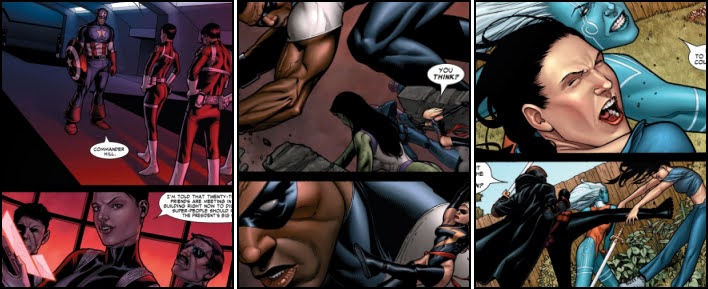
For starters Maria Hill’s portrayal in this thirty-three page periodical is as utterly mesmerising as it is despicable. Brilliantly pencilled by artist Steve McNiven wearing just the sort of supercilious sneer upon her face that one would expect from a long-time underling suddenly promoted to the top of her department, the trained agent makes it abundantly clear straight from the start of her awesomely tense confrontation with Captain America that she simply views him as a tool for her to use (and abuse) as she sees fit.

The fact that the Commander knew Steve Rogers’ strong moral compass would vehemently oppose the government’s viewpoint makes Nick Fury’s successor even more dislikeable, as the woman is clearly looking for any excuse to start persecuting non-compliant super-heroes, and blatantly provokes the First Avenger into a fight by threatening to tranquilise him on the spot if he doesn’t comply with her demands; “Weapons down or I will not be responsible for what comes next -- This is insane! Completely insane! Damn you to Hell for this, Hill…”

Similarly as sensitive is Millar’s handling of Robert Baldwin’s alter-ego, who quickly gets ‘under the skin’ with his utter conceit and desire to grab record-breaking viewing figures for the televised second season of the “New Warriors”. Admittedly, the more generous-hearted bibliophiles who hold a soft spot for Steve Ditko’s co-creation might put down some of this haughtiness to the rookie hero’s inexperience. But it’s hard to pity a crime-fighter who is more worried about the skin complexion of a co-star than he is for the welfare of innocent bystanders when the costumed vigilante is about to tackle a villain who “almost took down the Hulk.”
Writer: Mark Millar, Penciler: Steve McNiven, and Inker: Dexter Vines

Thursday, 26 May 2016

Free Comic Book Day 2016 (Civil War II) #1 - Marvel Comics

FREE COMIC BOOK DAY 2016 (CIVIL WAR II) No. 1, May 2016
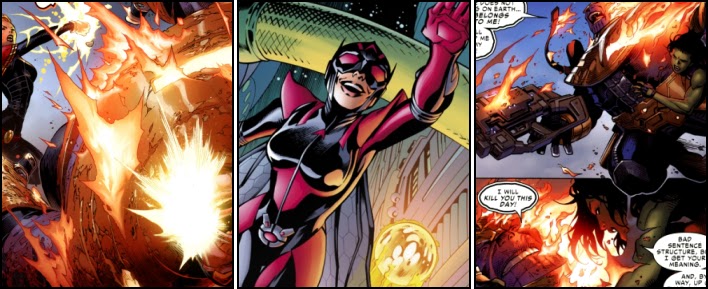
Despite the brevity of Brian Michael Bendis’ actual narrative, this “opening salvo of Civil War II” must surely have whetted the appetites of “Marvel Worldwide” fans everywhere with its utterly outrageous action-packed plot concerning War Machine, She-Hulk and Captain Marvel literally going toe-to-toe with Thanos in a desperate bid to prevent the Titanian Eternal from acquiring the Cosmic Cube. The Free Comic Book Day ‘exclusive’ certainly lives up to its pre-publication hype of being a magazine “no fan can afford to miss out on” and it’s extremely doubtful many of its readers didn’t immediately hunger for the crossover storyline's official opening issue in order to ascertain just how badly hurt Jennifer Walters and James Rhodes actually were having been badly battered during their short-lived confrontation with “The Mad Titan”. Little wonder the New-York based publishers were so “proud to officially peel back the curtain on…” their summer 2016 blockbuster multi-title event and let people “get their very first taste of the ensuing war…”

Indeed within the space of just eleven pages the five-time Eisner Award-winner’s short story not only provides plenty of exposition as to the Inhuman behind “the escalating conflict” and their seemingly formidable precognitive ability. But additionally mixes some rarely seen emotional tenderness in with the terrifically entertaining carnage of The Avatar of Death’s attack upon Project P.E.G.A.S.U.S.; “The Cosmic Cube does not belong on Earth… It belongs to me! You will not keep me from my prize!”

Fortunately Jim Cheung’s stunningly detailed artwork is precisely the sort of quality pencilling needed to depict this “snapshot of the conflict that will split the Marvel Universe in two!” The British illustrator does a superb job of making Captain Marvel’s deep-felt affection for War Machine abundantly evident in her facial expressions. Whilst his drawing ability equally excels in representing the ferocious power Thanos can wield with a single-punch and the impact such a devastating blow can cause a mortal man; albeit it one who wears a Variable Threat Response Battle Suit.    

Issue One of “Free Comic Book Day Civil War II” is also noteworthy for containing “a special secondary story from All-New, All-Different Avengers writer Mark Waid and legendary artist Alan Davis.” Debuting the “sting” of Nadia’s Wasp, this brief introductory tale makes it tantalisingly unclear as to whether the “mysterious new character” is actually “friend or foe” by portraying the teenager successfully invading the internal workings of the Vision.
Writer: Brian Michael Bendis, Penciler: Jim Cheung, and Inker: John Dell

Monday, 11 January 2016

Civil War #1 - Marvel Comics

CIVIL WAR No. 1, September 2015
Based upon the premise that “the events of the 2006-2007 Civil War series never ended” this rather perplexing ‘alternate-universe’ portrayal of a “Marvel Universe” firmly divided between supporters of Captain America and Iron Man makes for a tense if not entirely enthralling read, and somewhat justifies its 'shifting' of 170,546 copies in order to become the third best-selling comic book of July 2015. Indeed, for all its absurdities, such as the United States of America being “shattered… down the middle” into the territories of Steve Rogers’ The Blue and Tony Stark’s The Iron, Charles Soule’s narrative swiftly acquires a tense edginess to it as the plot moves towards the two former Avengers meeting one another to ‘talk’ after years of hostility and “bloody conflict”.

Admittedly the Brooklyn-born writer’s attempt to make neither side the ‘baddie’ of this book isn’t particularly successful, nor does such a concept willingly lend itself to the New Yorker plotting a credible chronicle of events which caused a need for the heroes' ‘historic gathering’ in the first place. It’s certainly hard to believe that “Iron Man rigged the entire [Project 42] prison with a self-destruct” and then activated it so as to destroy “Cap and the rest”. Especially when during the fighting a battered Commander Hill informs Stark that T’Challa had actually “hacked into the prison’s security systems” and “activated the self-destruct… on Captain America’s orders.” Why would the Sentinel of Liberty, billionaire inventor or Black Panther willingly consign “fifteen million other people” to so ghastly a fate..?

Perhaps inevitably Soule’s writing does ultimately lean towards favouring one side of the dispute with his depiction of life within The Iron appearing far more militaristic, unforgiving and aggressive than Shield-slinger’s more compassionate Western America, where “most lived in peace and happiness.” In fact the “shock and awe” approach of Stark’s “asserted order” agents when they discover “a kid” flying for the first time, coupled with the playboy’s antagonistic demands for a portion of The Blue’s land because “The Iron’s population is growing...” and Miriam Sharpe's assassin actually having been aiming at Steve Rogers, makes it very hard to sympathise with Shellhead's side.

Sadly Leinil Francis Yu’s artwork for so serious a mini-series’ script is something of a major disappointment. The Filipino comic book artist, “who began working for the American market through Wildstorm Productions”, clearly has a very distinctive style which can imbue his figures with impressive life and vitality. But whilst such an ability arguably works on the full-page illustration of Captain America, Spider-Man, Storm and Daredevil battling Iron Man, Doc Samson and others, the technique's evident sketchiness regrettably makes the pencilling appear rushed and hurried when used to depict the story’s more sedentary panels. An arguable flaw which is particularly pronounced and noticeable when the characters are drawn against a blank one-dimensional background.
The regular cover art of "CIVIL WAR" No. 1 by Lenil Francis Yu & Sunny Gho