Showing posts with label S.H.I.E.L.D.. Show all posts

Saturday, 28 January 2017

Captain America: Steve Rogers #4 - Marvel Comics

CAPTAIN AMERICA: STEVE ROGERS No. 4, October 2016
Advertised by “Marvel Worldwide” as a “Civil War II Tie-In” within which “Steve attempts to broker a truce between Iron Man and Captain Marvel”, and featuring a similarly-themed cover illustration by Aaron Kuder and Tamra Bonvillain, Nick Spencer’s script for Issue Four of “Captain America: Steve Rogers” must have had its 49,559-strong audience scratching their collective heads in utter bemusement. For whilst the former politician’s narrative briefly touches upon the publisher’s “crossover storyline” by way of Cappy informing Doctor Erik Selvig that Thanos is currently searching for the Cosmic Cube, the thirty-page periodical contains no mention of Tony Stark’s alter ego, or his super-powered feud with Carol Danvers.

Instead, the American author pens a choppy mess of superficially disparate scenes involving S.H.IE.L.D. Director Hill and Everett Ross, a Senate Intelligence Committee Hearing, Jack Flag’s sick bed inside a S.H.I.E.L.D. medical bay, Scarecrow and sheriff Taskmasker’s examination of Captain America’s crashed ship in Bagalia, the Thunderbolts thwarting “a whole alien army” headed for Earth, Wendell mentoring a floundering new Quasar and an infant Steve Rogers witnessing the cold-blooded murder of his mother by HYDRA agents. None of which actually help move this title’s overarching story-line noticeably forward on account of them all lasting little more than a handful of panels…

One such ‘flashback’ sequence that does make a lasting impression however, is Spencer’s graphic depiction of the titular character’s ‘securement’ of Selvig’s laboratory. Constructed by the Red Ghost and protected by his Apes, the supposed Sentinel of Liberty bloodily bludgeons its primate occupants to death with the pointed edge of his shield, and then causes a fleeing Ivan Kragoff to have one of his arms and legs severed at the joint; “Hhh-- Hh-- My leg-- My arm-- What have you done?” Disconcertingly though, Cappy isn’t finished with the Soviet scientist, and having casually dragged his mutilated body across to a control panel in order for the machinery to scan the villain’s one good hand, cold-bloodily dispatches the kneeling man in the self-same gory manner as he did his “children.”  

Equally as inconsistent as the haphazard storytelling, is this over-sized comic’s artwork. Dually drawn by Javier Pina and Miguel Sepulveda, presumably due to the book’s high page count, some scenes are remarkably well illustrated, such as those which take place in the Lower East Side of Manhattan in 1926, and the Red Ghost’s laboratory. Whilst others, like S.H.I.E.L.D.’s preliminary meeting with Hill or Taskmaster’s exploration in Bagalia, are far less successfully pencilled.
Writer: Nick Spencer, and Penciler: Javier Pina & Miguel Sepulveda

Thursday, 18 August 2016

Captain America: Steve Rogers #3 - Marvel Comics

CAPTAIN AMERICA: STEVE ROGERS No. 3, September 2016
Disconcertingly focussing upon a mission debrief between a kneeling, bare-chested titular character and his holographic master, the Red Skull, it is genuinely hard not to see the narrative for Issue Three of “Captain America: Steve Rogers” as yet another attempt by “Marvel Worldwide” to ‘quickly backtrack’ on their “initial choice” that the Sentinel of Liberty has always been a Hydra agent. Indeed, considering Nick Spencer’s pre-publication interview with “Entertainment Weekly” in which he “unequivocally” stated that “this is not a clone, not an imposter, not mind control, not someone else acting through Steve. This really is Steve Rogers, Captain America himself”, the plot to this twenty-two periodical not only reinforces that the super-soldier was actually brainwashed “because he had false memories implanted by Kobrik, the sentient Cosmic Cube who became a girl.” But depicts the ‘sleeper agent’ actually fighting against his mental programming by disobeying the order to murder Doctor Erik Selvig, and seemingly having genuine feelings for S.H.I.E.L.D. Commander Sharon Carter; “You. Don’t. Ever. Touch. Her. Again!”   

Perhaps unsurprisingly, such ‘misdirection’ from the comic’s writer arguably proves somewhat detrimental to the smooth flow of its narrative, and whilst Nicky Fury’s old International Espionage Agency landing a ship in “a city primarily populated by super villains” certainly creates plenty of suspense and action, courtesy of both Crossfire and “Sheriff” Taskmasker taking umbrage at their sovereign island nation being “invaded by S.H.I.E.L.D.”, any such drama is completely overshadowed by the America author’s inconsistent and erratic portrayal of Rogers. In fact it’s genuinely hard to fathom out just what the World War Two veteran is going to do from one panel to next, especially when he appears murderously determined to kill Jack Harrison, angrily incensed by Tony Masters stabbing Carter through her hand with his sword, and genuinely troubled by failing to “save the [Hydra] pawn in the train bombing” all within the same storyline.

Sadly Spencer’s solution to the trials and tribulations of this book’s supporting cast is just as ludicrous as his portrayal of Captain America’s mercurial behaviour. Surrounded and trapped within a country “ruled by criminals and populated by the Masters Of Evil”, and clearly outnumbered a hundred to one, things do not look good for Sharon, Free Spirit and Rick Jones, even when the Sentinel of Liberty arrives at the last minute in order to dissuade Taskmaster from skewering his beloved. Yet “the most hated man in America today” would have his audience believe that by simply threatening to “empty every last (casino) account” on the Bagalia Strip, “all (the) bad guys” would just stop “finally getting back at that mean old Captain America --”? As the S.H.I.E.L.D. Commander herself states “that is the stupidest plan I have ever heard.”  
The variant cover art of "CAPTAIN AMERICA: STEVE ROGERS" No. 3 by Joe Madureira

Thursday, 11 August 2016

Howling Commandos Of S.H.I.E.L.D. #6 - Marvel Comics

HOWLING COMMANDOS OF S.H.I.E.L.D. No. 6, May 2016
As swansong editions go, especially those based upon the exploits of a (field) team of super-heroes, Frank J. Barbiere’s narrative for Issue Six of “Howling Commandos Of S.H.I.E.L.D.” is frustratingly far more focussed upon the exploits of missing member Orrgo than the other nine “ragtag group of monsters”. Indeed, the script for the twenty-page action-packed periodical is so obsessed with the thirty foot tall extra-terrestrial “space god” that its terribly abrupt finish unexpectedly arrives just as team leader Dum Dum Duggan is contemplating his squad ‘mouth-wateringly’ having to confront both the entirety of Pleasant Hill’s villainous escapees, as well all “the prisoners of S.T.A.K.E.” Doctor Kraye has recently released…

So infuriating a conclusion doubtless vexed many of this title’s 12,700 readers, particularly when its publishers had ‘forewarned’ both the public and presumably the book’s creative team of the series’ (stealth) cancellation as early as January 2016, by failing to include “the lowest selling Marvel All-New All-Different book of December” in its solicitation listings, and thus given its American author plenty of time to reconcile his story-arc’s numerous plot threads. Sadly however, such prudence simply isn’t evident in the former English teacher’s writing, with the choppy script sporadically leaping between Orrogo’s innermost desire to be accepted, and his team-mates’ impotent attack upon the young sentient Cosmic Cube, Kubik; “Orrgo has been many things… Been to many places… But what you did, it was not real. My real family… The Howling Commandos… Has come to me.”

Admittedly the contents of “Standoff” form an integral part of the “Marvel Comics” multi-title comic book event “Avenger: Standoff!”, and therefore by its very nature needs to leave plenty of sequences open to exploitation by other series, such as “Captain America: Sam Wilson”. But even so, one would have thought that Barbiere could have created a more satisfying conclusion to his magazine than a patronizing pretence in the letters page, “Going Commando”, thanking his “humble readers, for joining us on this adventure.”

Perhaps equally as disillusioned with the abolition of this “four-coloured battlefield”, Brent Schoonover’s inconsistent pencilling is arguably a far cry from the “talented” artwork his co-collaborator intimates he submits before each deadline. In fact, apart from a seemingly Jack Kirby-inspired double-splash depicting Orrogo first coming to Earth and being beaten up by a gigantic circus gorilla, as well as the Grey Gargoyle being bested by Teen Abomination, the Freelancer’s disappointing breakdowns appear lifelessly static and inanimately wooden at best…
Writer: Frank J. Barbiere, Art: Brent Schoonover, and Color Art: Nick Filardi

Wednesday, 10 August 2016

Captain America: Steve Rogers #2 - Marvel Comics

CAPTAIN AMERICA: STEVE ROGERS No. 2, August 2016
Whilst a meteoric drop in sales and numerous death threats via social media were undoubtedly not influential upon the narrative for Issue Two of “Captain America: Steve Rogers”, arguably the vast majority of this book’s 66,416 strong audience must surely have felt that Nick Spencer’s storyline concerning the sentient Cosmic Cube Kobik being responsible for recently transforming the titular character into an agent of Hydra, something of a dramatic U-turn as to what the former politician was postulating before its publication. Indeed, the very presence of the one-time cube-shaped entity, a character who according to the “Marvel Database” didn’t make her first full appearance until April 2016, makes much of the “Superior Foes of Spider-Man” writer’s rhetoric concerning the star-spangled symbol of mortality always being one of the Marvel Universe’s “most insidious villains” rather questionable; especially when “the most hated man in America” has openly admitted he “designed” his ‘outrageous’ storyline simply to “upset people and shock people and worry people.”

Concerns as to just how long (or even real) Steve Rogers’ allegiance to the secret criminal organisation are aside however, this twenty-page periodical’s script seems horrifically contrived at best considering that it is based upon the premise that of all the people who the naïve child-like cube-fragmented form could turn to and befriend, she chooses the Sentinel of Liberty’s greatest adversary, the Red Skull. It certainly seems a convolutedly convenient way for Johann Schmidt to suddenly obtain the power to reimagine the entity’s handler, Doctor Erik Selvig and readily recruit him to “immortal Hydra!”; “My entire life I have served your cause. I have worked tirelessly to promote your vision. A more perfect world -- through Hydra!"

Disconcertingly, Spencer’s script doesn’t unfortunately stop there either, and proves increasingly illogical by having the one-time “confidant of Adolf Hitler” manufacture the entire prisoner breakout from S.H.I.E.L.D.’s heavily-disguised Pleasant Hill super-villain incarceration centre, simply to manipulate Kobik into rejuvenating the elderly Cappy before Brock Rumlow beats him to death with his own shield. Bizarrely, so overly-complicated a plot thread even apparently requires the facially disfigured war-criminal to don the apparel of an aging “compassionate” church minister in order to ensure the First Avenger isn’t bested by the likes of Dirk Garthwaite and his Wrecking Crew before he faces Crossbones.

Considering just how dissatisfying this revelation as to the ‘Secret History of Steve Rogers” arguably is, Jesus Saiz's artwork throughout the comic at least proves a gratifying experience. Admittedly the book’s breakdowns are luckily devoid of any panels depicting Daniel Acuna’s unimaginative redesign of Wing-head’s modern-day costume. But that still leaves the Spanish artist needing to do an incredible job of imbuing characters such as the Red Skull and his daughter Sin, with plenty of energy and emotion, when the vast majority of the comic comprises of little more than sedentary, dialogue-heavy conversations.
The variant cover art of "CAPTAIN AMERICA: STEVE ROGERS" No. 2 by Mark Bagley

Monday, 1 August 2016

Captain America: Steve Rogers #1 - Marvel Comics

CAPTAIN AMERICA: STEVE ROGERS No. 1, July 2016
Selling an impressive 99,768 copies in May 2016, Issue One of “Captain America: Steve Rogers” caused so much controversy at the time of its publication with regards to its surprise ending, that even nonagenarian Stan Lee ‘weighed in’ on the “crazy” twist of the super-soldier being “a double agent” of Hydra whilst attending a MegaCon panel; “It’s a hell of a clever idea. I don’t know that I would ever have thought of it… But it’s going to make you curious, it’s going to make you want to read the books…” Sadly however, this thirty-page periodical never actually lives up to any of its hype, and whilst Editor Tom Brevoort’s assurance that the Sentinel of Liberty’s dual identity had “been in the works for more than a year” may have appeased some fans, there is actually very little within Nick Spencer’s disappointing narrative that makes any real sense.

For starters the comic’s rather straightforward central plot of the Avenger thwarting a terrorist attempt to hijack “a train scheduled for routine maintenance… and detonate an explosive device” lacks any real menace, as the star spangled S.H.I.E.L.D. operative beats his numerous poorly-armed opponents so easily that it only takes him eight panels to reach suicidal bomber Robbie Tomlin. Hardly thrill-a-minute stuff even for a “man out time” who is still “learning” to use his new shield, and Rogers subsequent confrontation with Baron Zemo’s New Masters (of Evil) doesn't provide much in the way of suspense either; especially as the laughable Plantman, Flying Tiger and Firebrand are soon all-too soundly thrashed by Cappy’s sidekicks Free Spirit and Jack Flag.

As a result of such deficiencies all that is arguably left to enjoy is the America author’s entertaining, though perturbingly nonsensical flashbacks to Steve’s childhood in 1926, when his drunken brute of a father is shockingly outfought by posh socialite Elisa Sinclair, and his mother wined and dined by the female Hydra recruitment officer. Such a “trail of breadcrumbs” in order to ensure “people will be able to connect the dots” seems rather contrivingly choreographed, especially for a “Marvel Worldwide” character whose origin story has already been (re)told so many times in the past.

Equally as disquieting as Spencer’s script is Jesus Saiz’s somewhat cartoonish-looking breakdowns. “Best known for his work on Manhunter and Brave And The Bold” the Spaniard’s audacious pencilling certainly gives the comic a high-quality, almost glossy appearance. Yet his technique of giving all his figures a thick black outline additionally makes the characters look a little comical, and certainly doesn’t suit the reimagined Sentinel of Liberty’s sleeker, more rubberised (head-wingless) costume.
The regular cover art of "CAPTAIN AMERICA: STEVE ROGERS" No. 1 by Jesus Saiz

Friday, 22 July 2016

The Amazing Spider-Man [2015] #9 - Marvel Comics

THE AMAZING SPIDER-MAN No. 9, May 2016
Arguably best described as being reminiscent of an early Seventies copy of “Marvel Team-Up”, courtesy of a fast-paced, no frills opening which quickly sees its titular character and Nick Fury racing towards a “Zodiac hacked” orbital space platform on board the painfully-named “Arachno-Rocket!”, Issue Nine of “The Amazing Spider-Man” must surely have caused plenty of its 88,164 strong audience many a wry smile when first published in March 2016. For despite being a thoroughly entertaining twenty-page periodical that sees Peter Parker’s alter ego at his action-packed best as he helps the “agent of S.H.I.E.L.D.” trouble-shoot a number of Scorpio-controlled killer satellites, it’s hard not to feel that Dan Slott’s enjoyable script wouldn’t have better suited a protagonist like the Fantastic Four or Iron Man instead. Indeed the Diamond Gem Award-winner even makes light of the fact that his hero isn’t the Golden Avenger later in the book by having a worried Web-head, whose suit is rapidly breaking up as he re-enters Earth’s atmosphere, grimly state “H-h-hell, Iron Man d-d-does stuff like this all the t-t-time!”

The Wall-crawler’s access to all manner of state-of–the-art technology, whether it be a rocket ship, a spider-armoured space-suit, an emergency beacon or back spinnerets capable of deploying an all-encompassing ball of protective web-foam, also must have undoubtedly grated upon the subconscious of the long-suffering Spider-Man reader, especially as the Web-Spinner seems to demonstrate a contrivingly convenient amount of forethought in each device’s creation; “Impossible! This is Spider-Man we’re talking about. Not Thor!” It’s true that during the Berkeley-born writer’s tenure the former Daily Bugle photographer’s intellect has been continually re-emphasised to the point where Parker is the CEO of a “cutting edge” company which “has offices across the globe.” But even so “One Way Trip” still feels like something out of a Jim Steranko espionage-laden “Strange Tales” storyline than a narrative entirely in tune depicting the (mis)adventures of the friendly neighbourhood hero.

Slight misgivings as to Spidey’s use aside however, Slott’s opening instalment of the “Scorpio Rising” storyline is additionally engaging on account of it containing a succinct update as to Otto Octavius’ mechanical machinations within the “London Headquarters of Parker Industries.” Trapped inside the metallic mind of the robot servitor Living Brain, the super-villain spies Aiden Blain sharing an affectionate kiss with the criminal’s one-time fiancée Anna, and momentarily becomes enraged at the sight. Disappointingly Doctor Octopus' murderous electronically-voiced rant is cut all-too short by Spider-Man’s current plight. Yet such developmental teases as to a future confrontation between the costumed crime-fighter and his arch-nemesis provides some assurances as to the American author’s commitment to an over-arching narrative, and undoubtedly delivers an ample hook with which “Marvel Worldwide” could maintain this title’s impressively-sized readership.
Writer: Dan Slott, Artist: Giuseppe Camuncoli, and Inker: Cam Smith

Wednesday, 18 May 2016

Howling Commandos Of S.H.I.E.L.D. #5 - Marvel Comics

HOWLING COMMANDOS OF S.H.I.E.L.D. No. 5, April 2016
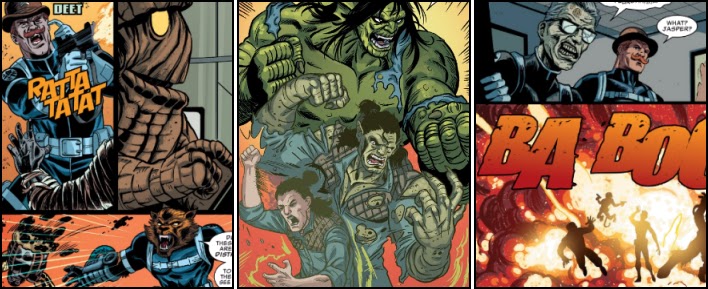
There can be little doubt that Frank J. Barbiere tried to bundle Issue Five of “Howling Commandos Of S.H.I.E.L.D.” with as much action-packed gunplay, fist-fights and magical mumbo jumbo as this twenty-page periodical could take. For whilst the Rutgers University graduate’s narrative still provides plenty of exposition regarding just who The Adversary is that has been causing the “elite black ops unit of monstrous agents” so many recent problems, as well as moments of character development such as Nadeen self-doubting her own suitability to become part of “Dum Dum” Duggan’s strike force. It does so against the dynamic backdrop of S.T.A.K.E.’s covert team defending the world against one of its “weird[est] and bizarre threats” as Anath-Na Mut storms New York City’s Grandview Museum with an assault-rifle carrying zombie army desperately searching for the Mask of Amenhotep.

Such a weird storyline must surely have bewildered this comic’s 12,281 regulars, let alone any curiously perusing bibliophiles, especially when the book begins with an overcoat-wearing Hit-Monkey nonchalantly approaching some of the Sphinx’s undead minions before blowing them away with its twin submachine guns. But so incredulous an ambush is actually just the start of an extraordinarily entertaining publication-long pitched battle. Which, whilst undoubtedly taking a “fun approach” to depicting Vampire by Night head-staking heavily-armed cadavers, Warwolf tearing away at glowing Egyptian spectral warriors, and Man-Thing tangling with a multi-tentacled Hellspawn, still manages to create an increasingly tense atmosphere as both Navid and his cosmic-powered master are revealed to be little more than pawns in a greater being’s powerplay.

Barbiere’s penmanship also manages to create some genuinely engaging moments amongst all the ‘lively’ chaos of the combat, and in doing so clearly highlights how far removed he wanted this “military book” to be from a “very cold and tactical” read. Indeed, few of this magazine’s audience could have stifled a belly laugh when the ‘high and mighty’ Sphinx is brought low by the Commando’s resident Japanese Macacque, or later not felt Duggan’s validation as Jasper Sitwell finally groans “I…mmm…Commanndoooo!” when the S.H.IE.L.D.-suited zombie starts blazing away at The Adversary’s non-corporeal form.

Disappointingly however, the energetic script does seemingly take its toll upon the breakdowns of Bren Schoonover. The Midwestern-based freelancer does an incredible job of bringing dynamic life to the majority of his panels. Yet somewhat mystifyingly seems to struggle quite abysmally when pencilling either of the Hassan twins, as well as Nina Price in her occasional humanoid form.
Writer: Frank J. Barbiere, Art: Brent Schoonover, and Color Art: Nick Filardi

Thursday, 28 April 2016

The Amazing Spider-Man [2015] #5 - Marvel Comics

THE AMAZING SPIDER-MAN No. 5, February 2016
As Dan Slott has previously said himself “it used to be in the old days that if Peter was having an adventure, he would [simply] web his camera to a wall, take pictures of his fights, and then sell them." In Issue Five of “The Amazing Spider-Man” however, the Diamond Gem Award-winner somewhat disconcertingly has his incarnation of Uncle Ben’s nephew using a Quinjet to deduce that Zodiac’s hacking of S.H.I.E.L.D.'s defences is “just a decoy in order to gain access to your satellite scans”, imperiously co-ordinate a plan of attack which brings every Parker Industries surveillance asset "into play", and incredulously tell the likes of Nick Fury, Mockingbird, the Prowler, the Human Torch and Phil Coulson what to do when the international terrorist group strikes; “Huh. Whaddaya know. Peter Parker in charge. Amazing.”

So authoritarian and “cutting-edge” a wall-crawling crime-fighter must undoubtedly have caught many of this twenty-page periodical’s 79,122 strong audience somewhat off-guard. But fortunately by the time the Berkeley-born writer (and collaborator Christos Gage) has Scorpio initiate an all-out attack upon the British Museum halfway through “Set In Stone” and the former Daily Bugle photographer has activated his state-of-the-art suit, Spidey is once again the smart-mouthed wise-cracking superhero which has become the “flagship character” of “Marvel Worldwide” and the publisher’s “mascot.”

Indeed apart from the Human mutate’s annoyingly crass offer to “pay for any damages… and a new wing” when the institution’s curators plead for their exhibits not to be broken during the melee, Slott’s storyline momentarily resembles something similar to a Roy Thomas “Marvel Team-Up” tale from the Bronze Age of Comics… At least until Steve Ditko’s co-creation suddenly achieves a “nice win” by safely ‘zapping’ all six of the Zodiac Sect leaders with his antitoxin in a single splash panel which defies belief…

Equally as unsatisfactory as the writing team’s characterisation of Spider-Man, is some of this title’s artwork by regular contributor Giuseppe Camuncoli. The vast majority of the Italian’s breakdowns are first-rate, especially the action sequences set within Sir Robert Smirke's famous institution for Antiquities. But every now and then, most notably during Parker’s dismissal of Sajani and sketching of “the new head of the London Facility” Anna Maria, his pencilling appears a little rushed and angularly wooden.
Writer: Dan Slott & Christos Gage, and Penciler: Giuseppe Camuncoli

Wednesday, 27 April 2016

Howling Commandos Of S.H.I.E.L.D. #4 - Marvel Comics

HOWLING COMMANDOS OF S.H.I.E.L.D. No. 4, March 2016
As “the lowest selling Marvel All-New All-Different book of December [2015]” it’s hard not to let hindsight read too much into the somewhat choppy script for Issue Four of “Howling Commandos of S.H.I.E.L.D.”, as Frank J. Barbiere’s narrative rather abruptly not only brings ‘sparring partners’ “Dum Dum” Duggan and Warwolf together as friends. But also has Director Maria Hill supplant Paul Kraye as leader of her agency’s Threat Analysis for Known Extranormalities after the doctor “went crazy” and started “torturing our new recruit” Nadeen Hassan.; “Dammit, I knew I should’ve fired that weasel!”

Such an incredible turnaround of events, especially ones which up until this edition the American author appeared to be very slowly building up to, invariably leads to the supposition that the former English teacher both knew that “Marvel Worldwide” was already going to cancel the short-lived series before he finished writing this comic’s storyline and realised he was going to have to resolve all of his subplots concerning S.T.A.K.E.’s secret projects within the space of just a couple of twenty-page periodicals.

If this was the case then such a convoluted combination of ideas genuinely appears to have taken its toll upon the quality of Barbiere’s penmanship and his contrived handling of characters such as Orrgo, who has apparently been surreptitiously “transferred out of base” and Captain Martin Reyna; whose willingness to readily side with “Dum Dum” against his tech division superior occurs far too quickly considering his previous hostility towards the Life-Model Decoy, and the additional fact that in doing so the mechanically-armed agent declines a promotion to team “commander”. Certainly Nadeen’s inexplicably abrupt transformation into a fully-fledged bandage-wearing ghost-manipulator, complete with mummified face, seems terrifically artificial considering the prisoner’s entire makeover occurs within the space of a single panel?

Brent Schoonover’s illustrations for this ‘gestalt of ideas’ are also somewhat inconsistent in places. “Hailing from the epicentre of culture known as South Beloit” the artist can undoubtedly draw an impressively mean-looking Duggan, who despite occasionally appearing a little too much like one of James Cameron’s Terminators when battle-damaged, visually dominates every panel within which he appears. Disappointingly however the same cannot be said for Kraye, Hassan and the numerous poorly-depicted armoured S.H.I.E.L.D. agents who populate the rest of this comic's breakdowns.
Writer: Frank J. Barbiere, Art: Brent Schoonover, and Color Art: Nick Filardi

Friday, 22 April 2016

Howling Commandos Of S.H.I.E.L.D. #3 - Marvel Comics

HOWLING COMMANDOS OF S.H.I.E.L.D. No. 3, February 2016
Argued to be “by far the best book being published right now” by at least one of its 18,002 strong audience in December 2015, Issue Three of “Howling Commandos Of S.H.I.E.L.D." certainly contains the sort of storyline that illustrates just how much of a “blast” Frank J. Barbiere was having whilst “telling the story of our motley band of monsters.” Indeed right from the ‘get-go’, as an exasperated “Dum Dum” Duggan hurls a zombified Jasper Sitwell out a low-flying aeroplane in an effort to try and reawaken the former agent’s consciousness, it’s clear that “job number one” for the New Jersey-born writer was to pen a narrative which would “make our readers smile.”; “Sigh. C’mon soldier. You’ve gotta be in that bag of bones somewhere… Just don’t forget to pull your ‘chute!”

Admittedly, not everything within this twenty-page periodical appears to have been scripted by the Rutgers University graduate purely to induce a (cheap) laugh. Nadeen Hassan’s angry angst at suddenly manifesting both “ghost powers” and “super-strength”, coupled with her subsequent incarceration by the “special division for Supernatural Threat Analysis for Known Extranormalities” on account of being “some kind of a monster”, proves to be serious emotional stuff. Whilst Navid’s heartless manipulation of his sister as a ‘weapon’ to be used in the service of the Sphinx is as clinically callous and it is effective in momentarily distracting Doctor Kraye, Teen Abomination, Orrgo and Vampire By Night from the deadly plight of their fellow Howling Commandos at the Museum of Egyptian Culture in San Francisco.

Overall however, the former English teacher has definitely produced a quite delightfully humorous “monster team book” and it is hard to imagine that many “Howlers” didn’t at least grin as Duggan’s “creepy pet zombie” Sitwell, much to Warwolf’s evident exasperation, crash-lands on top of a tree from free fall, or smirk when the “overgrown pile of dinosaur skin" called Orrgo ineffectively flails his gigantic arms at some Egyptian apparitions breaching the S.T.A.K.E. bunker whilst informing them that “Orrgo does not believe in ghosts! They defy all logic!”

Somewhat disappointing though, considering the promise shown by this comic book’s enticing cover illustration of a battered, clearly robotic “Dum Dum” leading his “rag-tag group of monsters” in the defence of a Museum of Antiquities, is Brent Schoonover’s drawing. The Minnesota-based artist’s breakdowns for this amalgamation of “horror, comedy and adventure” aren’t terribly consistent at all, with his pencilling for the Hassan twins proving especially erratic and crudely drawn.
Writer: Frank J. Barbiere, Art: Brent Schoonover, and Color Art: Nick Filardi

Saturday, 16 April 2016

The Amazing Spider-Man [2015] #4 - Marvel Comics

THE AMAZING SPIDER-MAN No. 4, February 2016
Whilst it is very clear within the narrative for “High Priority” that “Peter Parker has [undeniably] stepped up” and taken his “gumption… to new heights” on account of Dan Slott suddenly transforming the former Daily Bugle photographer into “a globe-spanning entrepreneur”. Similar, rather disconcerting, changes could also be said to have come into being for the Berkeley-born writer’s “All-New All-Different” incarnation of Aunt May as well.

Indeed the frail, elderly “adoptive mother” originally conceived by Stan Lee and subsequently published in August 1962, has been almost unrecognisably replaced in this comic book by a ‘fighting fit’ Nadua charity worker, who seems perfectly at home coordinating the installation of “water pumps and purification systems”, as well as ensuring a deprived African village has the “power to run schools and hospitals.” So much for a supporting cast member whose nephew once feared would actually die of shock “if she ever learned about his dual identity as Spider-Man.” This humanitarian version of the ‘infirm’ pensioner is actually quite capable of outrunning a pumpkin-bombing glider-riding mercenary when the occasion calls for it: “We’re here to help! Oh, My! I Swear!”

Fortunately any of this title’s 82,066 readers perturbed by so noticeable an alteration to May Reilly Parker Jameson’s physical capabilities shouldn’t have dwelt on such a discrepancy for too long though, thanks to this twenty-one page periodical’s incredible action sequences. Admittedly having Spidey (Agent of S.H.I.E.L.D.) ‘gunning down’ a host of Green Goblin wannabes with his state-of-the-art web-jet smacks more like something you’d see within an issue of “Moon Knight” than one based upon the exploits of your friendly neighbourhood Web-Slinger. But the Diamond Gem Award-winner soon has the costumed crime-fighter back on foot athletically dodging explosions and automatic weapons fire (despite there being “no buildings to swing from and no cover”) once the super-hero's hi-tech ride is brought crashing down to earth.

Equally as pulse-pounding as Slott’s plot is Giuseppe Camuncoli’s excellent artwork. The Italian’s incredible attention to detail during the terrorist attack upon Okiro’s remote settlement, as well S.H.I.E.L.D.’s “co-ordinated strike on enemy bases around the globe”, imbues his panels with some delightful dynamism. Whilst the former "Superior Spider-Man" penciller's well-animated facial expressions for Nick Fury when he learns of the Wall-crawler's  sudden departure and that the Zodiac’s Chilean Base is “just sets and props” genuinely seems to breathe life into the frustrated one-eyed Public Director. 
Writer: Dan Slott, Penciler: Giuseppe Camuncoli, and Inker: Cam Smith

Tuesday, 12 April 2016

Howling Commandos Of S.H.I.E.L.D. #2 - Marvel Comics

HOWLING COMMANDOS OF S.H.I.E.L.D. No. 2, January 2016
Enjoyably similar to an episode of Chris Carter’s Nineties science fiction horror drama television series “The X-Files”, Issue Two of “The Howling Commandos Of S.H.I.E.L.D.” predominantly concentrates upon the exploits of just Commander Duggan, Manphibian and Vampire By Night as they search for a missing commuter train deep within “the tunnels beneath New York City”, rather than the espionage agency’s entire team designed to deal with the “stranger aspects of homeland protection”. Such a focused story-telling technique doubtless frustrated those 20,498 readers anticipating an appearance in "Ghost Train" by Man-Thing, Hit-Monkey or Teen Abomination, but does understandably allow Frank J. Barbiere a bit more space within the storyline with which to develop the lesser known character of Nina Price, as well as the super-strong widowed extra-terrestrial accompanying her.

Indeed a good deal of this twenty-page periodical’s engaging charm stems from its narrative containing some fascinating exposition surrounding Manphibian’s secondary role within the squad as a hi-tech weapons designer, and the female Lycanthrope’s ability to project her mind into others “touched by the supernatural” following “another darkness” transforming the operative into a vampire. These insights, sprinkled throughout the American’s author’s sinister subway infestation by “the spirits of the Ancient Ones!” genuinely helps maintain interest, and even allows for the occasional ‘belly laugh’, such as when the grizzled “Dum Dum” is startled by a surviving train passenger having just fended off an Egyptian apparition attack: “Perhaps after you’re done being scared witless, we can free them?”

Barbiere’s script is equally as strong in advancing matters within the mysterious Area 13, most notably the monstrous agents’ “enigmatic leader” Paul Kraye and his questionable motivation for monitoring the “horrors” in his charge. Just why the ‘good’ Doctor has a bed-ridden comatose Dracula secretly locked up deep within the bowels of S.T.A.K.E. HQ is just one of several intrigues the “writer from Brooklyn” tantalisingly teases his audience with, and, along with Duggan’s “hush-hush” ‘extraction’ of Nadeen Hassan in order to “assess any extranormal threats” the young girl may possess, proves an extraordinarily persuasive hook for any casual bibliophile to keep the title on their Pull List.

Suitably colourful and dynamic, though suspiciously weak when illustrating the more sedentary conversationally-lead panels, Brent Schoonover’s pencilling for this comic book is enticingly eye-catching. Admittedly some of the South Beloit-born artist’s panels depicting Kraye and Captain Reyna talking are somewhat underwhelming, as is his work surrounding Nina’s mental confrontation with Nadeen. But there is no doubt that “the stylin’, profilin’, limousine riding, jet flying, kiss-stealing, wheelin’ n’ dealin’, Midwestern based” freelancer’s drawings of the Ancient Egyptian ghosts battling a gun-toting “Dum Dum” and Manphibian are worth the cover price of this magazine alone.
Writer: Frank J. Barbiere, Art: Brent Schoonover, and Color Art: Nick Filardi

Sunday, 10 April 2016

Howling Commandos Of S.H.I.E.L.D. #1 - Marvel Comics

HOWLING COMMANDOS OF S.H.I.E.L.D. No. 1, December 2015
Consisting of “the mightiest monsters in Marveldom” this rather tongue-in-cheek title’s narrative rarely pauses for breath during its debut publication courtesy of Frank J. Barbiere literally throwing S.H.I.E.L.D.’s “newest subsidiary to contain supernatural threats” into the thick of the action, as they’re deployed to secure the Earth Idol of Golthana from the hold of a tanker ship. Indeed the Brooklyn-based writer doesn’t even concern himself with providing his 44,532 strong audience with any meaningful introduction and simply has this comic’s opening start with a picture of an old-fashioned typewriter, upon which a short summary of long-time agent “Dum Dum” Dugan’s formation of the S.T.A.K.E. strike team is written. This extremely direct plot device is then immediately followed by the harrowing experience of “Captain Anderson of the S.S. Chaney” as the hard-hatted sailor is first attacked by former First Mate Scully and then saved by a heavily-armed monkey who blows the plant-infected crewman away.

Just as no-nonsense as the preamble to Issue One of “Howling Commandos Of S.H.I.E.L.D.” is Maria Hill’s pulse-pounding insertion of the Man-Thing, Teen Abomination, Vampire by Night, Hit-Monkey, Manphibian, and a zombified Jasper Sitwell elsewhere upon the stricken vessel. For no sooner has the reader recovered from witnessing a gun-toting small-sized simian in the distinctive dark blue uniform of a law-enforcement operative, than the rest of the chimp’s team-mates are introduced completely surrounded by the walking undead on-board the boat’s main deck, their automatic weapons blazing, powerfully-huge fists flying and razor-sharp claws disembowelling.

Admittedly there are times when the American author is forced to momentarily step away from the fourteen-page long frantic battle sequence in order to provide at least a little exposition as to why Duggan is now “an advanced Life-Model Decoy” and just how Warwolf happens to be the handler of Stan Lee’s bowler hat wearing co-creation. But these “earlier” scenes, sedentarily set at S.T.A.K.E. Command. Area 13, are equally as to the point as the rest of Barbiere’s penmanship for “Earth Idol”. Though just why “Dum Dum” arms his squad’s resident living brainless cadaver with a rocket launcher is however never adequately explained, even if Jasper blowing up his new field commander with a projectile later in the story is a potential ‘laugh out loud’ moment; “Wait, It’s me! Dum Dum! &%*$.”

Somewhat disappointing though is Brent Schoonover’s decidedly dynamic yet occasionally inconsistent pencilling. The American’s illustrator’s technique undoubtedly appears as similarly Late Seventies in style as this comic’s script does, and his renderings of Man-Thing, Manphibian and the gigantic Orrgo are outstanding. Yet “The Astonishing Ant-Man” artist’s panels depicting Commander Hill’s “bad Juju” briefing to Doctor Kraye and Reyna appear rather awkwardly wooden, as frustratingly does the majority of his “mindless humanoid plant creatures.”
The regular cover art of "HOWLING COMMANDOS OF S.H.I.E.L.D." No. 1 by Brent Schoonover & Nick Filardi

Friday, 1 April 2016

The Amazing Spider-Man [2015] #3 - Marvel Comics

THE AMAZING SPIDER-MAN No. 3, January 2016
It’s rather hard to work out what was in “fan favourite” Dan Slott’s mind when he penned the narrative for Issue Three of “The Amazing Spider-Man”. For on the one hand “Friendly Fire” depicts an outrageously bold attack upon Nick Fury’s Helicarrier “over the East China Sea” by Scorpio and the rest of the Zodiac. Yet on the other, paints a pretty petty portrayal of Johnny Storm, as the founding member of the Fantastic Four irresponsibly causes “over a hundred thousand in damages” simply because Peter Parker has placed “the Baxter Building… under new management” and Jack Kirby’s co-creation isn’t best pleased about it.

Indeed so contrasting are the tones of the two simultaneous storylines that many of this twenty-page periodical’s 93,848 readers must have been completely bemused as to whether the Berkeley-born writer was trying to tell a genuinely chilling tale of just how deadly S.H.I.E.L.D.’s sectarian opposition are, bearing in mind the affiliation’s sinister leader cold-bloodily murders an imprisoned Leo simply for failing him, or if the Diamond Gem Award-winner was actually attempting to wittily tap into the “triangle… [of] characters who are vying for Pete’s attention” by having a seemingly ‘jealous’ Human Torch almost give away Spider-Man’s secret identity by initiating a disconcertingly childish fist-fight; “You built a new spider-mobile. Without me. You son of --”

Disappointingly the most probable answer is that Slott was trying to achieve both, and in doing so has produced a nauseating narrative which makes the audience yearn for far more Zodiac-based exploits on board Fury’s “signature capital ship” and infinitely less coverage of a Johnny Storm who seems irritatingly close to the impetuous, brash, dislikeable youth of his Sliver Age appearances. In fact the American author’s version of the flaming human mutate is so unappealing it actually comes as a disappointment that the Wall-crawler doesn’t ‘take his head off’, and Harry “Lyman” Osborn magnanimously agrees not bill him “for the damages.”

Incredibly, despite this rather choppy script, Giuseppe Camuncoli still manages to pencil plenty of eye-candy throughout this comic book. The Italian artist’s designs for Gemini, Aries and Taurus, as well as their boss Scorpio, are disturbingly ominous-looking. Whilst the sheer sense of dynamically-charged chaos during the Zodiac’s “all-out war” against S.H.I.E.L.D., as well as Spider-Man’s destructive duel with his so-called fiery friend, is entirely palpable via the illustrator’s energetic panels.
The variant cover art of "THE AMAZING SPIDER-MAN" No. 3 by Gabrielle Dell'otto

Thursday, 21 May 2015

Strange Tales #153 - Marvel Comics

STRANGE TALES No. 153, February 1967
The influence of the mid-Sixties superspy craze, itself inspired by the “James Bond” movies and “The Man From U.N.C.L.E.” American television series, is abundantly clear throughout this comic’s lead feature “The Hiding Place!” Indeed Roy Thomas would seem to have tried to cram within the narrative’s twelve-pages as many secret agent gimmicks and gadgets as the ‘seldom-surpassed scriptwriter’ could think of. Why else would a newspaper which suddenly crackles into a two-way communications monitor, a flying car, an identity changing machine and even a ‘magni-force repulsing saucer’ all feature within this short action-packed tale?

Admittedly such corny, pulp fiction-based references as Agent ‘O’, “the ultimate hiding place”, “the Hydra-piller” and “the new space warp missile” come across as being somewhat unsophisticated hokey. But such innocent contrivances are easily forgotten as the fast-paced storyline rushes from a catastrophic car chase to a furious firefight within the space of few pages as Hydra once again attempt to infiltrate the Supreme Headquarters International Espionage Law-Enforcement Division (S.H.I.E.L.D.), and all attention is focussed upon the exploits of Colonel Nick Fury and his stalwart companion Dum Dum.

Dishearteningly such a tensely frantic tale surprisingly suffers from some regrettably lack-lustre artwork. With many of the figures, most notably that of the Director of S.H.I.E.L.D., all appearing to have rectangular-shaped one-dimensional heads. Something which starkly contrasts to the rest of their body’s dynamic animation. Such a criticism is doubling disappointing when the “seldom-lacking layouts” have been sketched by the legendary Jack Kirby, and the “seldom-rivalled rendering” completed by innovative illustrator Jim Steranko.

Arguably even more relentlessly intense however is this comic’s Doctor Strange adventure, “Alone, Against The Mindless Ones!” A “stupefying story by spellbinding Stan Lee” which hurls the Master of the Mystic Arts into a brutal ten-page long no-holds barred battle against “the most brutal man-beasts in all the cosmos!”

Fans of the Sorcerer Supreme will doubtless have been delighted with the iconic writer’s inclusion of the Cloak of Levitation, the Eye of Agamotto and the former neurosurgeon’s curse “by the Hoggoth’s Hoary Hosts”. But probably less happy with the clunky nonsensical plot which sees the Earth’s primary protector against magical and mystical threats foolishly investigate a blinding beam of supernatural light rather than simply fly over an army of Mindless Ones and reach safety. Indeed the Will Eisner Award Hall of Famer’s storyline defies logic on several occasions for the sake of a few more thrilling pages, as Strange first allows himself to be beaten half-senseless by "his inhuman attackers" in order to recover "his former strength" and then later "hypnotically take(s) the form of a mindless one"? 

Equally as perplexing are the “inconceivable illustration(s) by mystical Marie Severin”, which though packing plenty of punch (literally) sadly lack any sort of consistent quality; appearing impressively reminiscent of the good Doctor's creator Steve Ditko one moment and then amateurishly misshapen in the next.
Scripting: Roy Thomas, Layouts: Jack Kirby, and Rendering: Jim Steranko

Sunday, 15 February 2015

S.H.I.E.L.D. #1 - Marvel Comics

S.H.I.E.L.D. No. 1, February 2015
With the words “Inspired By The Hit TV Series!” boldly emblazoned upon its rather lack-lustre and slightly impotent Julian Totino Tedesco front cover, it is easy to see why this first issue of “S.H.I.E.L.D.” could be criticised for being a crass ‘cash-in’ comic. However despite the considerable budget of the American Broadcasting Company, the “Agents of S.H.I.E.L.D.” television programme was always going to struggle to replicate the sheer cacophony of super-powered characters living within the ‘Marvel Universe’.

Indeed, originally Joss Whedon’s vision for the show was for it to simply focus upon the exploits of the law enforcement agency’s ordinary agents, its “peripheral people… the people on the edges of the grand adventures” as opposed to just side-lining them as mere support for popular heroes such as the Black Widow and mighty Thor. The executive producer’s vision has softened with later televised stories featuring the extraordinary likes of Absorbing Man and Asgardian Lorelei. But it is still clearly substantially easier for an artist to draw the Thing and incredible Hulk ‘duking it out’ on paper than have a special effects and costume design team labouring for months in order to bring them to life using computer generated imagery.

However writer Mark Waid would actually appear to have significantly over compensated for this ease of incorporating such ‘heavy hitters’ into the ‘comic book’ world of Supreme Commander Phil Coulson and his fellow S.H.I.E.L.D. agents, as “Perfect Bullets” contains more super-heroes than the leader of a rebel terrorist group can shake a stolen cosmically charged sword at. In fact throughout the issue the Eisner Award-winning American comic book writer boastfully lists the plethora of fan-favourites he’s managed to ‘crowbar’ into its thirty pages.

Fortunately the inclusion of such luminaries as Iron Man, Hulk, Hyperion, Hercules, Captain America and Nova are in many ways superficial distractions with the main storyline focusing upon the “guy with a plan” leading Leo Fitz and xenobiologist Jemma Simmons up against Abu Mussan and rescuing Heimdall, the sentry of Bifrost.

Disappointingly though, all is still not as it seems as Waid appears unable to stop himself from using super-powered heroes in order to save the day. Tasked with straightforward containment, the S.H.I.E.L.D. operatives simply stand by as first the Black Knight and Valkyrie dispatch Mussan and then the Vision defeats the Shard of the Aftertime. Worse, the freelancer appears to have bestowed Coulson with both analytical reasoning and memory powers similar to that of the original Beetle’s chest-plate mounted tactical mini-computer.

Perhaps this story’s best asset though is that all the action is rather well illustrated by penciller Carlos Pacheco, and inked by Mariano Taibo with Jason Paz. Indeed some of the single-page larger drawings, such as the epic scale battle with an army of fire demons and especially the “heavy hitters” tackling the great serpents, are fabulously dynamic.
The variant cover art of "S.H.I.E.L.D." No. 1 by Skottie Young