Friday, 20 July 2018

Man Of Steel #4 - DC Comics

MAN OF STEEL No. 4, August 2018
It’s arguably hard not to feel that Brian Michael Bendis placed an awful lot of faith in this title’s 63,565 readers, in so far as believing they’d actually go and seek out all the additional information relating to Rogol Zaar's background which "DC Comics" was contemporaneously printing, simply to help them fill in the gaps which his penmanship creates throughout this mini-series’ narrative. For whilst the Cleveland-born author’s script for Issue Four of “Man Of Steel” predominantly focuses upon the titular character’s failed fist-fight against the “alien who claimed to have been responsible for destroying Krypton”, the twenty-two page periodical never touches upon the Phantom Zoner supposedly committing “a string of atrocities across the cosmos” prior to his arrival on Earth, nor clarifies what his vendetta with Jor-El's people is.

Admittedly, this lack of clarity surrounding the facially-disfigured, super-strong “religious zealot” does provide a significant element of intrigue to proceedings as to why he seemingly hates Clark Kent’s alter-ego so much and how he so nonchalantly managed to obliterate the entire hapless population of Kandor. But in only laying “down the bread crumbs leading to the writer’s first issues of Superman and Action Comics in July” the Metropolis Marvel’s lengthy battle with his new nemesis in this publication eventually becomes little more than a debatably stale confrontation which rather drags on, especially as Kal-El’s adversary “has not spoken. Not one word.”

Similarly as disconcerting is just how tough Zaar apparently appears to be, batting off the all-powerful punches of the Big Blue Boy Scout and his cousin, Supergirl, in one pulse-pounding panel, and then effortlessly laying a serious sense-shattering smackdown upon the pair in the next. Indeed, it’s hard to recall Kara Zor-El being treated in such a disrespectful fly-like manner as Bendis portrays her within this book, with the Kryptonian being repeatedly swatted away into the sky like an irksome insect by “the new big bad.” 

Perhaps this magazine’s biggest disappointment however, comes with Kevin Maguire’s artwork which seems better suited to a more humour-filled magazine, than one cataloguing Superman’s all-too sombre “cleansing” with an extra-terrestrial mass-murderer. Highly stylised, and supposedly “comedian… Seth Meyers… favourite comic book artist”, the American’s heavily outlined cartoony illustrations badly jar with such life-threatening circumstances and debatably make the likes of Hal Jordan’s appearance as “the Green Lantern of this Sector” look like something from a Late Sixties issue of “Not Brand Echh”.
Writer: Brian Michael Bendis, and Artists: Kevin Maguire & Jason Fabok

Thursday, 19 July 2018

Doctor Strange [2015] #18 - Marvel Comics

DOCTOR STRANGE No. 18, May 2017
For those amongst this comic’s 41,801 readers anticipating some sort of sorcerous showdown between its titular character, Thor and Mister Misery, Jason Aaron’s narrative for Issue Eighteen of “Doctor Strange” debatably must have come as something of a let-down with its predisposition towards surgical procedures as opposed to mythical weapons, spells and incantations. Of course that doesn’t mean that the Alabama-born author wastes an opportunity having Jane Foster’s alter-ego prevalent throughout this twenty-page periodical, au contraire, but his penmanship does fiercely focus upon her god-like abilities as a medical practitioner rather than the wielder of Mjolnir.

Indeed, in many ways “The World’s Finest Super-Surgeons” shows an enthralling side to the Goddess of Thunder which has not been seen before in a “Marvel Worldwide” publication, as Stephen mentors the Asgardian in the nuances of brain surgery and she uses a scalpel to “open a corridor to the tumour” inside a terminally unwell patient’s head. This intriguingly tense sequence, and subsequent ‘successful smiting’ of the abnormal growth of tissue, is tremendously well-written and only ventures into the macabre towards its end when “Thunderpants” is actually attacked by the objecting slick-black tumour; “You are… eating a brain tumour, Doctor Strange. Tell me, are all of your team-ups this bizarre and revolting?”

Even more impressive though, is Thor’s decision to operate on all the remaining patients simultaneously when Mister Misery realises what the pair are up to, and decides to “inflict maximum pain” on his hated adversary by causing the rest of its hopelessly sick victims to suffer lethal seizures. Working at the velocity of lightning, a move which necessitates Strange to “cover thy ears”, the Former Avenger’s sheer speed is breath-taking and shows just how different this particular incarnation of the Norse mythological legend is from her potentially more action-orientated predecessor Odinson.

For those bibliophiles who perhaps wanted to see more of the “Mighty Mallet” however, this comic’s conclusion still provided plenty of multi-eyed, tentacle-thrashing pounding, as all the “Odin-damned tumours” coagulate together into a grotesque gestalt which only Mjolnir can apparently best. Disconcertingly drawn and coloured by Chris Bachalo, this ‘set-piece’ is simply packed full of squidgy tendrils, xenomorph-like incisors and maleficent maws, all of which are either electrocuted by the weapon forged by the Dwarves of Nidavellir or enraged by Doctor Strange's seemingly impotent magical axe...
Writer: Jason Aaron, Artist & Colorist: Chris Bachalo, and Letters: VC's Cory Petit

Wednesday, 18 July 2018

Outpost Zero #1 - Image Comics

OUTPOST ZERO No. 1, July 2018
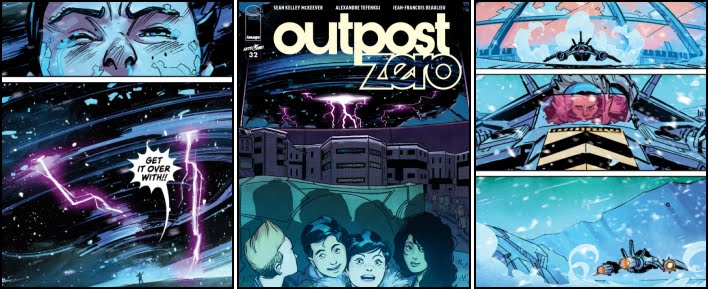
In many ways it’s hard to imagine that seven years before this title saw print, Sean Kelley McKeever’s external pitches had dried up at “Marvel Worldwide” and that despite “DC Comics” “just launching the New 52” the California-based publisher “didn’t have any openings” for him. True, the Appleton-born writer’s treatment for this “oversized debut issue” doesn’t contain any super-powered heroes and villains, or actually anyone even slightly outside the accepted Homo sapiens norm. But it does include a thoroughly engrossing script which quite beautifully depicts the inhabitants of “the smallest town in the universe”, and all their emotional insecurities as they go about their daily routines of working the land, visiting “the fights every Friday night” and “tuck[ing] their children into bed”.

Indeed, due to “Outpost Zero” being located “on a frozen world never meant to support human life” the book's narrative spends the best part of its formidable page count portraying the adults as determined drones who, for better or worse, have set aside their own personal aspirations in order to serve the larger community. However, even this seemingly endless carousel of educationalists, low-level workers, engineers and civilian administrators somehow manages to enthral any reader who can stomach a script which essentially revolves around the lifestyles and desires of a handful of young teenagers.

Arguably any such “Little House on the Prairie” in space story-line will eventually start to peter out in both pace and interest though, yet fortunately for fans of McKeever's penmanship the discovery of an all-too imminent, civilisation-level threatening electrical storm two-thirds through the publication swiftly injects the Eisner Award-winner’s treatment with plenty of actual pulse-pounding pizzazz. In fact, the potentially lethal plot twist genuinely imbues all the characters which the American author has so patiently painted a detailed background to with a startling amount of dynamic energy, and only the most superfluous of bibliophiles won’t be caught up in all the excited activity of the stranded colony’s final three and a half hours as it prepares for the inevitable assault upon its dome and life-giving apparatus. 

Somewhat as successful as McKeever’s soul-searching story-telling is Alexandre Tefenkgi’s competent, almost cartoon-like, artwork. Considering just how many individuals feature within this comic’s cast, it’s incredible to see how unique-looking the “Skybound Entertainment” artist makes each person’s facial details appear, whilst few within this book’s audience could surely suppress an involuntary shudder when the settlement’s discovery team venture outside in the cold, arctic tundra; “I feel good about this spot. We’ll find something. Solid ground, signs of life…”
Creator/Writer: Sean Kelley McKeever, and Creator/Artist: Alexandre Tefenkgi

Tuesday, 17 July 2018

Judge Dredd: Under Siege #2 - IDW Publishing

JUDGE DREDD: UNDER SIEGE No. 2, June 2018
Mark Russell’s treatment for Issue Two of “Judge Dredd: Under Siege” clearly shows the Eisner Award-nominee taking up the “chance to step into the role of sci-fi social commentator” by focusing far more upon the fall of Patrick Swayze Block into an insular, self-serving community than it does Judge Beeny’s firefight with attacking mutants. Indeed, in many ways this twenty-page periodical’s narrative is all about Tiger Whitehead’s exploitation at the hands of Kidney Hut, and her young brother’s subsequent rescue before the organ harvester’s body-armoured bully boys can remove it, rather than a story about Mega-City One’s greatest lawman defending a band of his metropolis’ hapless citizens from the multi-limbed machinations of the Cursed Earth’s mutated denizens.

Fortunately however, that doesn’t mean that “the author of God Is Disappointed in You” hasn’t penned an enthrallingly entertaining tale, as his plot-thread involving the examination of “fine print” and giving a corporation your liver “when someone turns seventy” proves itself to be a disturbing, disconcertingly engrossing read which in some ways arguably harks back to the horror of Malcolm Shaw’s April 1977 “2000 A.D.” story “Frankenstein 2”. Certainly, it’s not hard to cheer Gilberto on as the (then) young man desperately engages a pair of the corporation’s mean-spirited internal collection agents with a hand pistol in order to give his purple-haired friend an opportunity to both find the infant Jerome and “destroy all the records for Swayze Block.”

For those within this mini-series’ audience more interested in the exploits of its titular character though, such advantageous abuse of the underprivileged by greedy, money-making executives, are impressively also interspersed with action-packed insights into Judge Dredd’s current battle against the building’s invading host. Hauntingly illuminated by Whitehead’s “light jacket”, these pulse-pounding panels not only show the lawman at the very top of his game, as he dispatches numerous heavily-armed mutants courtesy of the various settings available on his lawgiver, but also manage to convey the sense of unease between the judges and their lawbreaking allies, “a small local gang, under the command of an enigmatic man known as The Mayor.”

Perhaps this book’s only disappointment is therefore some of Max Dunbar’s pencilling, which whilst top notch and sense-shattering when used to convey all the dynamism of the publication’s pitched battles in the near darkness of a church and shopping mall, strangely lack that ‘something extra’ when depicting family life within Tiger’s household and the sterile environment of the Kidney Hut offices.
The regular cover art of "JUDGE DREDD: UNDER SIEGE" No. 2 by Max Dunbar

Monday, 16 July 2018

The Immortal Hulk #1 - Marvel Comics

IMMORTAL HULK No. 1, August 2018
Spinning out of the sixteen-issue long “Avengers: No Surrender” story-line, at least according to its author Al Ewing, this first instalment of a “new ongoing series… which launches this June as part of Marvel Comics Fresh Start initiative” certainly seems to have lived up to its pre-publication promise that none of the title's 84,153-strong audience needed “to have read No Surrender – or any other comic ever published by Marvel or anyone else – to enjoy Immortal Hulk.” For whilst an understanding of the lengthy association between Bruce Banner and the World’s Mightiest Mortal makes it easier to understand just how come Thomas Edward Hill’s attacker “was big… built like an engine of Hell… and… was green”, “every Hulk fan, old and new”, will still make sense of the British comic book writer’s script for “Or Is He Both”. In fact, in many ways an ignorance of the Green Goliath’s previous adventures probably helped better sell this oversized thirty-page periodical as a “new, horror-themed comic”, rather than just another straightforward chapter in the titular character’s ever ongoing ‘super-heroic’ chronology.

Interestingly however, this magazine’s readers still had to wait quite a considerable time before Joe Bennett's fantastically pencilled Hulk actually made an appearance, due to the creator of “the comedic blog The Diary of Ralph Dibney” initially just focusing upon “the psyche and fragile form” of Banner as he witnesses the cold-blooded murder of an innocent young girl in a bungled petrol station robbery and is ruthlessly shot through the forehead before he can 'transform’; “You… You just… You --” BDAM. This truly horrific crime, made all the worse by Hill’s callous ability to simply shoot the hapless cashier as the crying man pleads for his life, is wonderfully penned by Ewing and proves such an emotional journey that the vast majority of bibliophiles were probably cheering when “the Strongest One There Is” later bursts in upon the Dogs Of Hell’s dilapidated headquarters so as to wreck his revenge upon the weak-willed man who killed him.

Somewhat bizarrely though, Bruce’s “savage, nocturnal alter-ego” undoubtedly appears to have undergone something of a personality change for this book, with his renovation into "an instrument of justice and vengeance” appearing more in keeping with that of Gary Friedrich’s Ghost Rider than the human mutate’s usual “Dr. Jekyll and Mr. Hyde” shenanigans. Indeed, Tommy's slaying of three innocent people and the loathsome man’s irritating claim that he didn’t want to do it, would surely have tried many a crime-fighter’s patience beyond its moral limits, and yet the green-skinned, oft-times murderous “monster who can’t die” surprisingly still leaves the blonde-haired robber “clinging to life”, apparently unwilling to completely snuff out his existence.
Writer: Al Ewing, Penciler: Joe Bennett, and Inker: Ruy Jose

Sunday, 15 July 2018

Geek-Girl #2 - Markosia Enterprises

GEEK-GIRL No. 2, July 2018
It’s rare for a magazine to generate such a strong, mounting sense of injustice in its audience as Sam Johnson’s script for Issue Two of “Geek-Girl” arguably does in its terrible treatment of the “comic book geek with a basement stuffed with super-hero funny books”, Summer James. For whilst by her own admission, the fashion student has simply been carrying “on Geek-Girl’s work until you got better -- Just until you got back into it --”, the poor young woman’s unforgivably antagonistic reception by Ruby Kaye and her best friend’s mean-spirited parents is infuriatingly hostile, especially considering that the super-heroic stand-in only visited Little Miss Popular's residence because her supposed buddy invited her to; “Yeah, it’d be great to see you.”

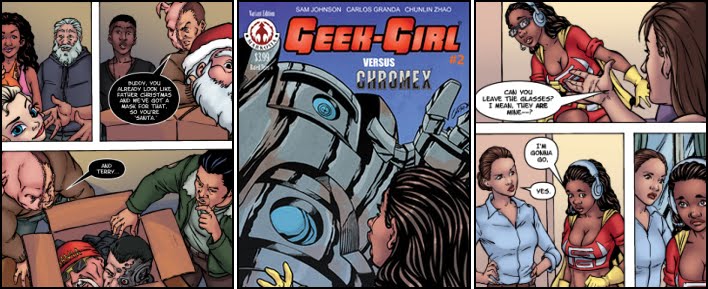
This scene is tremendously well-penned by the title’s creator, and turns what was initially expected to be a joyful reunion between “the cool kids” into a somewhat uncomfortable doorstep greeting, and then later full-on verbal tirade by Janice, who immediately starts irrationally accusing the bespectacled-rookie of irresponsibly putting her daughter in a coma and almost getting her killed. This outrageous welcome to someone who has simply been trying to do their best, and placing their life on the line as a consequence, genuinely gets the blood boiling, and any liking for the original super-tech glass-wearing protagonist debatably evaporates when she subsequently further deflates Summer’s bubble by taking back Trevor Goldstein’s invention from her, even though Ruby apparently has absolutely no intention of ever wearing them again…

Happily however, this understandably depressing, dialogue-heavy sequence is interestingly interspersed by a much more humorous series of scenes focusing upon the utterly inept Terry and his unwise decision to join the League of Larcenists. Anyone foolish enough to believe a man with literally half a boar’s brain is going to produce a “rock-solid” plan for robbing Maine of half its considerable wealth is asking for trouble, so it surely wouldn’t have come as a surprise to this twenty-one page periodical’s audience that the criminal’s relationship with Pig Head and Mongo quickly degenerates in something of a farce, particularly when one of the crew reveals “he was telling me his wife made him have a vasectomy the other week” and the naïve crook’s resultantly awarded the codename “Numb Nuts”.

Quite possibly this publication’s biggest draw though is Summer’s confrontation with the mechanically-menacing Chromex. Fantastically pencilled on this comic’s variant edition cover by Carlos Granda, the heavily armour-suited villain would potentially appear a match for James even if the caped crime-fighter still actually had her powers, let alone now when she isn’t “wearing the glasses”, so his devastating destruction of Josh’s car as the student desperately attempts to save the head-miked damsel in distress sincerely shows what the robotic lawbreaker is probably planning to do to his fallen prey at the conclusion of this book.
The regular cover art of "GEEK-GIRL" No. 2 by Carlos Granda 

Saturday, 14 July 2018

Stroper #2 - Stroper Store

STROPER No. 2, June 2018
It’s clear from Eddie Porter’s script to Issue Two of “Stroper” just why the digital comic’s Kickstarter managed to raise an impressive $2,186 in funds by the end of February 2018, with its broadening of the title’s leading cast and additional insights into Pak Booker’s incarceration “in the Bo’ak 5 prison mines”. Indeed, the thoroughly entertaining interplay between the mullet-haired hunter and his robotic assistant Tango, is arguably worth any cover price alone, especially when the surprisingly terrified bot begins to produce a high-pitched scream as it desperately tries to help its master lug his latest prey’s burdensome corpse aboard their spaceship before the pair are consumed by zillions of hungry Krill; “You know my courage drive is under cranked. It’s a sensitive subject for me.”  

Similarly amusing is the automaton’s all-pervading aura of doom, which persistently appears to tweak the nose of the fate for all its worth. Understandably defensive when it is initially blamed for not correctly calculating that the stalker would actually encounter a female Rook on the Moon of Centi-7, the android rather humorously constantly goads the gods with its prediction that “things could be worse…” and subsequently seems to set up a sequence of events which disquietingly sees Booker’s dead extra-terrestrial prize ‘give birth’ to a cute, six-eyed living hatchling just before his vessel C16-227 is intercepted by “the boys in blue”.

Far less witty however, and understandably so, is the visual effects artist’s disconcerting dalliance upon Pak’s daily deadly routine “chain ganged to the Galaxies finest scum bags.” Strapped into a hammer suit whilst drilling for “the galaxies most precious resource” this arduous, soul-sapping punishment actually seems entirely appropriate for someone who killed “endangered aliens for money.” But when the prisoner stood working right beside our titular character is seemingly vaporised by a ruby-red release of rays from inside the ‘coal face’ upon which they’re working, it quickly becomes apparent that Pak’s sentence is probably a short-lived terminal one, where he literally takes his life in his hands every second of the working day…

Of course, what really helps bring across the monotonous nature of the captive stroper’s existence is Porter’s excellent computer-generated artwork. The scenes showing this title’s protagonist simply being one of many minuscule-sized miners as he traverses a leviathan-long, winding ravine “down into the belly of hell” alongside his innumerable fellow inmates, really captures the analogy of him simply being seen by the Galactic Union as nothing more valuable than a replaceable worker ant. Whilst Booker’s increasingly troubled facial features, in light of his latest hunt’s aftermath, shows the man's agitated unease as circumstances pour woe after woe upon his shoulders, and really adds to the growing tension inside his spacecraft’s cockpit.

‘First published on the "Dawn of Comics" website.'
Writer & Illustrator: Eddie Porter