Tuesday, 30 October 2018

Aliens: Dust To Dust #3 - Dark Horse Comics

ALIENS: DUST TO DUST No. 3, October 2018
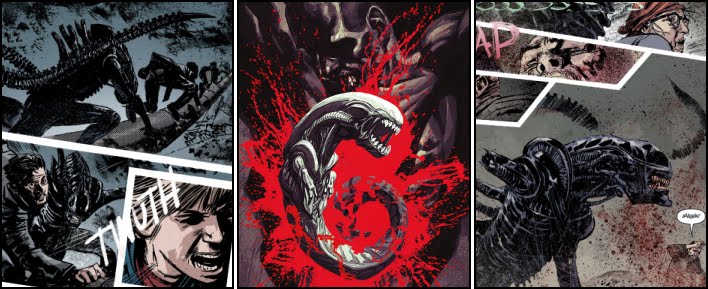
Only pausing mid-way through its narrative whilst the rapidly dwindling survivors of the Trono colony somewhat hard-heartedly decide whether to leave their youngest member behind before attempting to “follow the bank of the spillway right to the facility”, Gabriel Hardman’s sense-shattering screenplay for Issue Three of “Aliens: Dust To Dust” must have had the majority of the mini-series’ audience panting for breath when the long-delayed publication finally hit the spinner-racks in October 2018. For although the twenty-page periodical momentarily becomes a little weighed down with the morality of “pushing forward without” the twelve year-old orphan, it quickly picks up its pulse-pounding pace once Maxon makes to ‘go it alone’ and inadvertently encounters an entire nest of xenomorphs hiding underneath the floor of the very system engineering facility he’s fleeing from.

Indeed, whether it be Roman and his aged wife’s horribly bloody deaths during this comic’s gore-fest of an opening, or the callous co-pilot’s ‘all-too just mutilation’ at the hands of a howling mob of aliens, having literally just refused to let the terrified boy and Waugh back into the building because “I’m not dying for them”, the persistent deadly threat of Ridley Scott’s legacy is palpably all-pervading, and rarely lets up even when the captain believes there’s “no evidence of xenomorph activity” and begins making sensible-sounding plans to reach a terraforming station the following morning. Certainly, it soon becomes hard to keep track of just who is still alive within the group as the “mysterious and deadly creatures” stalking them continuously claw, bite and tear their number asunder…

Arguably this comic’s greatest highlight however, has to be young Cregar’s headlong dash through the magazine’s final third, which starts with the adolescent being roughly rushed around the alien-infested sanctuary’s exterior by the unfriendly Assistant Administrator, and ends with him haplessly plunging into a fast-flowing river of “overflow from the facility’s cooling tower” along with the tale’s last remaining few fighters and a plethora of hostile life-forms. In fact, Hardman’s scratchy-styled line work for this sequence is so well-suited to the scene’s sense of panicked desperation, that it is a pity the frenzied flight across the broken bridge’s depilated suspension cable doesn’t last that bit longer and perhaps replaced the Hugo Award-nominee’s patronising panels within which Anne’s son is told to rest because “you’re just a kid.”
The regular cover art of "ALIENS: DUST TO DUST" No. 3 by Gabriel Hardman

Monday, 29 October 2018

Judge Dredd: Toxic #1 - IDW Publishing

JUDGE DREDD: TOXIC No. 1, October 2018
Publicised as Paul Jenkins’ “first shot at Judge Dredd” by “IDW Publishing”, this twenty-page periodical’s plot probably didn’t provide its audience with quite the spine-chilling shenanigans John Gallagher’s marvellously grotesque variant cover illustration foreshadowed. In fact, the “celebrated” British writer’s narrative for Issue One of “Judge Dredd: Toxic”, which disconcertingly heavily bogs the reader down with a politically-fuelled piece about anti-immigration and the aggressive prejudice of Mega-City One’s citizens, doesn’t even feature any sort of gigantic ghoulish-looking mutation whatsoever, and instead seemingly relies upon the shock inclusion of a Donald Trump lookalike leading an Anti-Alien League protest as its main adversary.

Admittedly, that isn’t to say that this twenty-page periodical lacks a genuine ‘monster’, as its titular character’s investigation into Clifton Chud’s surprisingly well-developed corpse soon reveals the presence of an extra-terrestrial life-form hidden away amongst the disagreeable-looking scrubbers of the urban sprawl’s Spillover. However, this tiny, “intelligent… species” with “an advanced intellect and a possible psychic connection with the host” actually appears to radically benefit the humans with whom they form a mutually agreeable symbiotic relationship, and certainly don't appear to want anything more than to be peacefully left alone in the sewer works.

So amiable an alien arguably means that the Prism Award-winner must instead turn his attention towards making someone else the supposed ‘villain of the piece’ and dishearteningly it soon becomes clear that “Old Stoney Face” has been cast in that role, as the future lawman is penned acting like a ‘real jerk’ around Judge Anderson during the telepath’s interrogation of the “off-world entities”; “You don’t like anything, Dredd. How about you let me do the talking, and you just go grimace in the corner, okay?” Indeed, this entire comic portrays Fargo’s clone at his robotic worse, impatiently discussing an autopsy with Coroner Levine, recklessly threatening to have the Spillover “pop like a blister” simply because he hasn’t thought through his demand of wanting “every scrubber in this sector assembled on the lower ops deck in ten minutes”, and childishly whining to Chief Judge Hershey that despite all their potential advantages the “undocumented illegals” shouldn’t be granted immunity because “they broke the law.”

Debatably this book’s biggest disappointment though, is Marco Castiello’s scratchy artwork, which seems particularly unsuitable when applied to Mega-City One’s lawmen. Dredd’s famous chin is especially inconsistently drawn unless pencilled in profile, whilst Scammon’s bedraggled red beard looks as if he’s spent the past year or more literally walking across the Cursed Earth and certainly reveals just the “sign of vanity” which saw Judge Lopez ‘unwillingly’ consume the fatal Oracle Spice during “The Judge Child Quest”.
The regular cover art of "JUDGE DREDD: TOXIC" No. 1 by Mark Buckingham & Chris Blythe

Saturday, 27 October 2018

Batman [2016] #57 - DC Comics

BATMAN No. 57, December 2018
First teased by artist Tony S. Daniel through his Twitter account, Tom King’s script for Issue Fifty Seven of “Batman” undeniably provides a seriously bone-shuddering third chapter to “Bruce Wayne’s latest duel with the Soviet assassin” Anatoli Knyazev. But whilst “the fight between the Bat and the Beast” ably demonstrates just how formidably brutal a combatant Jim Starlin’s co-creation from the late Eighties can be when cornered three hundred clicks from civilisation, this twenty-page periodical’s most engaging asset is arguably it’s intermittent secondary plot thread detailing the exploits of a pig, wolf, fox, hare and squirrel travelling together to Saint Petersburg “to pray to god.”

In fact, in many ways it is debatably “the Cold War between Batman and the Russian killer” which intrudes upon this comic’s overall enjoyment, especially when the youngster’s night-time nursery read takes a decidedly dark turn into the macabre and disconcertingly describes three of the supposedly fluffy animals mercilessly feasting upon those “who has the thinnest voice” following the entire group’s entrapment down a broad, deep pit. Perturbingly pencilled and painful to peruse courtesy of the fox apparently “eating my own flesh” at one stage, these perplexing panels are a far cry from the imagery conservationist Beatrix Potter created with her twenty three children’s books such as “The Tale of Peter Rabbit.”

Of course that doesn’t mean to say that the ex-CIA officer’s well-penned fist-fight amidst the frozen tundra isn’t also worthy of praise, as few within this comic’s audience could surely have found much to fault with the Dark Knight’s grim-faced, pulse-pounding punch-up against the cybernetically enhanced hit man and it’s cheerless conclusion. True, the Caped Crusader is unnervingly on the wrong end of a severe beating by a one-armed man whose simple-looking prosthetic hook can apparently scythe through the costumed vigilante’s face mask and body armour like a hot knife through butter. Yet the World’s Greatest Detective had apparently just trudged “through nothing but snow and ice” for almost two hundred miles, as well as “got a bullet in my arm.”

Regardless of any writing quibbles, Antonio Salvador Daniel is clearly at the very top of his game drawing “Beasts Of Burden”, and whether it be Batman unsuccessfully dodging all of his foe’s numerous shots, or Knyazev felling his well-worn opponent with a series of 'big boots', each and every one of this book’s break-breaking pictures is packed full of animated life. Indeed, it’s a genuine shame that the “Battle For The Cowl” illustrator doesn’t continue to regularly sketch for this title, or that "folklore artists" Mark Buckingham and Andrew Pepoy won't dip into another of the fictitious Alexander Nikolaevich Afanesyev’s traumatising tales.
The regular cover art of "BATMAN" No. 57 by Tony S. Daniel

Friday, 26 October 2018

Uber: Invasion #16 - Avatar Press

UBER: INVASION No. 16, September 2018
Viewed by creator Kieron Gillen as the end of his “Mother Russia” arc, or rather “What To Do About A Problem Like Maria?”, this decidedly different “take on The Sound Of Music” almost exclusively focuses upon Katyusha’s miraculous resurrection following her previously depicted death during “a chance attack from a flank”, and the sweet mad thing’s subsequent unsurprisingly merciless revenge upon the traitorous Soviets responsible for her cold-blooded murder; “The enhanced forces that had accompanied Andreevna’s apparent corpse on its return from the East were deployed, but were neutralised swiftly. It could not be truly characterised as a fight. It was more like punishment.”

But whilst such a one-sided conflict may well seem a rather superfluously long sequence to some readers, the utter terror etched upon Joseph Stalin’s blanched features, as well as the narrative’s frequent biblically-based analogies, impressively still manages to imbue this twenty-two page periodical’s plot with an enthralling aura of nervous tension and suspense. Indeed, the Georgian dictator’s ultimately horrific, painful demise is as unforeseen a fate as his transformation into a statue of the highly valuable ruby “red muck” is fantastical, and few within this title’s audience wouldn’t have felt their heart quicken when the soon-to-be “pillar-of-catalyst” first peers from out of his Kremlin office’s window and open-eyed spies Maria merrily waving back at him from the cobbled Moscow street below.

Pleasingly however, just because the former music journalist’s narrative predominantly follows the exploits of "The Manic Sniper" doesn’t mean it simply ignores the likes of Olesya, Molotov, Siegmund and Leah Cohen either, with H.M.H. Churchill in particular being penned an especially poignant moment when Maria fixes the huge monster’s partially severed right leg and enables the super-strong woman to walk once again. This extraordinary ‘twinkling of optimism’ amidst a publication packed full of alarming atrocity is then arguably made all the brighter when artist Daniel Gete’s ‘camera’ promptly pans away from the fading figure of the stumbling British behemoth and highlights that Maria’s act of kindness actually occurs beneath the disconcertingly well-pencilled remains of the three crucified “Judas” Russians the “Battleship class Ubermensch” gruesomely dispatched without a moment’s thought just minutes earlier.
The regular cover art of "UBER: INVASION" No. 16 by Daniel Gete

Thursday, 25 October 2018

Star War Adventures #1 - IDW Publishing

STAR WARS ADVENTURES No. 1, September 2017
Presented in early 2016 by “IDW Publishing” as “a comic book series aimed at younger audiences to Lucasfilm”, Cavan Scott’s narrative for Issue One of “Star Wars Adventures” probably did provide its smaller readers with some semblance of excitement due to its heavy focus upon an early adventure of Rey's on the remote desert planet of Jakku. But whilst this fifteen-page long narrative ‘perfectly’ replicates the female scavenger’s claustrophobic tension as she explores the huge dilapidated “relics of a battle that was fought long before I was born”, as well as features a fun action-packed sequence depicting the “dune-rat” battling a pair of less chivalrous junk collectors over a handful of com-links, its central plot is bemusingly based upon the premise that Daisy Ridley’s ‘Silver Screen’ character would risk her life so as to save the highly disagreeable Unkar Plutt from a gang of “off-worlders lead by some guy called Zool Zendiat”..?

Of course, it should have come as no surprise to the 49,184 bibliophiles who bought this comic that the headstrong ‘Force Sensitive’ “maintains [a] fierce loyalty to her friends”, as seen by Rey’s plucky intervention between the elderly Bobbajo and Jakku’s new Junkboss, which causes her to scurry around after the battered crittermonger’s “poor creatures” following Krynodd savagely flooring the wizened old-timer. But arguably such a short-lived scene, even when pacily pencilled by Derek Charm, shouldn’t be solely enough to convince the gifted scavenger who resides amidst the Goazon Badlands that the snout-faced scumbag is “going to be even worse than the Blobfish” so she needs "to rescue Unkar…”

Fortunately however, this publication “aimed at [the] next generation of comic book fans" debatably contains a far more satisfying secondary story in the guise of Scott’s “Tales From Wild Space”, which transports its viewers back to “the days of the Old Republic” when Obi-Wan Kenobi and Dexter Jettster tackle a Pa'lowick thief who has been repeatedly stealing from the Besalisk’s diner. Crammed into just six pages, and dynamically drawn by Jon Sommariva, this ‘short’ rather enjoyably demonstrates the Jedi Master’s famous wiliness in order to successfully locate the secret den the petite pickpocket “shared with an old rogue called Magreda”; “The Jedi Knight taught Tri Tellon a valuable lesson that day that nine time out of ten, you’re not half as clever as you think you are.”
The regular cover art of "STAR WARS ADVENTURES" No. 1 by Derek Charm

Wednesday, 24 October 2018

Avengers [2018] #4 - Marvel Comics

AVENGERS No. 4, September 2018
Despite “Marvel Worldwide” clearly hoping this comic’s 61,897 readers would focus upon its pre-publication question as to just how the Avengers could “possibly defeat a crew of 2,000-foot-tall, nearly omnipotent Dark Celestials bent on annihilating the human race”, it’s entirely possible many within this twenty-page periodical’s audience were actually more occupied trying to make sense of Jason Aaron’s incredibly choppy and convoluted narrative. Indeed, the sheer number of sub-plots and secondary cast members which the Alabama-born writer crams into “A Battle That Was Lost A Million Years Ago” is bewilderingly breath-taking, with the likes of Agamotto, Starbrand, a swarm of cosmic locusts, Celestials, Eternals, Frost Giants, Proto-Humans and even the “Dragons of K’un-Lun” all getting at least a mention.

Of course, such a wide ensemble would be perfectly palatable if this book’s script actually tried to tie the different races and their fantastic locations together into a sensible, logical storyline. But any perusing bibliophile who casually glanced inside Issue Four of “Avengers” would instead have first found themselves being thrown back in time to the prehistoric Pleistocene Period, before arriving at Old Asgard, the Mountains of Greece, Alpha Flight Space Station, and the North Pole, all within the passage of a plethora of Paco Medina and Ed McGuinness’ perfectly pencilled panels.

Disappointingly however, few of these trips actually appear to make much sense, with Iron Man’s surprise visit to the Home of the Eternals proving particularly puzzling as Tony Stark’s alter ego discovers that Zuras, Sersi and Thena have all apparently killed one another “within the last few hours” simply because they were driven mad by “the deaths of all those Celestials”..? To make matters worse, Thor’s outing to see the All-Father is arguably even more bizarre with Odin refusing to help his son recover the Blood of Ymir, and She-Hulk deciding the best way to warm up an all-too conveniently faltering God of Thunder is to give the bearded warrior a huge kiss on the lips; “Thank you… For, Ah… Saving my life back there, my Lady Hulk.”

Fortunately, such debatably poor penmanship is entirely survivable thanks to Medina and McGuinness’ sumptuous storyboarding and this comic’s attractively lavish inking by Juan Vlasco (with Mark Morales). Ordinarily, any series “scheduled to release eighteen issues per year” would understandably prove too “large load for one artist to handle by himself”, so Executive Editor Tom Breevort’s decision to add Paco “in the mix” with his similar style to Ed, really seems to have paid dividends with the illustrations for this specific edition.
Writer: Jason Aaron, and Artists: Paco Medina & Ed McGuinness

Tuesday, 23 October 2018

Boy Zero: Volume One [Part Two] - Caliber Comics

BOY ZERO: VOLUME ONE, January 2016
Firmly fixing its sights upon the events occurring inside “a small neighbourhood, built for the workers of the factories” just outside the limits of Glass City, rather than depicting the corpulent Detective Nigel Drekker solving another bloody slaying, Chapter Two of “Boy Zero” undeniably delivers a far less pulse-pounding plot than its preceding instalment with its dark depiction of the day when “a moving van approached House Twenty Two” and “brought with it the Marshall Family.” Yet such a change in subject matter and pace certainly doesn’t mean that Charles Chester hasn’t penned a tale equally as shockingly spine-chilling and disturbing as that encountered within “The Ember Rose”.

Indeed, Edmund’s childhood memories of a time when two of his friends were literally torn in half (supposedly) by their father whilst sleeping in their beds, must have kept many of this graphic novel’s readers awake well into the night, especially as the “award winning” filmmaker’s text repeatedly insinuates that the mysterious Christian is in all likelihood actually at the centre of the horrific happenings and may well be this tension-filled tome’s Boogeyman; “And when night fell the half dreaming boy would often wander about the neighbourhood like a wraith, peering into the homes of his neighbours as if he couldn’t be seen.” 

Of course, that doesn’t mean that the portly policeman is completely omitted from this twenty-four page phase of Chester’s enthralling narrative, as Drekker patiently plies a now adult Edmund with food in order to illicit the ashen-faced youth’s memories of his sister and how she dealt “with all the death surrounding her.” But such an intrusion upon this segment’s story-telling is fleeting, with the detective’s presence being largely left to the shadows so this book’s audience can watch in mounting dread as tiny, fresh-faced Paulette is found to be missing from her bed during the dead of night at the same time as “Boy Zero” is depicted stalking the local cemetery crying…

Adding to this episode’s aura of all-pervading doom and despair is Shiloh Penfield’s arguably angular pencilling, which imbues each character with a physical awkwardness that really lends itself to the disagreeability of this tale’s gory subject matter. Doe-eyed and grim-faced, the artist’s sketching style almost paints each of Charles’ characters as hapless puppets, who are woodenly walking towards some truly horrific fate from which there is absolutely no hope of escape or redemption.
Written by: Charles Chester, and Artwork by: Shiloh Penfield