Sunday, 31 July 2016

Injection #10 - Image Comics

INJECTION No. 10, June 2016
It probably wasn’t too hard for the majority of this comic’s 11,771 followers to read “Image Comics” post-publication announcement that Warren Ellis’ series concerning “five crazy people… [who] poisoned the 21st Century” would not return until “later in the year”, as the unimaginative writing and woefully poor artwork contained within this concluding instalment of ‘Volume Two’ must genuinely have resonated with them as to just how fatigued “the acclaimed creative team of Moon Knight” had presumably become working on the series. Indeed it’s genuinely hard to take anything positive away from a twenty-page periodical whose narrative predominantly focusses upon a debate between Vivek Headland and some Rubedo operatives in Mister Van Der Zee’s sitting room…

Admittedly the Essex-born writer uses this frighteningly lengthy conversational piece to quite neatly tie-up all of the plot points his multi-issue story-arc has generated. But even so it shouldn’t take a multiple Eagle Award-winner over a dozen convoluted pages of wearisome wordiness to depict the “logician and Ethicist with an interest in security” informing his armed opponents that “the rogue artificial learning system” the terrorists “keep calling the Philosopher’s Stone” is actually The injection, and that it was actually responsible for the deaths of the financier’s wife and son; “Yeah. Traffic light failure did for her. Car’s onboard computer system failure caused his.” 

What isn’t explained however is just how the Manhattan-based detective miraculously managed to have all of the Rubedo assassins’ “guns unloaded hours ago.” It is quite clear that Ellis has endowed Headland with such an incredible “ability to think of all the possible outcomes” that Vivek ‘borders on the precognisant.’ Yet that still doesn’t explain the removal of the bullets, especially when one of the black-jacketed would-be killers expostulates that she checked her firearm before infiltrating Van Der Zee’s isolated mansion.

Such objectionable gobbledegook might though have been potentially palatable if it were not for Declan Shalvey’s amateurishly sketched and diabolically rushed pencils. Having “made his name with his first comic Hero Killers” it seems unacceptably strange that the Irishman’s breakdowns for so well publicised a title as “Injection” would, in the main, simple consist of numerous panels comprising of a single, awkwardly angular, facially disfigured form, with nothing in the background whatsoever apart from the occasional outline of a curtain or piece of furniture.
The regular cover art of "INJECTION" No. 10 by Declan Shalvey

Saturday, 30 July 2016

Free Comic Book Day 2016 (Captain America) #1 - Marvel Comics

FREE COMIC BOOK DAY 2016 (CAPTAIN AMERICA) No. 1, May 2016
Heavily advertised by “Marvel Worldwide” as “one of Steve’s first adventures since his dramatic return” this Free Comic Book Day publication of “Captain America: Steve Rogers” probably came as something of a disappointment to many of the Sentinel of Liberty’s followers, despite the ten-page short story somehow containing the pulse-pounding exploits of the ‘original’ World War Two super-soldier, S.H.I.E.L.D. Commander Sharon Carter, Sam Wilson and the “All-New All-Different” Falcon, Joaquin Torres. For whilst Nick Spencer’s script undoubtedly gives “the reinvigorated Steve Rogers” plenty to do as the patriotic powerhouse pulverises a hidden Hydra cell in Graz, Austria. It does so using a seemingly pedestrian ‘plot-by-numbers’ technique which unfortunately pales in comparison with the excitement and sense of anticipation Dan Slott’s secondary Spider-Man tale “Up & About” undeniably generates.

Indeed of this publication’s two stories, it is the Diamond Gem Award-winners nine-page “special prelude to Dead No More” which doubtless raised the most questions in its audience's mind, on account of its narrative containing at least three characters who are supposedly deceased; “Oksana [Sytsevich] should be dead. The Rhino should be dead. And Vanessa [Fisk] should be rotting away in a crypt somewhere." The Wall-crawler’s pulse-pounding 'novella' even finishes on a devilishly well-timed cliff-hanger, courtesy of a shock appearance by Sixties super-villain the Jackal, and (presumably) his clone of Gwen Stacy… 

Disappointingly however, Slott’s purported “first look at the blockbuster storyline coming later this year” is nowhere near as well drawn by Javier Garron as this title’s star-spangled opening adventure is by Jesus Saiz; a new face at Martin Goodwin’s old company who was clearly enjoying his “first gig for Marvel”. In fact the Spaniard’s artwork is arguably awfully amateurish in places, especially when Peter Parker grimaces at the sound of nearby gunfire, or the Rhino realises his web-spinning nemesis has quite literally pulled the ground from under his feet with a few well-placed “explosive spider-tracers”. Certainly the vast majority of Spidey fans, upon seeing the Barcelona-born penciler’s panels depicting an incredibly egg-headed Kingpin, must have breathed a huge sigh of relief when they realised that Jim Cheung was going to be the main artist on the “Dead No More” multi-issue event and not Garron.
Writer: Nick Spencer, Penciler: Jesus Saiz, and Letterer: Joe Caramagna

Friday, 29 July 2016

Kong Of Skull Island #1 - BOOM! Studios

KONG OF SKULL ISLAND No. 1, July 2016
Publicised as “an original, limited comic book series… featuring the famous gargantuan ape, King Kong”, and coinciding with the increasing public interest generated by “Legendary Pictures” planned release of a “Kong: Skull Island” motion picture in 2017, the plot to Issue One of “Kong Of Skull Island” must surely have still come as something of a surprise to the twenty-two page periodical’s audience. For whilst Merian C. Cooper’s colossal-sized anti-hero does feature somewhat throughout James Asmus’ narrative, the gigantic gorilla is actually just one of several simian monstrosities referred to as "The Kong", who have been bred to compete in gladiatorial confrontations.

In fact the activities of the great warrior primates are undeniably secondary to a storyline which primarily focusses upon the mounting political tensions between the Atu tribe (who “gorge their Kong on our island’s precious limited resources) and the Tagu people (who “must sail for greener grazing -- just to ensure there will still be enough here for the people”). Certainly “BOOM! Studios” incarnation of the “prehistoric type of ape” appear to be just as much a victim of the events on Skull Island as their accompanying superstitious native sailors are, and swiftly succumb to the sudden savage attack of a giant Pteranodon flock.
  
Fortunately, despite its arguable lack of any titular character, the Stan Lee Excelsior Award-winner’s tale of a female Kong trainer and her beloved Prince K’Reti is rather well-written, even if it is a little too stereotypical in its portrayal of Usana as an evil, manipulative rival for the royal’s attention. The barbed banter betwixt Ewata and the various members of the arrogant Atu clan rather succinctly illuminates the fragile, patently one-sided arrangement the two populations ‘enjoy’; an understanding which presumably won’t last once the island's "comfortable" inhabitants realise they need the Tagu fleet to evacuate them before they fall prey to a volcanic eruption.

Carlos Magno’s artwork for this opening instalment of a ‘six-issue series’ is incredibly well-detailed, as his pulse-pounding drawings of the Kong battling one another attests. But whilst the Brazilian’s panels are somewhat reminiscent of an overly-cluttered Gil Kane illustration, the sheer volume of detail he depicts can at times actually make it hard to distinguish one cast member from another, especially when both Usana and Ewata are together.
Writer: James Asmus, Illustrator: Carlos Magno, and Colors: Brad Simpson 

Monday, 25 July 2016

James Bond #6 - Dynamite Entertainment

JAMES BOND No. 6, April 2016
Focussing almost exclusively upon the movements of its titular character, this concluding instalment to “the debut storyline in the all-new James Bond comic book series” certainly brings Warren Ellis’ multi-issue narrative to a thrilling, rather blood-thirsty end as the British spy single-handedly storms a privately-owned battleship docked in Norwegian waters and ultimately blows it up. But such a dynamic resolution disconcertingly, never actually explains what motivated Slaven Kurjak to go to such extraordinary criminal lengths and put “a disease inside a drug” in the first place?

In fact, even the secret serviceman asks his mortally wounded foe as to just “why you did all this… The real reason. No justifications…” at the very end of the twenty-two page periodical and rather frustrating receives a nonsensical uninformative response from the bleeding villainous mastermind about him wanting “to be happy with friends and doing beautiful things.” It is little wonder therefore that the black-clad occasional assassin immediately shoots the crook neatly through the head once he’s presumably finished talking.

Plot holes as to his heavy’s incentive aside however, the Essex-born writer’s script for Issue Six of “James Bond” swiftly throws its 15,287 strong audience straight into the thick of things by having the former Royal Naval Reserve Commander utilise the “Russian collapsible suppressed sniper rifle” his Quartermaster has given him, and ruthlessly dispatch two of Vargr’s land-based guards with grisly throat shots. Indeed it’s hard to imagine a more pitiless cold-blooded incarceration of the main protagonist as the one Ellis has stalk the corridors of the German-owned “live action role playing” vessel, indiscriminately shooting men, women and unarmed laboratory technicians through the brains; “What the hell is going on --”

Impressively all of this pulse-pounding action is wonderfully illustrated by Jason Masters, whose pencilling of Bond furiously rushing through the ship’s sparsely decorated walkways, dodging bullets and eliminating his well-armed pursuers, quickly makes it evident as to why the comic pop culture website “Comic Crusaders” described the publication as containing “strong action pieces… full of pace and movement.” Certainly the South African’s detailed panels depicting the fragmentation of the secret agent’s bullets as they enter the heads, mouths and soft body organs of his victims are as insanely impactive as they are arguably ghoulish.
Writer: Warren Ellis, Artist: Jason Masters, and Colors: Guy Major

Sunday, 24 July 2016

Harrow County #4 - Dark Horse Comics

HARROW COUNTY No. 4, August 2015
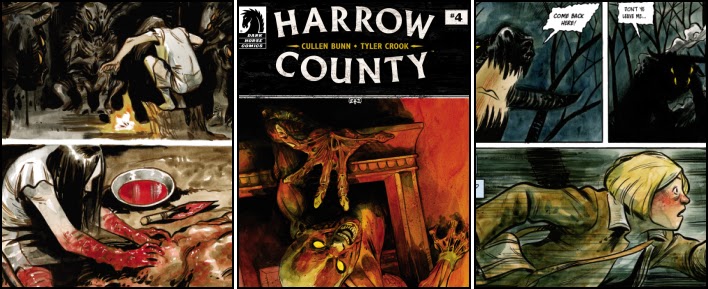
Whilst undeniably proving to be a twenty-six page periodical which quite neatly ties up most of the plot-threads from the title's "Countless Haints" story-arc, Issue Four of "Harrow County" must surely have disappointed some of its 8,893 readers with the illogically contrived manner in which it does so. For having spent the best part of the lengthy narrative fearfully fleeing her Pa and fellow townspeople because “she knows we want her dead”, Emmy bizarrely returns to where the ‘lynch mob’ are congregating and supposedly convinces them to let her reside amongst them despite disintegrating three of their number when they murderously launch themselves upon the young witch; “I don’t want to hurt anyone… Not you… Not the other folks who live hereabouts.”

Admittedly Cullen Bunn does try and rationalise this arguably incongruous behaviour on behalf of his story’s main protagonist, by having Mister Sorrell illuminate her as to Hester Beck’s creation of men and women “from the mud” during a rather dialogue-heavy sedentary sequence. But the suggestion that the settlement’s local folk have been lead to their homicidal resolution by a number of cruelly misguided mud-people, who “genuinely believed Hester was a creature of evil” and “thought they would never truly be alive until their creator was dead”, is perturbingly far-fetched.

Fortunately, despite these reservations as to the teenager’s guileless behaviour, the Bram Stoker Award-nominee’s script does still contain plenty of “genuinely creepy and engaging” moments. The comic’s opening, within which Emmy faces a ferociously huge, multi-eyed black-furred demon in the woodland, provides a wonderfully tense confrontation that momentarily actually looks like being a rather fatal meeting for the flush-cheeked blonde. Whilst Mister Sorrell’s overly-friendly, bespectacled countenance proves as disturbing a characteristic for a child kidnapper as any Film Noir writer could wish for.     

Possibly somewhat fatigued by this edition’s extra page count, or perhaps because so much of the tale is confined to well-lit locations, Tyler Crook’s artwork also seems to be a little worse for wear towards the end of this comic book. The American artist’s initial pencils and water colours depicting the long-forgotten bull-horned forest-dwelling fiend are wonderfully detailed, as are the panels depicting the stark terror etched upon the fledgling witch’s face as she flees the monster’s furious assault. Yet some of his illustrations concerning the ruddy-faced child snatcher, the skinless haint, and Emmy’s badly battered father aren’t quite as well-realised as perhaps they would have been in previous issues…
Script: Cullen Bunn, Art and Lettering: Tyler Crook, and Publisher: Mike Richardson

Friday, 22 July 2016

The Amazing Spider-Man [2015] #9 - Marvel Comics

THE AMAZING SPIDER-MAN No. 9, May 2016
Arguably best described as being reminiscent of an early Seventies copy of “Marvel Team-Up”, courtesy of a fast-paced, no frills opening which quickly sees its titular character and Nick Fury racing towards a “Zodiac hacked” orbital space platform on board the painfully-named “Arachno-Rocket!”, Issue Nine of “The Amazing Spider-Man” must surely have caused plenty of its 88,164 strong audience many a wry smile when first published in March 2016. For despite being a thoroughly entertaining twenty-page periodical that sees Peter Parker’s alter ego at his action-packed best as he helps the “agent of S.H.I.E.L.D.” trouble-shoot a number of Scorpio-controlled killer satellites, it’s hard not to feel that Dan Slott’s enjoyable script wouldn’t have better suited a protagonist like the Fantastic Four or Iron Man instead. Indeed the Diamond Gem Award-winner even makes light of the fact that his hero isn’t the Golden Avenger later in the book by having a worried Web-head, whose suit is rapidly breaking up as he re-enters Earth’s atmosphere, grimly state “H-h-hell, Iron Man d-d-does stuff like this all the t-t-time!”

The Wall-crawler’s access to all manner of state-of–the-art technology, whether it be a rocket ship, a spider-armoured space-suit, an emergency beacon or back spinnerets capable of deploying an all-encompassing ball of protective web-foam, also must have undoubtedly grated upon the subconscious of the long-suffering Spider-Man reader, especially as the Web-Spinner seems to demonstrate a contrivingly convenient amount of forethought in each device’s creation; “Impossible! This is Spider-Man we’re talking about. Not Thor!” It’s true that during the Berkeley-born writer’s tenure the former Daily Bugle photographer’s intellect has been continually re-emphasised to the point where Parker is the CEO of a “cutting edge” company which “has offices across the globe.” But even so “One Way Trip” still feels like something out of a Jim Steranko espionage-laden “Strange Tales” storyline than a narrative entirely in tune depicting the (mis)adventures of the friendly neighbourhood hero.

Slight misgivings as to Spidey’s use aside however, Slott’s opening instalment of the “Scorpio Rising” storyline is additionally engaging on account of it containing a succinct update as to Otto Octavius’ mechanical machinations within the “London Headquarters of Parker Industries.” Trapped inside the metallic mind of the robot servitor Living Brain, the super-villain spies Aiden Blain sharing an affectionate kiss with the criminal’s one-time fiancée Anna, and momentarily becomes enraged at the sight. Disappointingly Doctor Octopus' murderous electronically-voiced rant is cut all-too short by Spider-Man’s current plight. Yet such developmental teases as to a future confrontation between the costumed crime-fighter and his arch-nemesis provides some assurances as to the American author’s commitment to an over-arching narrative, and undoubtedly delivers an ample hook with which “Marvel Worldwide” could maintain this title’s impressively-sized readership.
Writer: Dan Slott, Artist: Giuseppe Camuncoli, and Inker: Cam Smith

Thursday, 21 July 2016

Doctor Strange [2015] #7 - Marvel Comics

DOCTOR STRANGE No. 7, June 2016
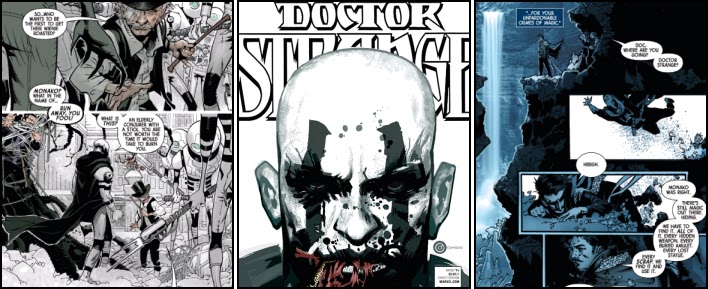
It's hard not to think that at least some of this title’s 49,590 readers didn’t pause midway through the comic’s opening third and check Chris Bachalo’s rather gruesomely grotesque illustrated cover to ensure that they hadn’t inadvertently picked up a copy of “Superman” by “DC Comics” instead. For whilst the opening to this second chapter in “The Last Days of Magic” story-arc doesn’t specifically refer to the Man of Steel’s home planet of Krypton, Jason Aaron’s script depicting the last moments of a scientific couple determined to save their sole child from death by transporting him off-planet in a spaceship before they themselves are killed, significantly smacks of Kal-El’s origin story. Indeed with the exception of Abbadona Hellgore’s son actually being saved from the sacrificial maw of “the great beast called, Shuma-Gorath” and obtaining a crew of eyebots in the process, the similarities are all too evident and perturbing.

Fortunately the Alabama-born author’s narrative doesn’t linger too long upon the supposedly innovative causation of the “heretic” Imperator from Tentacle Hill and instead soon returns this book’s audience to New York City “now” in order to resolve the titular character’s grim fate having been irrefutably defeated in the series’ previous instalment. This rather terse, overly-wordy ‘judgement’ by the super-scientist upon the bloodied Sorcerer Supreme initially proves something of a dank dialogue-heavy disappointment, despite the Imperator partially focussing some of his ire upon an incarcerated Magick. But is then rather delightfully ‘saved’ by the sudden appearance of Monako; a somewhat underrated magic-user who first appeared in the January 1940 first edition of “Daring Mystery Comics” (as published by “Timely Comics”).

This rather endearing “son of a missionary couple who were proselytizing in early Twentieth Century India” injects Aaron’s seemingly bleak adventure with some much-needed colourful humour as the gruff ‘elder statesman’ momentarily stands his ground against the formidable might of the Empirikul, and additionally imbues the twenty-page periodical with a genuine sense of tragedy too as the “Prince of Magic” subsequently sacrifices his life in order to teleport all his friends to safety; “Used up everything I had. Heh. But it was worth it. You shoulda seen the look on your --”
The 'Civil War' variant cover art of "DOCTOR STRANGE" No. 7 by Chris Stevens