Sunday, 8 July 2018

Star Wars: The Last Jedi #2 - Marvel Comics

STAR WARS: THE LAST JEDI No. 2, July 2018
Whilst Gary Whitta’s treatment for Issue Two of “Star Wars: The Last Jedi” valiantly tries to portray all the sense-shattering shenanigans of the “2017 American epic space opera film written and directed by Rian Johnson” with its depiction of the First Order preparing "to crush the rebels once and for all” courtesy of Snoke’s formidably-sized fleet, its arguably lifeless storyboarding and ‘by the numbers’ plodding pace must have made many of its 22,281 readers wondering just why they bothered purchasing the official “Marvel Worldwide” movie adaptation. In fact, due to this publication’s battle scenes set around the Resistance Cruiser the Raddus lacking much in the way of sound effects, momentous motion or more than a pair of attacking Tie Fighters, it is actually difficult to even glean just why General Organa’s flagship was so disastrously damaged by enemy “torpedos inbound”, or how in the preceding panels Po Dameron’s X-Wing is literally blown to smithereens whilst still inside its hanger bay without Leia’s forces apparently ever firing a single shot in anger..?

Certainly, this brief summarisation of the wider conflict, somewhat amateurishly-pencilled by Michael Walsh, makes Admiral Gial Ackbar’s shocking death debatably all the more ignoble, as its brevity seemingly shows “the foremost military commander of the Rebel Alliance” panicking in the face of only three enemy fighters to the point where he commands “all craft full ahead! Concentrate rear shields” so as to supposedly neutralise their threat, and subsequently then sees his opponent fatally penetrate his presumably undefended bridge with a couple missiles; “It’s been an honour serving with you all.” Such ludicrously-poor decision-making is hardly the sort of strategic thinking one would expect from a Mon Calamari who lead “a small under-equipped navy” to successfully defeat the might of Darth Sidious’ Galactic Empire.

Fortunately, the “English-born American screenwriter” does manage to at least inject a few “added parts that we didn’t see” on the ‘Big Screen’ into this twenty-page periodical’s script, most notably Organa’s steel-willed determination not to have her “lifetime spent fighting, resisting, surviving” suddenly ended in the vacuum of outer space. This particular ‘insight’ is pure Carrie Fisher’s character, and it’s resultantly easy to hear the Saturn Award-nominated actress’s voice defiantly shouting out the line “The End? Like Hell” as she briefly considers whether this is indeed to be her fate, and emphatically decides to utilise the Force to float “back to the ship” safely.
Writer: Gary Whitta, Artist: Michael Walsh, and Colorist: Mike Spicer

Saturday, 7 July 2018

The Amazing Spider-Man #792 - Marvel Comics

THE AMAZING SPIDER-MAN No. 792, February 2018
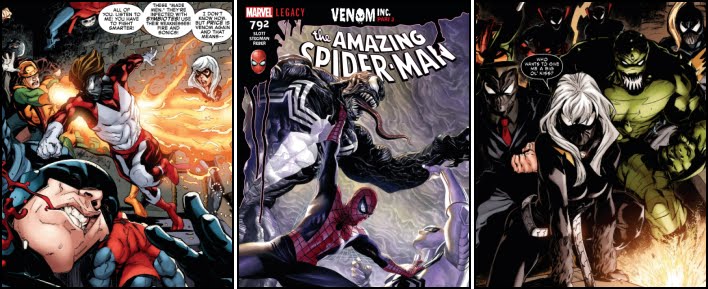
For those readers unable or unwilling to purchase the “Marvel Worldwide” one-shot “Amazing Spider-Man: Venom Inc. Alpha”, Dan Slott’s script to this second instalment of his “Venom Inc.” comic book event arguably must have proved a rather frustrating read, considering the twenty-page periodical disconcertingly begins just after “Peter’s best friend, Flash Thompson” was exposed to an experimental cure at Alchemax and inadvertently “transformed into the all-new Anti-Venom!” True, the Berkeley-born writer does at least provide this publication’s 61,994-strong audience with a brief summary of events at the start of the magazine, yet for those regular bibliophiles solely dedicated to buying just the New York City-based publisher’s “flagship series”, and resultantly perhaps having little recent exposure to the likes of Eddie Brock, Lee Price, the wheelchair-bound Doctor Steve and Norton Fester, the Eisner Award-winner’s narrative is a confusing, somewhat choppy piece of story-telling at best.

Happily however, that doesn’t mean that Issue Seven Hundred And Ninety Two of “Amazing Spider-Man” doesn’t have its good points. Felicity Hardy’s Black Cat Gang in particular provides plenty of pulse-pounding punches, courtesy of Maniac’s successful attempt to “make a move” on the Crime Lord’s territory being given plenty of ‘screen time’. Featuring the likes of Melter, the Brothers Grimm, Hammerhead and the Scorpion, this free-for-all is rather disappointingly one-sided, and also sadly shows some of the titular character’s foremost villains reduced to little more than impotent low-class minions. But it’s hard not to still enjoy watching Ryan Stegman’s dynamically-drawn former anvil-headed Maggia Enforcer in action once again, even if he is quickly overpowered by a symbiote and used to ‘beat down’ Mac Gargan; “Hey, Flat-Top! What’re you doing? We’re on the same si--”

Far less successful though, is Slott’s oft-times debatably pointless dialogue between Peter Parker’s alter-ego and Thompson, as well as their utterly meaningless movements. Just why Anti-Venom’s departs Alchemax Tower alongside “short, dark and slimy” with absolutely no idea as to where they’re going is incomprehensible, and somewhat smacks of simply being a contrived excuse for the American author to manufacture a motivation for Parker’s former classmate to suddenly accompany the wall-crawler back to Bobbi Morse’s empty apartment. Whilst the sheer speed with which Flash subsequently convinces Spidey to surprisingly turn away from his determined plan to finally destroy the “hostile alien organism” and bring an emotional end to “everything bad thing it’s ever done--or spawned” is staggeringly swift, especially when the web-slinger’s alternative to so drastic a course of action is to disconcertingly devise a “patent-pending symbiote tracker” instead..?
The regular cover art of "THE AMAZING SPIDER-MAN" No. 792 by Alex Ross

Friday, 6 July 2018

Sherlock Holmes: The Vanishing Man #2 - Dynamite Entertainment

SHERLOCK HOLMES: THE VANISHING MAN No. 2, June 2018
Printed nine years after the husband and wife writing team’s “first Holmes series arrived on comic shop shelves”, it is clear to see why “Dynamite Entertainment” was “proud to announce their continuing exploration of a literary icon” with this particular title and its “fantastic job bringing the fog, grime, and blood of Victorian London to the page”. But although the collaborative couple’s script to Issue Two of “Sherlock Holmes: The Vanishing Man” undoubtedly provides “a mystery a bit more in line with the Strand Magazine short stories” as the “pop culture sensation” and faithful companion “continue their search for Michael Williams, only to discover they are not the only people doing so”, it also arguably lacks the enthralling hook and captivating pace which made so many of Arthur Conan Doyle’s adventures so difficult for a reader to put down until finished.

Foremost of these difficulties would appear to be as an unintentional result of the publication’s drab, disconcertingly stained overall appearance. Ellie Wright’s choice of colours outwardly does a very good job of portraying the dirty, squalid brown-grey world “of the original stories.” But in using this oft-times monotone palette to capture such an ‘accurate atmosphere’ throughout the comic, the freelance colourist unfortunately also unwittingly seems to additionally drain the life out of the twenty-two page periodical’s action sequences as well. Most notably, a potentially pulse-pounding foot chase over poultry-packed garden walls, through busy maid-filled kitchens and up tight winding staircases, which ultimately results in Doctor Watson unsuccessfully trying to stop a fleeing villain from charging away on a two-horse driven van.

This sense of listlessness even extends as far as a horrifically macabre-looking scene set within Channel Row Police Station, where Inspector Lestrade discovers the tongue-lolling corpse of Sergeant Bailey in the cell block after two supposed members of Special Branch visited to interview the detective’s latest prisoner. Ordinarily, such a ghastly murder would debatably prove a genuine ‘stand-out’ moment within a narrative, yet in this case, because Julius Ohta’s competently pencilled artwork ‘blends in’ with the rest of the mahogany-tinted storyboard, it only fleetingly catches the audience’s eye before their attention is jarred back to the conclusion of Holmes' aforementioned pursuit; “I think that the gentleman standing in the same spot he was when we arrived is most assuredly watching this house. Hi! You there! Stop! Come, Watson! There’s no time to waste!”
Writers: Leah Moore & John Reppion, and Illustrator: Julius Ohta

Wednesday, 4 July 2018

Doctor Strange [2015] #17 - Marvel Comics

DOCTOR STRANGE No. 17, April 2017
Focusing upon the titular character’s desperate search for his long-time friend and manservant, Wong, “State Of Misery” arguably provided its 37,686-strong audience with far more entertainment courtesy of its carousel of super-hero cameos, rather than Jason Aaron’s main storyline concerning Mister Misery’s horribly unsettling plan to implant the “preeminent” surgeon’s former patients with aggressive brain tumours. Indeed, there’s a genuine ickiness to the Alabama-born writer’s suggestion that “the magical being” can cause massive cancerous growths within people’s heads, that can only be off-set by the somewhat humorous appearance of Man-Thing and a pack of ferociously thirsty blood-drinking Nazi Ninja Vampires; “I’ll give you credit for originality in your rogues there, Manny. I guess this is what you get when you’re guardian of the Nexus of all Realities.”

Admittedly, the Inkpot Award recipient’s disagreeable plot twist, which sees the “significant cranial” malformations savagely mutilate any physician foolish enough to make an “initial incision” upon a patient, undoubtedly brings an immense amount of emotional gravitas to this twenty-page periodical’s previously pedestrian pace. But such is the sheer callous ruthlessness with which “The Thing in the Cellar” inflicts the horrendously terminal condition upon its prey, that the entire nauseating sequence debatably must have left a lingering aura of unpleasantness within the minds of this publication’s readers, until the baseball-wielding Sorcerer Supreme is subsequently depicted battering the rather comically-costumed “Undead Reich” to bits after the fanged villains foolishly underestimate “the power of my Man-Thing.”

Equally as enjoyable as Ted Sallis’ alter-ego however, is the inclusion of the Scarlet Witch, Doctor Voodoo, Medico Mistico, and Alpha Flight’s Shaman within Aaron’s script. Understandably, these formidably-powerful magic users are sadly relegated to simply making a fleeting appearance inside The Bar With No Doors, yet their involvement in Stephen’s fruitless search for “the first-born son of Harmir the Hermit” provides a welcome reminder that this particular incarnation of the Master of the Mystic Arts does not defend the Earth from supernatural threats alone.

Whether hired by editor Nick Lowe because his “style owes something to the art of Bernie Wrightson, but with a computer-driven edge” or not, Frazer Irving’s unique-looking illustration work for Issue Seventeen of “Doctor Strange” certainly appears entirely appropriate for such sense-shattering horror-based shenanigans. In fact, the “2000 A.D.” artist’s drawings of Mister Misery warping Samuel Wintergreen’s “pretty brain” with his all-penetrating tendrils is utterly soul-shuddering, and alongside the Englishman’s grotesquely disfigured patients, is undoubtedly the stuff nightmares are made off…
Writer: Jason Aaron, Artist: Frazer Irving, and Letters: VC's Cory Petit

Tuesday, 3 July 2018

Avengers [2018] #3 - Marvel Comics

AVENGERS No. 3, August 2018
Pausing only to provide its audience with incontrovertible proof as to what a “full-power jerk” Tony Stark is, Jason Aaron’s treatment for “Where Space Gods Go To Die” pretty much picks up with precisely the same pulse-pounding pace as its preceding publication by presenting a series of dramatic action-packed sequences involving She-Hulk, Ghost Rider, Doctor Strange and the Black Panther. In fact, with the notable exception of Loki Laufeyson explaining to Steve Rogers just why the “naughty star-spangled boy” failed in his attempt to “murder a sorcerer of my calibre… by throwing said sorcerer into the Sun”, there probably isn’t a dull moment in the Alabama-born writer’s narrative until Colonel Carol Danvers finally informs the rest of the anxiously-waiting Avengers that the Alpha Flight space programme have confirmed Captain America is still alive and has been teleported away by the God of Mischief; “Of course he is. That old man will outlive us all.”

Such sense-shattering shenanigans, superbly pencilled by Paco Medina and Ed McGuinness, could admittedly have become a little wearisome for this comic’s audience if there was little plot progression to accompany it, but fortunately nearly every blow thrown seems to advance the story further on, especially Jennifer Walters and Roberto Reyes’ rollercoaster of a ride down towards the centre of the Earth, and subsequent rendezvous with a beleaguered Sorcerer Supreme and T’Challa. This disconcerting ‘rescue’ from an underground army of ferocious spider-sized robots is fantastically penned and provides both a genuine belly laugh moment as the Master of the Mystic Arts apologizes to his flaming-headed saviour for “throwing up so many times” in “his demon-possessed car”, and also finally brings the “Earth’s Mightiest Heroes” together just in time for Iron Man to demonstrate just why the character was only ranked twelfth on “IGN's Top 100 Comic Book Heroes in 2011”.

Indeed, the founding member of the super-group really comes across as an especially dislikeable fool in Issue Three of “Avengers” as he arrogantly blames Captain Marvel for “the giant dead bodies” which have been falling from the sky, accuses the Human/Kree hybrid for having previously put him in a coma, and then rudely dismisses the man “who just drove to the centre of the Earth and back” simply because he doesn’t know “this Spooky and the Bandit guy.” Such utter condescending haughtiness on behalf of the new team’s armoured leader is incredibly infuriating, and alongside his subsequent disregard of the savage She-Hulk’s help, arguably must have sadly convinced a few disenchanted perusing bibliophiles to place this twenty-page periodical back upon the spinner rack.
Writer: Jason Aaron, and Artists: Paco Medina & Ed McGuinness

Monday, 2 July 2018

Stroper #1 - Stroper Store

STROPER No. 1, June 2018
Awarded “Comic of the Week” during June 2018 by “ComixCentral” - “The Hub For Indie Comics”, Issue One of “Stroper” undoubtedly relies far more upon its visual content than it does dialogue in order to tell the digital-only publication’s tale of Bo-ak 5 Prison miner Pak Booker, and resultantly, despite its twenty-six page length, could arguably therefore be viewed as a somewhat short reading experience. Yet such is Edward Porter’s attention to detail with his quirky, cartoonish story-boarding, that anyone in this book’s audience who doesn’t invest some additional time perusing the finer points of his computer-drawn imagery, such as blood vessels in the titular character’s eyes or the reflection of Krill eggs on his bubble-style astronaut’s helmet, will absolutely be missing a trick with this title.

Naturally for a narrative focusing almost solely upon a hunter’s “illegal harvest of alien wild life” though, there still needs to be some sort of hook with which to ensnare any bibliophile’s passing attention besides pretty artwork, and fortunately this adventure set “in the far future, [when] Mankind’s golden age of space exploration has ended” manages to provide one by depicting an expedition which is far from straightforward. Indeed, the inclusion of “a violent and invasive fungus that spreads from space rock to space rock” in the very vicinity of the stroper’s injured prey must genuinely have made some readers momentarily hold their breath just as soon as it becomes clear that any noise generated by the tracker will result in the carnivorous parasites instantly eating the main protagonist alive; “Sound sensitive. Vibration sensitive. One more misstep and I am a dead man.” 

This underlying threat also causes Booker to put down his long-range ray-gun and attempt to settle matters “the old fashioned way” with a long knife. Perhaps unsurprisingly however, the gigantic extra-terrestrial insectoid Pak ultimately faces isn’t going to be so easily dispatched and the ensuing pulse-pounding close combat quickly produces far more noise than the long-haired stalker’s rifle arguably ever would have. Certainly, the multi-legged alien’s shrill cries of pain as its limbs are brutally carved away from under it, causes thousands of the purple hatchlings to break free of their reproductive cells and helps establish a well-thought out cliff-hanger by subsequently stampeding towards the cave entrance where the a worn-out stroper has only just successfully finished fighting…
Writer & Illustrator: Eddie Porter

Sunday, 1 July 2018

Man Of Steel #3 - DC Comics

MAN OF STEEL No. 3, August 2018
When the highlight of a “Superman” comic is arguably a nine-panel long cameo by Gotham City’s Caped Crusader, then something has potentially gone badly wrong with its penmanship, and unfortunately for Issue Three of “Man Of Steel” that is precisely what happens with Brian Michael Bendis’ narrative when the titular character turns to “someone who might help shine a little light on the investigation for us--” by introducing Deputy Fire Chief Moore to Batman.

Of course, this twenty-two page periodical’s plot contains a far more substantial central thread than a simple inspection into “a series of coordinated criminal attacks that are designed to scare the residents of this city”, such as the devastating destruction of Kandor and the Last Son of Krypton’s Fortress of Solitude. But debatably nowhere else within this publication does the Cleveland-born writer manage to so successfully mix humour with enthralling suspense, not even when he later teams up Kal-El with Supergirl in order to confront “the merciless killer and zealot calling himself Rogol Zaar”.

Indeed, despite such an incalculably deadly “threat from… [Superman’s] earliest origins” re-emerging and causing untold damage to Clark Kent’s highly valued heritage, this book’s audience are supposed to believe the Big Blue Boy Scout would squander valuable time tracking down his wrecked home’s assailant, by having a sedentary discussion with his cousin as to who might be responsible; “Who did this? Another Superman from another Earth? Ugh. Not Bizarro. Please not Bizarro. [Luthor]… has to know what you’d do to him for this.” Sadly however, this rather artificially worded, stilted conversation leads into an even more lack-lustre sequence as Joe Shuster’s co-creation ‘wastes’ four entire pages hunting Metropolis for a foe every reader knows the identity to, and resultantly, not even a few random explosions whose “impact tremors rattle the city” can help imbue the two adversaries’ ‘titanic’ meeting with any sense of sensationalism.

Quite possibly this publication’s biggest disappointment though is Ryan Sook’s strangely inert pencilling. The American artist certainly puts together some dynamic-looking storyboarding for Zaar’s battle against Kelex in the Artic, as well as Superman’s subsequent speedy search through the high-rise towers of his adopted homeland, yet it’s hard to see from such ‘run-of-the-mill illustrations just why “his style has been compared to that of Mike Mignola, Adam Hughes, and Kevin Nowlan.”
Writer: Brian Michael Bendis, and Artists: Ryan Sook & Jason Fabok