Friday, 27 August 2021

Lady Freedom #2 - Second Sight Publishing

LADY FREEDOM No. 2, June 2021
Introducing a ton more “super beings from the Freedomverse” Art Bellfield’s narrative for Issue Two of “Lady Freedom” could certainly have baffled and bewildered some within this comic’s audience with its flurry of new faces, names and surplus of special abilities. But whilst the odd passage within this twenty-seven page periodical might require a second read, such as when Dread Devil suddenly transforms into his impish green costume so as to tackle a robot training simulation, the vast majority of this publication romps along just fine with its highly entertaining mixture of pulse-pounding pugilism, interdepartmental politics and time-travelling trickeries.

In fact, straight from its action-packed opening depicting Scarlett sparring off against Ultra Lass, this book barely allows any bibliophile a moment to pause for breath, and arguably even quickens its intense pace once the ever-arrogant Black Valkyrie has abducted Camille Arboghast during the villain’s sense-shattering escape from Tesla Prison; “Now, let’s have a chit chat between us girls an’ discuss those parents of yours and why out of thousands of failed attempts at replicating my powers your DNA seemed perfect for it. An’ then we can discuss how I am going to kill you for that very reason!” 

Equally as enthralling as all this publication’s plentiful punch-ups has to be the intriguing notion of “a nexus to all realities”, and that certain characters are actually able to teleport between the past, present and future. This captivating concept eventually leads to “the mysterious liaison between Lady Freedom and The Government of the United States” essentially becoming a younger version of “the ultimate Nazi weapon against America”, as well as shockingly cause the often referenced Tomorrow Man to finally materialise within the storyline’s modern-day timeline as nothing more than a seemingly powerless, gurgling baby boy.

Imbuing this comic with even more ‘bang for its buck’ are the clean-looking layouts of creator Larry ‘Spike’ Jarrell, which really help add some extra bone-breaking crunch to every blow, kick, throw and explosion. The artist’s somewhat short sequence illustrating the Headliners working together in order to rid Black Valkyrie of her prized possession from the past is particularly impressive, and quickly establishes that despite the occasional squabble, the team’s myriad of members can still operate together as a truly impressive, well-oiled machine.

Creator/Penciler/Writer/Plot: Larry Spike Jarrell, Script: Arthur Bellfield, and Finishes: Bill Marimo

Thursday, 26 August 2021

Star Wars: War Of The Bounty Hunters #1 - Marvel Comics

STAR WARS: WAR OF THE BOUNTY HUNTERS No. 1, August 2021
Those fans blissfully unaware that Issue One of "Star Wars: War Of The Bounty Hunters" was actually preceded by “a canon one-shot”, were probably quite a bit perturbed by his comic’s succinctly short opening crawl detailing that Boba Fett had somehow lost the carbonite-contained body of Han Solo following the events seen in Irvin Kershner's 1980 science fiction film "The Empire Strikes Back". Sure, the sudden loss of the male mercenary’s "greatest prize of all” certainly promises to have the mini-series depict a lot of exhilarating gun-play and violence in “a galaxy far, far away.” But it also begs the question as to just why Jabba’s most favoured enforcer would even dare risk the Hutt’s infamous wrath by not flying straight back from Cloud City to the gangster’s palace on Tatooine..?

Fortunately, such ignorance doesn’t impact too much upon Charles Soule’s narrative for “Most Wanted”, courtesy of the Milwaukee-born writer quickly gathering up any unconvinced readers with his penmanship’s pulse-pounding pace. Indeed, just as soon as a positively peeved Fett arrives at Nar Shaddaa and begins offloading his problems to the corpulent bar-tender, Jango’s son is shown blasting away both inexperienced hot-heads and Gand findsmen within the space of just a few panels; “Thought you could predict the future, Zuckuss. Should’ve seen that coming.”

These intense fire-fights simply don’t stop either, at least until the thirty-page periodical’s concluding revelation as to just who was personally behind the Corellian smuggler’s theft, due to the American author continuing to portray Boba at his most murderously impatient - even when confronted with the combined forces of Bib Fortuna and a plethora of the majordomo’s most deadly assassins. These enthralling skirmishes genuinely help the book’s plot bound along at a corking rate, and also quickly establish the formidable reputation that the Mandalorian clone has throughout the universe as a stone cold killer who only those as “tough as hell, or too stupid to know” better would rip off.

Helping such scintillating storytelling is Luke Ross, whose proficient ability to illustrate this title’s central character in his prime makes every picture involving the bounty hunter well worth an additional look or two. The Brazilian artist also does a particularly fine job of pencilling the overly-confident Zuckuss and his constant companion, 4-LOM, and as a result it’s arguably something of a shame that the skilled insectoid tracker doesn’t last longer against the devastating firepower of Slave 1’s ion cannons.

The regular cover art for "STAR WARS: WAR OF THE BOUNTY HUNTERS" #1 by Steve McNiven & Frank D'Armata

Wednesday, 25 August 2021

Battlestar Galactica #1 - Marvel Comics

BATTLESTAR GALACTICA No. 1, March 1979
Based upon “the first episode of the television series”, Roger McKenzie’s script for this comic book adaption’s opening instalment somewhat wisely limits itself to simply focusing upon the destruction of both Humanity’s formidably-sized Colonial Fleet and its defenceless home planets by the merciless Cylons, rather than trying to stretch itself too thin by concerning itself with either the crossing of the Nova of Madagon, or the Ovion’s subsequent carnivorous machinations on Carillon. Indeed, despite the “monthly” arguably suffering with a tremendously text-heavy final few panels, Issue One of “Battlestar Galactica” ends on a natural high-point as Commander Adama initiates a mass exodus of his race in search of a mysterious "planet called Earth!” 

Furthermore, whether because of some last minute changes to Glen Larson’s storyline or not, the American author even goes so far as to deprive this eighteen-page periodical’s audience of Zac’s dialogue-driven opening exchange with Lieutenant Starbuck on board the Galactica, and instead immediately throws the inexperienced pilot straight into his fatal patrol with the youngster’s older brother, Captain Apollo. Such a decision really helps transport the reader straight into the cataclysmic action by demonstrating, within the space of just a handful of sketches, that this publication’s hapless peace envoy is clearly facing a ton of pain by pitting just two military-class space superiority fighters against “thousands” of Cylon warships, and enough combined firepower to annihilate all but one of Mankind’s capital ships.

Similarly as enthralling is the writer’s ability to demonstrate the extremity of Count Baltar’s treachery and just how close the former Colonial military officer comes to bringing the Thousand Yahren War to a calamitous conclusion. Admittedly, a lot of the mass carnage is actually explained through word balloons and text bubbles as opposed to graphic depictions of the slaughter, yet it still helps to ‘sell’ Adama’s eventual decision to bravely mass evacuate his people from the Twelve Colonies following their devastating destruction at the hands of the robots; “If we stay in this star system, the alliance will eventually hunt us down and destroy us!”

Disappointingly however, this comic is debatably badly let down by some decidedly uninspiring pencilling by Ernie Colon, which whilst prodigious when it comes to depicting the narrative’s impressive-looking spaceships, seems to somewhat lack much in the way of detailed dynamism for its quite considerable cast of characters. Indeed, the “stateside Puerto Rican” artist rarely seems to provide many of his drawings with any sort of background whatsoever, and when he does, they disconcertingly consist of simple, rudimentary line-art.

Script: Roger McKenzie, Art: Ernie Colon, and Coloring: George Roussos

Tuesday, 24 August 2021

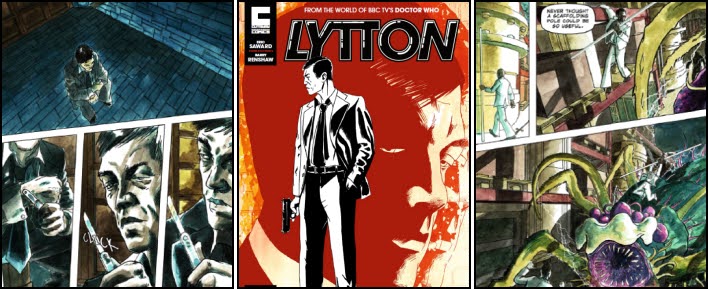
Lytton #4 - Cutaway Comics

LYTTON No. 4, June 2021
Tenaciously trying to tie-up all the different plot threads which this title has previously created during the lead protagonist’s utterly mind-blowing hunt “for the Positron”, Eric Saward’s screenplay for Issue Four of “Lytton” must surely have kept its readers holding on to the comic for dear life with the sense-shattering speed of its numerous action sequences. Sure, so frantic a pulse-pounding pace arguably leads to the odd scene needing to be re-read so as to ensure all of its nuances are properly understood, but the former “Doctor Who” script editor crams so much into this single twenty-eight page periodical that such an undertaking to comprehend the breadth of the screenwriter’s storyline was probably always going to prove a necessity anyway; “I’m not used to working this amount of overtime on a week night, Mister Lytton.”  

For starters, the revelation that Mister Longbody is actually a Terileptil planning to take over a London warehouse packed full of extra-terrestrial weaponry in order to use its explosive stockpile to destroy the capital city, must certainly have caught many a bibliophile by surprise. Coupled with the aggressive alien’s determination to have the “rogue prototype” E.V.E. similarly annihilated, and much of the intergalactic freelance soldier’s extreme efforts earlier in this mini-series to both placate the reptilian humanoid’s mounting anger, as well as cover-up its bloody murder spree, finally starts to make much more sense.

In addition, the exhilarating adventures of Wilson and the mysterious Artemis positively demand a willing suspension of disbelief from this book’s audience, due to just how well Saward pens them. The pair do a first-rate job of overcoming some of the Terileptil’s infamously formidable androids with little more than brute force, and then continue to impress as ‘kick-ass’ companions when they individually tackle a truly massive Vindanty Snare Beast and recalibrate the complex inner workings of a Positron’s backup coolant unit respectively.

Equally as enthralling though are Barry Renshaw’s colourful pencils, which contain all manner of nods to numerous other science fiction/Spy-Fi franchises such as Logan’s Run and Jason King. The “Lucasfilm Officially Approved Star Wars Sketch Artist” does a particularly fine job depicting Lytton’s swashbuckling swordfight with Longbody, and momentarily manages to make it look as if the deadly contest may well actually portray the final moments of the mercenary from the satellite Riften 5.

The regular cover art of "LYTTON" #4 by Barry Renshaw

Monday, 23 August 2021

Batman '89 #1 - DC Comics

BATMAN '89 No. 1, October 2021
Supposedly promising long-time comic book fans the opportunity to “step back into the Gotham of Tim Burton’s seminal classic Batman movies”, Sam Hamm’s script for Issue One of “Batman ‘89” probably disappointed many within the six-part limited series’ opening audience with its familiar rehashing of ideas previously seen within Frank Miller’s “Batman: Year One”, and even Christopher Nolan’s 2008 superhero movie “The Dark Knight”. For whilst the narrative arguably somewhat follows straight on from Michael Keaton’s double outing on the Silver Screen, the premise of the Caped Crusader being seen as the actual source of Gotham City’s increasingly violent plight by the authorities, as well as the figurehead of a score of cowl-wearing vigilantes, has been seen more than once before.

In addition, the America screenwriter appears to have completely changed the personality of district attorney Harvey Dent from that portrayed by Billy Dee Williams during the actor’s sole celluloid appearance so as to pitch “the big man” as the twenty-page periodical’s central antagonist. This arrogant, self-important chief prosecutor seems to have completely forgotten about the events depicted previously during boss Carl Grissom’s murderous reign, and even accuses Jim Gordon of fabricating the costumed crime-fighter simply so the Police Commissioner can apparently deploy a “well-trained and well-funded” covert crew of enforcement officers to tackle the metropolis’ “untenable” rise in armed robberies; “You think there’s only one Batman? You think one human being could take that sort of punishment?”

Happily however, that isn’t to say that “Shadows” doesn’t contain some exciting elements, courtesy of the Dark Knight recovering thirty one million dollars from two stolen armoured cars. But this sense-shattering sequence involving a Russian helicopter, a giant penny piece and a ton of gratuitous gunfire hardly makes up for a plot which depicts a highly disagreeable Dent lording it over a poor nine year old with his flash sports car, and setting up a death trap to have the Caped Crusader instantly shot by a team of rooftop snipers should he be so foolish as to answer the Bat Signal.

Sadly, Joe Quinones’ layouts debatably fail to capture the look of Burton’s films either, despite the American apparently being a “noted fan” of them. The artist’s cover illustration for this book is tremendously evocative of Keaton’s incarnation of Batman. Yet his interior pencilling simply doesn’t project the same attention to detail, with Bruce Wayne in particular appearing to be little more than a roughly-animated caricature of the Academy Award nominee.

Writer: Sam Hamm, Artist: Joe Quinones, and Colorist: Leonardo Ito

Saturday, 21 August 2021

Black Widow #9 - Marvel Comics

BLACK WIDOW No. 9, September 2021
Beginning with the titular character being brutally stabbed by a horde of Apogee’s super-powered disciples, Kelly Thompson’s opening for Issue Nine of “Black Widow” may well have had fans of the former-Soviet assassin thinking that perhaps the Avenger might not necessarily survive her latest encounter with the San Francisco-based villain. Indeed, if it wasn’t for the fact that Yelena Belova is apparently dead by this point in the four-parter’s storyline, many readers would probably have thought that Stan Lee’s co-creation was about to be permanently replaced by her blonde-haired "sister-in-arms” throughout the rest of this ongoing series’ run; “This will not happen. Not like this. Suit will do its job for a while. But that would will be mortal if this takes too long.”

Equally as enjoyable as this shock start is the development of Romanoff’s ‘backup crew’ consisting of Lucy, Craig and Anya Corazon, who genuinely seem to gel reasonably well together so as to provide Natasha with both the ingredients and expertise necessary so as to provide an antidote to “Apogee’s mass dosing”. Admittedly, it could be argued that the Black Widow stumbling upon the ‘sole’ scientific member of the Olio group who could synthesise a solution to her problem is conspicuously contrived at best, but this ‘lucky find’ was originally conceived by Belova during the White Widow’s own investigation into the shady shenanigans of Hux Advisors LLC.

In addition, the inclusion of Spider-Girl as part of this book’s badass trinity really helps sell the Black Widow’s ability to defeat a county-wide criminal organisation without its author needing to resort to the ‘tried and tested’ method of top-tier guest star appearances. Instead, it soon becomes very clear that between the three elite fighters, there’s every chance the drug-taking cartel of mysterious hooded cultists and smart-suited gunmen are going to fail in their felonious endeavours; “I remember you tried to kill me. And also you. And I don’t remember you, but I don’t like the look of you either.”

Quite possibly this book’s only brief bout of discombobulation therefore comes with this twenty-page periodical’s pencilling, which swaps between the pictures of Elena Casagrande and Rafael De Latorre. Luckily both artists are more than capable of prodigiously portraying this comic’s butt-kicking protagonists, so the sudden shift in slightly different styles at the end of its first act isn’t quite as disconcerting as perhaps it could have been if two more contrasting illustrators had been employed.

The regular cover art of "BLACK WIDOW" #9 by Adam Hughes

Friday, 20 August 2021

The Immortal Hulk #49 - Marvel Comics

IMMORTAL HULK No. 49, October 2021
Consisting of nothing more than a carousel of splash pages each accompanied by a few paragraphs of text, Al Ewing’s decision to turn Issue Forty Nine of “Immortal Hulk” into more of a children’s reading book than an actual comic doubtless perturbed a fair few of this ongoing series’ followers. Indeed, coupled with the lack-lustre storyline of the titular character simply being invited to walk through the Forever Gate by Benjamin Grimm, many readers were probably of the opinion that this penultimate instalment to the British author’s overall narrative was nothing more than a ‘filler’ edition prior to its “giant-sized” finale.

Admittedly, that isn’t to say that this publication doesn’t generate a modicum of interest with its word-heavy transcript approach, as Joe Fixit’s alter-ego encounters the increasingly dislikeable Avengers and, owing to a non-disclosed communication error, ends up once again fighting the entire roster of the Earth’s Mightiest Heroes. But it’s arguably difficult to get particularly excited by a single picture of the “Green Goliath” battering upon Captain America’s infamously tough shield, even when the artist is Joe Bennett; “I didn’t see who threw the first punch. Someone must have.”

In addition, whilst Ewing’s short tale does somewhat make sense as far as the Hulk seeking out the help of Reed Richards to finally confront the Leader in “the city of suffering”, just how this option becomes a possibility is never properly explained. Instead, Jackie McGee and Jen Walters simply escort the nonchalant behemoth through the night-time streets of New York City to a presumably pre-arranged rendezvous at the Baxter Building, where he encounters the likes of an extremely hostile Captain Marvel, Thor, Iron Man, Black Panther and Nova.

Likewise, the Avengers’ presence is never rationalised, and simply seems to have been unceremoniously crowbarred into the comic so as to give the writer an opportunity to include at least one pulse-pounding punch-up amidst all his prose. In fact, the Thunder God and his team-mates are quite clearly depicted as the ‘villains of the piece’ for this book, with Invisible Woman’s scathing look of absolute disgust at them when she is forced to separate the fighting forces speaking a thousand words.

The regular cover art of "IMMORTAL HULK" #49 by Alex Ross