Tuesday, 20 October 2020

Star Trek: Deep Space Nine - Too Long A Sacrifice #3 - IDW Publishing

STAR TREK: DEEP SPACE NINE - TOO LONG A SACRIFICE No. 3, September 2020
As comic-long conversational pieces go, Scott and David Tipton’s narrative for Issue Three of “Star Trek: Deep Space Nine – Too Long A Sacrifice” isn’t quite as plodding as it initially appears, thanks largely to the cold-blooded murder of a pair of unfortunate Ferengi “outside Docking Port Five.” However, up until this latest in a long line of despicable deaths on board the Federation facility, this twenty-page periodical arguably consists of nothing more than a disconcertingly word-heavy dialogue between Odo and Detective Retlaw, as the two men seemingly try to outdo one another in a bid to demonstrate their superior investigative ability.

Such a conversational piece may well have proved a pleasant enough sub-plot if penned in moderation, but sadly a good two-thirds of this publication follows the Changeling and “the past-his-prime” Starfleet official as they sip tea, criticise one another’s work ethics and generally try to score cheap points during their meanderings throughout Terok Nor. Indeed, even when this publication does suddenly reveal that Ensign Schroeder has been “greasing the wheels for the Nausicaans”, all the ‘odd couple’ do is talk some more about how the junior officer is inconveniently blocking Retlaw from reading his mind; “He’s… blocking me somehow. I have nothing. I don’t know how he’s doing it, but he’s keeping me out.”

Perhaps this book’s biggest disappointment though, is the so-called “shocking discovery” its publisher’s promised being that Vedek Teler is somehow connected to the series of murders. This surprise was arguably telegraphed straight from the mini-series’ opening instalment, and the only bombshell it drops is just how contrivingly poor a shot the mysterious killer suddenly becomes when the culprit unsuccessfully tries to assassinate Odo and the Betazoid in a deserted corridor, just before the pair pay the Bajoran religious leader a visit.

Luckily adding a little bit of animated life to the proceedings is Greg Scott’s pencilling, which genuinely seems to come to the fore when illustrating the craggy-faced, white-haired Retlaw. As expected, the artist does a competent job of depicting the science fiction franchise’s televised characters, yet somehow adds even more to the aged investigator’s personality, as he scowls and scolds his way through the space station’s considerable supporting cast.

Writers: Scott Tipton & David Tipton, Artist: Greg Scott, and Colorist by: Felipe Sobreiro

Monday, 12 October 2020

Geek-Girl #6 - Markosia Enterprises

GEEK-GIRL No. 6, September 2020
Featuring a sizeable cast of characters, including a humorous cameo by Guano Guy and Mister Marvellous Man, Sam Johnson’s narrative for Issue Six of “Geek-Girl” probably pleased the majority of this comic’s fans when it ‘hit the shelves’ in September 2020. Sure, the titular lead doesn’t actually have much to do within this particular twenty-page periodical, apart from arrange “a fabulous, fancy-dress night – themed on Seinfeld’s alternative Xmas, Festivus” for her girlfriends. But that doesn’t stop the book’s plot from still posing some intriguing questions as to the motivation behind some of the series’ other personalities.

Indeed, arguably this publication’s best moment is the scene depicting “Johnny Carlyle’s right-hand man Digger Mensch” meeting up with the likes of villain Papa Potato inside a seedy bar area. There’s some seriously good tension generated by Digger’s conflict with his supposed pals, following their objections that he has helped restore the town’s previously destroyed police station with his construction super-powers, and the builder’s palpable fear of Black Mass literally leaps out of the panel when the criminal questions Mensch’s loyalties by warning him that Carlyle is fast becoming a problem for the rest of the group.

Likewise, the air of mystery surrounding a lone Satanist communicating with the dead in an upper apartment’s rune-covered mirror is equally as enthralling, especially when the man’s desperate pleas for help from beyond the grave actually seem to prove successful, and he conjures up the ghost of Kristina; “Haven’t seen… But someone could see him, maybe. Lady of Voodoo… Cabra Cini. Yesss. Find on the Dark Web.” The identity of this fair-haired cultist is intriguingly kept hidden from the reader, as is the reason as to why he’s trying to locate someone who has “taken all our cash and cleaned out his apartment.”

Carlos Granda should also be acknowledged as a key contributor to the competence of this comic, with his prodigious pencilling. Johnson has penned plenty of word-heavy, dialogue driven sequences in “Change Of Plan”, yet the artist still manages to make these conversations pleasing to the eye by imbuing all their participants with both animated life and, in the case of Summer James, plenty of vibrant personality too.

The regular cover art of "GEEK-GIRL" No. 6 by Jason Hehir & Chunlin Zao

Thursday, 8 October 2020

Batman: The Adventures Continue #8 - DC Comics

BATMAN: THE ADVENTURES CONTINUE No. 8, July 2020
It was probably difficult for some of this digital first comic’s readers to shake off the impression that Paul Dini and Alan Burnett were perhaps a little short of ideas when it came to writing the narrative for Issue Eight of “Batman: The Adventures Continue”. For whilst the book undoubtedly contains some excellent bouts of fisticuffs and super-heroic antics, such as the Caped Crusader and Azrael double-teaming the enormous Mister Wing with their “sword of salvation” manoeuvre, the seemingly endless stream of different characters appearing within the plot does disappointingly somewhat smack of a desire to simply pad out the plot until the publication’s page-count is filled.

Leading of this carousel of cameos is the badly underused Oswald Chesterfield Cobblepot, who disconcertingly appears to have been shoe-horned into the script as a simple middleman between Catwoman and this story’s supposed lead villain, Victor Fries. The Penguin is usually regarded as “one of Batman's most enduring enemies”, and yet in “The Darker Knight” he is deplorably depicted as nothing more than a scared little man, who is easily overcome by Azbats and actually requires saving by Bruce Wayne’s alter-ego before his portly frame plummets to his death; “Though of course, since he is Catwoman’s employer, the order demands he must suffer in her place.”

Similarly as swift in their contribution to this comic is Mister Freeze, who steps out from the shadows just long enough to zap Jean Paul Valley with his ice gun, and subsequently be bested by a simple sonic pulse bat-a-rang to the head. The fact the distraught doctor would want to use the sacred Shawl of Magdalene to resurrect his dead wife makes total sense. However, his defeat seems all too easily accomplished considering Fries was ranked as Imagine Games Network’s sixty-seventh best Comic Book Villain of All Time and has come close to defeating the cowled crime-fighter on numerous occasions.

Perhaps though, this book’s biggest indication that its writers were struggling for content lies in its ending which has Ty Templeton pencilling an all-too brief scene featuring the Joker. Following straight on from a bizarre scene where Valley and Wayne far too readily settle their differences over Azbats’ inclination to maim and kill, the Clown Prince of Crime’s cliff-hanger would appear to have been included purely as a cheap gimmick to ensure this publication’s audience return for another instalment of the ongoing series, rather than add anything to the dynamic duo’s actual adventure.

Writers: Alan Burnett & Paul Dini, Artist: Ty Templeton, and Colorist: Monica Kubina

Wednesday, 7 October 2020

U.S. Agent #3 - Marvel Comics

U.S. AGENT No. 3, October 2001
For those within this comic’s 20,718 strong audience who were expecting Issue Three of “U.S. Agent” to replicate the incredible excitement generated by John Walker and Steve Rogers’ first ever encounter during Mark Gruenwald’s run writing “Captain America” in the late Eighties, Jerry Ordway’s script for “A Matter Of Trust” probably left them bitterly disappointed. Sure, the Inkpot Award-winner’s narrative depicts the two combatants briefly battering one another in a desperate attempt to ‘save’ Senator Warkovsky from a mind-controlling extra-terrestrial, but the impact of their tête-à-tête is debatably lost amidst all the twists and turns of this twenty-two page periodical’s convoluted plot.

To begin with, it never seems particularly clear why the Republican Senator from North Carolina is so interested in speaking at the latest international trade conference nor what his partner-in-crime, the Power Broker, is actually trying to achieve with his ‘inter-galactic bugs’. The corrupt politician’s ‘reworked’ speech in front of the media certainly seems to put the American system concerning “free trade with no tariffs and no borders” in a bad light. However, Leon’s unsuccessful re-election, courtesy of the subsequent bad press his sermon generates, hardly seems to be something “an intelligent alien being” who has physically bonded with Curtiss Jackson would be interested in..?

Likewise, the implication that the green insect-like creature attached to the Power Broker’s back is in reality an escaped S.H.I.E.L.D. experiment seems to come completely out of the blue, and appears to have been ‘crowbarred’ into the comic simply to provide the traitorous Agent Kali Vries with a reason as to why she has been behaving so despicably towards her S.T.A.R.S. team-mates. Unfortunately though, it still doesn’t convincingly explain how a supposed crack sharpshooter like U.S. Agent’s former lover would accidentally shoot Machete dead during the trussed-up criminal’s arrest; “You want to know why I’m ashamed to admit it? Alive he could have led us to Jackson, and I wouldn’t have had to use you like I did Walker. I apologise for that. Then again, you know me -- I’ll do anything to win.”

Perhaps therefore this book’s only saving grace is Ordway’s dynamic pencilling during Captain America’s all-too short battle with this comic’s titular character. The two opponents clearly don’t like one another, and this animosity quickly reveals itself to the reader as the pair engage in a distinctly scrappy altercation as opposed to a bout of fisticuffs following the Marquess of Queensberry rules.

Writer/Penciler: Jerry Ordway, Inker: Karl Kesel, and Letterer: John Workman

Monday, 5 October 2020

The Immortal Hulk #37 - Marvel Comics

IMMORTAL HULK No. 37, November 2020
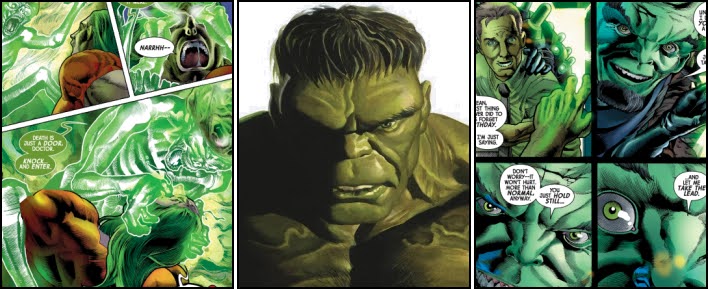
There’s clearly quite the pulse-pounding plot lurking beneath the surface of Al Ewing’s narrative for Issue Thirty Seven of “Immortal Hulk”, as Samuel Sterns’ convoluted revenge upon the titular character finally seems about to be fulfilled. But despite this comic’s dramatic conclusion resulting in Puck being manipulated by events into vaporising the green Goliath’s brain with a technologically-advanced energy weapon, it must have been difficult for many of this book’s Hulk-Heads to actually follow just what the Leader’s long-winded plan actually was.

For starters, it is never explained just how the “would be world conqueror” is able to use the mysterious green doors in order to repeatedly loop back into the past of gamma radiation victims such as Del Frye, and then take over their bodies in the present day. The megalomaniac has clearly developed a frightening power over the jade-coloured gateways, one which he can then seemingly use to actually stop others from being resurrected. Yet apart from cackling to Doc Samson that “that’s why controlling them is so much fun” the British writer doesn’t provide any details as to how the Leader is doing it, nor why he needs to do so when his ultimate aim was simply to have Bruce Banner’s alter-ego shot in the head.

Fortunately, despite some of this head-scratching story-telling, “The Keeper Of The Door” does provide some genuinely grim moments which must have thoroughly entertained its audience. Sterns’ horrific looking conversion into the green-glowing ‘corpse’ of Doctor Fyre’s son and subsequent murder of Leonard by forcing his flesh-melting fingers deep into the superhero’s eye sockets is chillingly told, as is Titania’s trouncing by Rick Jones when the so-called reformed villain finally starts to realise she is being manipulated; “Jones! Who are you talking to? I asked you a question, Pencil-neck -- Unnhh!”

Creative contributors Joe Bennett and colorist Paul Mounts would also appear to be at the top of their respective games for this particular twenty-page publication, with the Leader's aforementioned transformation into a radioactive glowing ghoul visually being the highlight of the comic. The Absorbing Man’s gamma-powered hurricane form is equally well pencilled, and doubtless many bibliophiles could actually hear the billowing wind as Carl Creel generates a storm which literally hurls the hapless Hulk from panel to panel.

The regular cover art of "IMMORTAL HULK" No. 37 by Alex Ross

Saturday, 3 October 2020

Iron Man [2020] #1 - Marvel Comics

IRON MAN No. 1, November 2020
Dealing with issues such as Tony Stark suffering a mid-life crisis, the brutality of social media’s unforgiving audience, and the theft of a fifteenth-century bible from the New York Public Library, Christopher Cantwell’s script for this thirty-page periodical probably landed reasonably well with fans of the armoured avenger. True, the comic’s opening half is rather dialogue-driven, courtesy of the billionaire desperately trying to rid himself of both “his high-tech toys and high-profile image” by selling his stocks in Stark Unlimited. But once Patsy Walker arrives at the industrialist’s celebratory party, the pace of this publication soon speeds up.

Indeed, arguably the highlight of Issue One of “Iron Man” is the television producer’s pairing of Hellcat alongside the titular character, as the ‘dynamic duo’ participate in “a little jaunt through the Big Apple” together, and stumble upon the Unicorn attempting a late night burglary. Enjoyably violent, and definitely not the one-sided affair readers might have expected from a battle involving such an old school villain, the American author definitely depicts the energy projecting criminal as a fearsome force to be reckoned with, rather than simply having him appear as harmless fodder for Stark to effortlessly trash; “I know that one of the twenty-one existing Gutenberg Bibles was destroyed in our battle with Unicorn, but there was really nothing I could do.”  

Cantwell’s handling of Iron Man’s ‘Twitter’ account is also cleverly interwoven throughout the story-telling, and does a good job of illustrating just how ungrateful humanity can be when a verbal few are inconvenienced by Tony’s efforts to save the planet. Spiteful, jealous and all-too quick to leap upon the hateful hindsight bandwagon, it soon becomes clear that Shell-head is in a no-win situation when it comes to justifying his actions to these people, and resultantly it comes as no surprise by the end of “Rest Your Brains” that the former Director of S.H.I.E.L.D. decides to delete his account.

Similarly as agreeable as Cantwell’s penmanship, is Cafu’s pencilling, which really begins to pack a punch by the time Iron Man has teamed up with Hellcat in order to defeat the Unicorn. The “Marvel Comics exclusive” artist’s style seems to particularly suit Alex Ross’ newly designed "vintage" armour, and really makes the energy blasts zing once the heroes begin their nocturnal battle atop the public library’s rooftop.

The regular cover art of "IRON MAN" #1 by Alex Ross

Thursday, 1 October 2020

Batman: The Adventures Continue #7 - DC Comics

BATMAN: THE ADVENTURES CONTINUE No. 7, July 2020
IIntroducing the Knight of St. Dumas to the world of “Fox Kids” 1992 animated television series, Issue Seven of “Batman: The Adventures Continue” surely must have excited its readers upon its digital first release in July 2020. Indeed, its pulse-pounding opening is arguably flawless as Azrael interrupts the Caped Crusader’s latest pursuit of Catwoman in order to physically torture the female burglar for stealing the sacred Shawl of Magdalene; “I never kid. The loss of an eye should make you see that.”

Sadly however, Paul Dini and Alan Burnett’s script suddenly goes badly off the rails once Bruce Wayne’s alter ego has thwarted the “aggressive” vigilante’s plan and fights the sword-wielding maniac off with a ferocious bout of fisticuffs. True, the plot to “The Darker Knight” does lead to Gotham City’s protector teaming up with Jean-Paul Valley in an attempt to locate the whereabouts of the artefact at the Iceberg Lounge, but before the ‘dynamic duo’ set-off on their mission Batman disconcertingly has time to construct the psychologically conditioned killer the famous “Knightfall” Bat-suit.

This bizarre development genuinely smacks of the writers simply crowbarring “Azbats” armour into the comic’s continuity purely for the sake of it, without giving any convincing rhyme or reason as to why Valley would suddenly change out of his ‘classic’ costume. In fact, the notion that Alfred Pennyworth would manufacture the technologically-advanced outfit just so Jean-Paul could supposedly appear “more ally than enemy” to the Batman is as persuasive as the Penguin’s belief that a giant humanoid puffin named Mister Wing was going to best the Dark Knight and his “cousin” single-handedly.

Mercifully, Ty Templeton’s ability to seamlessly pencil both of Azrael’s costumes into the highly-stylised world of the cartoon show means that visually no harm is debatably done to the look of this comic book, even if it does appear a little odd to see two incarnations of the Caped Crusader stood shoulder-to-shoulder. The Canadian artist’s drawing of the aforementioned battle with the fiery assassin is undoubtedly the highlight of this publication, with Monica Kubina’s excellent colours, such as the blue hue to Selina Kyle’s face contrasting against the pink of Wayne’s cowled visage, genuinely imbuing all the combatants with a life of their own.
Writers: Alan Burnett & Paul Dini, Artist: Ty Templeton, and Colorist: Monica Kubina